
The call usually comes at the worst time. A spouse says someone was picked up. A parent says the jail told them there’s a non-bailable warrant. A brother has heard three different stories from three different people, and nobody can tell him whether release is possible tonight.
That kind of call rattles families because the phrase sounds final. It isn’t final, but it is serious. In plain English, a non bailable warrant meaning is this: the person can’t post bond at the jail right away. A judge has to look at the case first.
Families in Colorado often need two things at once. They need the legal term explained clearly, and they need practical next steps that are effective in practice. That’s what matters when somebody is in custody, the clock is moving, and everyone is trying to avoid mistakes.
The Urgent Phone Call About a Non-Bailable Warrant
When families hear “non-bailable,” they often assume it means the person will stay in jail until the case is over. That’s usually not the right way to read it.
What it usually means at the start is simpler and more immediate. No one at the jail can fix it with a payment or a quick signature. The person has to be brought before a judge.

A common version of this situation looks like this. Someone misses court, or there’s an allegation that the court takes seriously, and a warrant issues. Then the arrest happens during a traffic stop, at home, or after a check with law enforcement. The family’s first instinct is to ask how to get them out fast. That’s understandable, and this guide on how to get someone out of jail helps with the bigger release process.
What the family needs to hear first
Panic leads people to do dumb things. They call the wrong people, give details they shouldn’t give, or tell the person to hide. None of that helps.
Practical rule: If a warrant is active, the safest mindset is cooperation, preparation, and fast coordination with counsel.
A non-bailable warrant is a court control issue. The court wants the person in front of a judge before release becomes an option. Once you understand that, the path gets clearer. You stop looking for shortcuts that won’t work and start preparing for the hearing that matters.
What a Non-Bailable Warrant Actually Means
A non-bailable warrant means release is off the table until a judge reviews the case. In practical terms, law enforcement can arrest the person, book them into custody, and hold them without accepting a bond at the jail window.
That is the part families need to understand fast. The problem is not finding the right amount of money at midnight. The problem is that no one at the jail has authority to take a bond yet.
What the term means in real life
The court has decided that judicial review comes first. That usually happens because the judge wants direct control over release conditions, wants an explanation for missed court, or sees a higher level of risk tied to the case.
A non-bailable warrant does not mean the person will never get out.
It means the release decision has been delayed until the first appearance before a judge. In Colorado, families often hear the same idea described as a no-bail hold. For a plain-English explanation of that phrase, see this guide on what no-bail meaning usually looks like in practice.
What families often get wrong
Families hear “non-bailable” and assume every option is gone. That is usually the wrong read.
The immediate option of posting bond is gone. Preparation still matters. A lawyer can get ready for the advisement or bond hearing. Family members can gather proof of local ties, work history, medical issues, treatment enrollment, or anything else that helps explain why release should be considered. If the judge later sets a bond, being ready saves time.
I tell families to separate two questions. First, can the jail release the person right now? With a non-bailable warrant, usually no. Second, can the court allow release after review? Often yes, depending on the charge, the history, and what the judge sees at the hearing.
Practical takeaway: “Non-bailable” usually describes the timing of release, not a permanent bar to release.
That distinction keeps people from making bad decisions. Hiding makes the case worse. Waiting around without a plan wastes valuable time. The better move is to get clear on the court date, get counsel involved, and get your paperwork lined up so you are ready if the judge sets conditions or a bond.
Bailable Warrants vs Non-Bailable Warrants
A side-by-side comparison usually clears up the confusion faster than a long explanation.
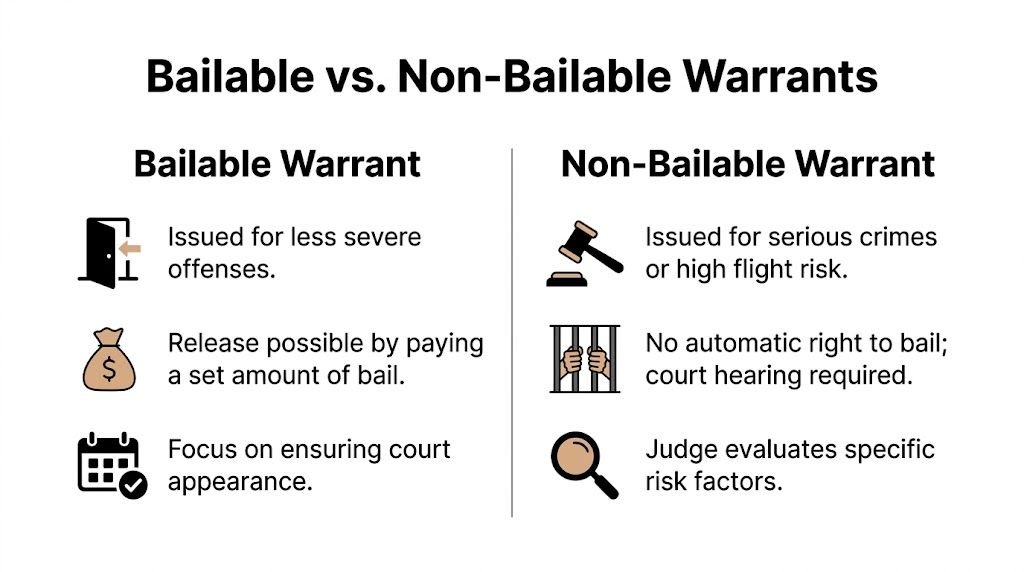
Bailable vs Non-Bailable Warrant at a Glance
| Feature | Bailable Warrant | Non-Bailable Warrant |
|---|---|---|
| Release at arrest | Often possible if bail is already set | Not available automatically at arrest |
| Who controls release first | Jail process can move forward if conditions are met | Judge must review first |
| Court concern | Securing appearance, often with lower immediate concern | Stronger concern about nonappearance, risk, or seriousness |
| Police discretion | More room to process release under preset terms | No authority to release on bond at station level |
| Family action | Arrange bond and paperwork quickly | Prepare for hearing, counsel, and post-hearing action |
| Typical experience | Faster route if bond amount is known | Waiting period until court review |
The practical difference on the ground
With a bailable warrant, the system already has a release mechanism attached to the arrest. If the amount is set and the bond type is workable, the family can move fairly quickly.
With a non-bailable warrant, that release mechanism isn’t active yet. The first real objective is getting the person before a judge and presenting the best possible circumstances.
That’s why these cases feel so different to families. In one, the question is mostly administrative. In the other, the question is judicial.
Where bench warrants fit in
Some non-bailable situations start with a missed court date. That can lead families to ask whether they’re dealing with a bench warrant, an arrest warrant, or both in practical terms. This overview of what is a bench warrant helps sort out that terminology.
A bailable warrant says, “You can be released under preset conditions.” A non-bailable warrant says, “The judge wants to see you before deciding anything.”
That is the core difference. Once families grasp that, they usually stop chasing the wrong solution.
Why Judges Issue Non-Bailable Warrants in Colorado
A family usually hears the words "no bond" after something has already gone wrong. The person missed court more than once, picked up a new serious charge, violated protection order terms, or gave the judge a reason to doubt they will follow release conditions. At that point, the court may decide it wants the person brought in first and heard in front of a judge before any release is considered.

Repeated failures to appear change how the court sees the case
Colorado judges pay close attention to follow-through. If someone has skipped hearings, ignored court instructions, or failed to address an older warrant, the issue stops being just the underlying case. The court starts focusing on reliability.
That is one of the clearest paths to a non-bailable warrant.
In practical terms, a judge may decide that setting a standard bond in advance does not address the primary concern. The concern is whether the person will return and comply next time. If the family is still trying to confirm what was issued, start with this guide on how to check if someone has a warrant.
Community safety and witness concerns
Judges also use no-bail warrants when they believe release needs closer court review because of safety concerns. That comes up more often in cases involving violence, credible threats, repeat domestic issues, weapon allegations, or facts suggesting the person may intimidate a witness or interfere with the case.
Money does not answer those concerns by itself. The judge may want to hear from counsel, review the file, and decide whether any release conditions can realistically protect the public and keep the case on track.
Some cases get tighter control from the start
Serious allegations usually bring stricter scrutiny. A felony charge does not automatically mean no bond, but the court will look more carefully at the person’s history, pending cases, prior compliance, and the facts supporting the new accusation.
A missed court date can also be part of the story. Families sometimes use "bench warrant" and "arrest warrant" interchangeably, but the label matters less than the reason the court issued it and what restrictions are attached. If you need a plain-English primer, this explains what a bench warrant is.
Here’s a short explainer before you talk to anyone at court:
From the bond side, the pattern is familiar. Judges issue non-bailable warrants when they believe they need direct control over the next step. Families do better when they treat that decision seriously, get counsel involved early, and prepare for a hearing instead of assuming a bondsman can fix the problem at the jail counter. In Colorado, that preparation still matters because once a judge does set bond, fast tools like remote electronic bond applications can save hours.
Your First Steps When Facing a Warrant
When a warrant is active, the family’s first moves can either help the hearing or make things harder. Keep it simple and deliberate.
Start with control, not panic
Don’t tell the person to keep moving, switch phones, or stay with different friends. That behavior looks like avoidance. Courts notice patterns, and avoidance rarely improves the outcome.
Call a criminal defense attorney quickly. A lawyer can assess whether there’s a path to a voluntary surrender, a recall request, or a hearing strategy that reduces damage.
The moves that usually help
Verify the warrant status
Families are often working off partial information. Before acting, confirm what exists. This page on how to check if someone has a warrant is a practical starting point.Ask counsel about voluntary surrender
A controlled surrender often presents better than getting picked up unexpectedly. It shows the person is addressing the issue instead of forcing law enforcement to do it for them.Prepare basic release logistics early
Gather identification details, case information, likely cosigner information, and contact numbers. That way, if the judge sets a bond, the family isn’t scrambling.Keep communication clean
Don’t contact alleged victims. Don’t discuss facts of the case widely. Don’t post online. Those mistakes create new problems fast.
Why remote coordination matters
For families coordinating from afar, especially out-of-state relatives dealing with a loved one’s warrant in Colorado, remote handling can make the difference between organized action and wasted time. The same challenge appears in NRI warrant situations connected to India, where families often depend on remote coordination with legal counsel. This overview of non-bailable warrants issued against NRIs and related remedies is useful because it highlights how much these cases depend on coordinated action rather than last-minute travel.
If you’re also trying to understand a missed-court-date situation in plain language, this article on what a bench warrant is gives a helpful outside explanation.
The family that prepares before the hearing is in a far better position than the family that starts making calls after the judge sets bond.
That’s true whether the relative is in Denver, Golden, Centennial, or calling from another state.
How Express Bail Bonds Helps in a No-Bail Situation
At 10:30 p.m., a mother calls and says the jail told her there is a non-bailable warrant. Her next question is usually the same one. If no bond is available tonight, what can a bail bond company do?
In Colorado, the answer is practical. A no-bail hold often means the court has to review the case before any release terms are set. Families still have work to do during that window, and getting organized early can save hours once the judge makes a decision.

Preparation before the hearing
Express Bail Bonds helps families get the bond side ready before bond exists. That means reviewing the defendant’s booking details, identifying a possible cosigner, checking what paperwork will likely be needed, and setting expectations about cost and timing. If the judge sets a bond, the family is not starting from scratch in the courthouse parking lot.
That early prep matters even more for out-of-state relatives. Colorado cases often involve family members trying to help from another city or another state, and remote electronic applications can keep the process moving without forcing everyone to travel first.
What that looks like in Colorado
A surety agency can often start the file, collect basic information, and send documents electronically while the case is still waiting for court review. If the judge later approves release on bond, those steps are already in motion.
For families trying to budget, cost questions usually come up right away. Express Bail Bonds may be able to offer a lower premium on some larger bonds with an approved cosigner, but that depends on the case and the underwriting review. If you need the structure explained in plain English, this page on what is a surety bail bond walks through how that kind of bond works.
Families should also plan for the legal side at the same time. If you are comparing defense costs while preparing for a possible bond, this guide to a lawyer consultation fee can help frame that part of the expense.
What Express Bail Bonds can and cannot do
A bail bond company cannot post a bond before the court allows one. No agent can override a no-bail hold.
What they can do is reduce delay after the hearing. They can answer questions clearly, collect information in advance, coordinate paperwork remotely, and stand ready if the judge sets a bond in Denver, Jefferson County, Arapahoe County, or another Colorado court. For a worried family, that preparation is often the difference between a controlled response and a long, confused scramble after court.
Frequently Asked Questions About Warrants
Can a non-bailable warrant be cancelled without an arrest
Sometimes, but it depends on the court and the facts. In some cases, counsel may ask the court to recall or quash the warrant. That usually works best when there’s a strong explanation and supporting proof. Families shouldn’t assume this is automatic.
How long will my loved one be held before seeing a judge
The practical answer is usually that there will be a wait for judicial review. In no-bail situations, families should expect a court-driven timeline, not an immediate release timeline. Delays can feel longer on weekends and holidays, so preparation matters.
What if the judge sets a cash-only bond
A cash-only bond means a surety bond may not be available. That changes the family’s options because the full amount usually has to be posted in the form the court requires. If you’re also budgeting for legal help, this guide to a lawyer consultation fee can help you think through the broader cost picture.
Does non-bailable always mean the case is hopeless
No. It means the court wants to review the person before release. That’s serious, but it is not the same thing as a final denial in every case.
If your family is dealing with a warrant in Colorado and needs fast, calm help with the bail side of the process, contact Express Bail Bonds. They serve clients statewide, including Jefferson County and Golden and Centennial, and they handle documents electronically for out-of-state cosigners. You can also review client feedback on Google here and here. If a judge may set bond soon, getting organized now can save valuable time later.