
When someone you care about is arrested, the legal and financial maze you're suddenly thrown into can feel overwhelming. One of the first and most confusing hurdles is understanding bail. A surety bail bond is the most common way families in Colorado get their loved ones out of jail, and it’s essentially a three-way agreement that guarantees the court gets what it wants: the defendant's return for their court dates.
Think of it like an insurance policy for the court system. For immediate assistance and clear answers, contact Express Bail Bonds 24/7 at 720-984-2245.
So, What Exactly Is a Surety Bail Bond?
Instead of having to come up with the entire bail amount in cash—which can easily be $10,000, $20,000, or more—you work with a licensed bail bond company. This company acts as a "surety," promising the court they will pay the full bail amount if the defendant doesn't show up for their hearings.
For taking on that big financial risk, the bail bond company charges a non-refundable fee, known as a premium. This premium is just a small percentage of the total bail, making it a much more affordable path to getting someone released from custody.
The Three Key Players in This Agreement
Every surety bond involves a partnership between three parties. Knowing who is who and what they're responsible for is the key to understanding how it all works.
Here’s a simple breakdown of the roles each party plays in the surety bond agreement.
The Three Key Players in a Surety Bail Bond Agreement
| Party | Role and Responsibility |
|---|---|
| The Court (The Obligee) | The court is the one who sets the bail amount in the first place. They are the "obligee" because they are owed the obligation—the defendant's appearance. |
| The Bail Bond Agency (The Surety) | This is us. The bail agency posts the full bond amount with the court, guaranteeing the defendant’s appearance and taking on the financial risk. To learn more about this role, check out our guide on what a bail bondsman does. |
| The Defendant & Cosigner (The Principal) | The "principal" is the defendant, but it almost always includes a family member or friend who cosigns. This party pays the premium and is legally responsible for ensuring the defendant follows all court-ordered conditions, especially showing up for every single hearing. |
Understanding these roles makes the whole process much clearer. It’s a system designed to work for everyone involved.
A surety bond allows families to secure a loved one's freedom for just a percentage of the total bail, making it the most practical and fastest path home without enduring a massive financial burden.
Ultimately, the court gets the assurance it needs, the defendant gets to return home to work and prepare their case, and your family is spared the immense stress of having to drain savings or sell assets to pay a huge cash sum.
If you have questions or need help right now, contact Express Bail Bonds 24/7 for a free, confidential consultation. We're here to walk you through it.
Navigating the Surety Bail Bond Process Step-by-Step
When a loved one is arrested, the path to getting them home can feel overwhelming, tangled in legal jargon and stressful deadlines. A surety bail bond, however, offers a clear, structured roadmap to freedom. Understanding how it works can turn a confusing ordeal into a manageable process, empowering you to act quickly and confidently.
The journey starts the moment an arrest is made. From there, a specific sequence of events unfolds, leading right to your loved one’s release.
From Arrest to Contacting a Bondsman
The process always kicks off with the arrest and booking, where the individual’s information is officially entered into the jail's system. Shortly after, a bail hearing takes place. A judge will set the total bail amount needed for release, basing the decision on things like the seriousness of the charge and the defendant's past record.
As soon as you have that bail amount, your next move is to contact a licensed bail bondsman. This is the single most important step you can take. A good agent, like the ones at Express Bail Bonds, will immediately get the ball rolling to secure the release.
The flowchart below shows how the key players—the court, the family, and the bail agency—work together.
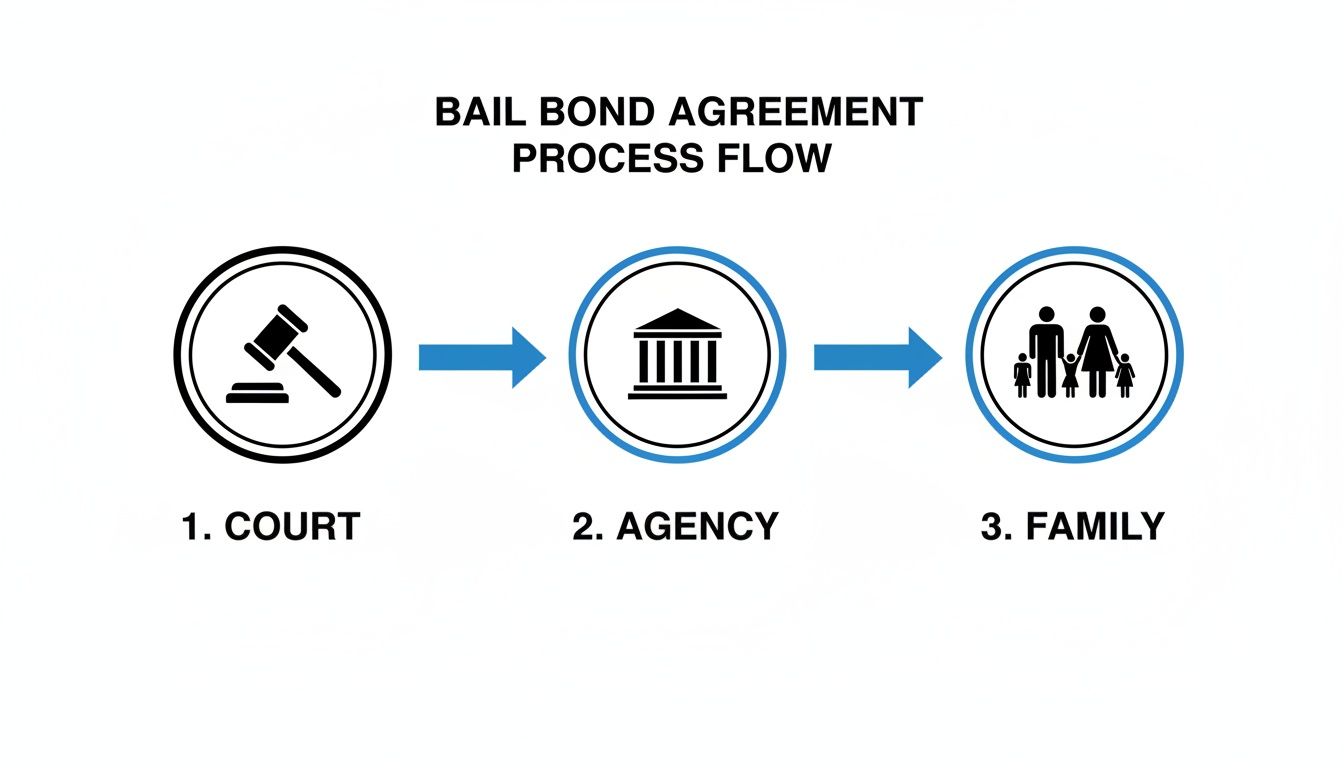
As you can see, the bail agency serves as the crucial link between the court's financial demands and your family’s need for a fast, affordable solution.
Completing the Paperwork and Posting the Bond
After you’ve connected with a bondsman, the next phase is all about the application and contract. This agreement is a legal document that clearly lays out the responsibilities of the person cosigning the bond. This initial documentation can feel a bit intimidating, but you can get a general idea of what's involved by looking at examples of common legal client intake documents.
With the paperwork handled, you'll pay the non-refundable premium. This fee, which is just a percentage of the total bail, is how the bondsman gets paid for taking on the full financial risk with the court.
Thanks to modern technology, this whole process can be handled remotely. Express Bail Bonds makes it easy for out-of-state cosigners to complete all the paperwork and payments electronically, so you never have to travel to Colorado.
Finally, once the premium is paid and the contract is signed, the bail agent heads to the jail. They post the bond directly with the court or detention facility, which triggers the jail staff to process the release. Your loved one is then set free.
If you need to get started right away, call or text Express Bail Bonds 24/7 at 720-984-2245. Our expert agents are standing by to offer a free consultation and walk you through everything.
Calculating the Cost of a Surety Bail Bond in Colorado
When a loved one is arrested, the first question on everyone's mind is almost always, "Can we afford to get them out?" It's a completely valid and urgent concern. Let's break down exactly how the cost of a surety bail bond works so you can make a clear-headed decision.
The main cost you'll pay is the non-refundable premium. Think of this as the bail bond agency's fee for service. By paying this fee, the agency takes on the full financial risk of the entire bail amount, guaranteeing it to the court on your behalf.
In Colorado, the standard rate for this premium is 15% of the total bail. So, if a judge sets bail at $10,000, the premium you'd pay the bondsman is $1,500. That single payment is what secures your loved one's release, while the agency puts up the full $10,000 guarantee with the court.

Lowering Your Premium and Understanding Collateral
While 15% is the standard, it's not always the final number. An experienced agency knows how to work with clients to find savings. For instance, here at Express Bail Bonds, we can often secure a 10% rate for bonds over $5,000 when a qualified cosigner is involved. That discount alone can save a family hundreds, sometimes thousands, of dollars. You can get a deeper dive into pricing by reading our guide on how much bail bonds cost in Colorado.
Now, for larger or higher-risk bonds, an agency might also ask for collateral. This isn't a fee; it's a form of security. Collateral is a tangible asset—like a vehicle title, real estate, or even valuable jewelry—that you pledge to secure the bond.
It simply acts as a safety net for the bondsman, ensuring they can cover the potential loss if the defendant doesn't show up for court. The most important thing to remember is that, unlike the premium, collateral is fully returned to you once the case is over and all court appearances have been made.
Cash Bail vs. Surety Bond Premium: A Cost Comparison
The real value of a surety bond snaps into focus when you compare it to paying cash bail directly to the court. Coming up with the full bail amount in cash means tying up a huge sum of your family's money for months, or potentially years, until the case is fully resolved.
Let's look at a simple example to see the immediate financial difference for a typical $10,000 bail.
| Cost Factor | Cash Bail | Surety Bail Bond (15% Premium) |
|---|---|---|
| Total Bail Amount | $10,000 | $10,000 |
| Immediate Out-of-Pocket Cost | $10,000 | $1,500 |
| Money Tied Up During Case | $10,000 | $0 (beyond the premium) |
As you can see, the difference is stark. The surety bond makes getting out of jail far more accessible for the average family.
Instead of draining your savings or liquidating assets, you pay a manageable, predictable fee. This allows your loved one to come home and prepare for their case without putting your family's financial future at risk.
If you're ready to explore your options and get a no-nonsense quote, contact Express Bail Bonds 24/7. We provide free, confidential consultations to help you figure out the most affordable path forward.
The Critical Role of the Bail Bond Cosigner
Behind almost every surety bail bond stands a vital person: the cosigner. You might also hear them called an indemnitor, but their role is the same. They're much more than a character witness; they are the financial anchor of the entire agreement.
Essentially, a cosigner gives the bail bond agency the confidence it needs to post the full bail amount for the defendant.
So, What Are You Signing Up For?
When you agree to cosign a bail bond, you're signing a serious, legally binding contract. You are personally guaranteeing that the defendant will show up for every single one of their court dates.
If the defendant skips a court appearance, that responsibility falls squarely on your shoulders. You become financially liable to the bail bond agency for the entire bail amount—not just the 10% or 15% premium you paid upfront.
What Does It Take to Be a Cosigner?
Because the cosigner is taking on such a massive financial risk, bail bond agencies need to see a few things that prove you're a reliable partner in the agreement. Every situation is a bit different, but the core requirements are all about demonstrating stability and the ability to cover the bond if things go wrong.
At Express Bail Bonds, we typically look for a cosigner who meets a few key criteria:
- Stable Employment: A steady job and consistent income show you're financially reliable.
- Good Credit: A healthy credit score is a good indicator that you have a history of paying your debts.
- Colorado Residency: Living in the state shows you have established roots and ties to the community.
- Sufficient Income or Assets: This proves you have the means to cover the bond amount if it were ever forfeited.
This is a serious commitment, and it's a decision that should only be made after you fully understand all the potential risks.
The relationship between the defendant and the cosigner is built on trust and responsibility. To make sure every court date is met, open and honest communication is absolutely essential.
This partnership is what makes the whole process work. The defendant gets to return home while awaiting trial, the court gets its assurance they'll return, and the cosigner is the one who makes it all happen. It's a powerful way to help a friend or loved one, but it requires everyone to be diligent.
Are you thinking about cosigning for someone but have questions about what it involves or if you qualify? Don't leave it to chance. Contact Express Bail Bonds for a free, no-obligation consultation. Our experts can walk you through every step so you can make a confident and fully informed decision.
What Happens After a Loved One Is Released on Bond
That moment you secure a loved one's release from jail brings a huge wave of relief. But it's crucial to understand that this isn't the end of the road—it's just the beginning of the next chapter. Once they're out, both the defendant and the cosigner have a set of responsibilities to follow to keep the bond active and avoid some pretty serious trouble. This whole period is all about one thing: compliance.
The most important job is simple, but there's zero wiggle room: the defendant must show up for every single court appearance. Missing even one court date sets off a chain reaction of bad news, starting with the judge issuing a new warrant for their arrest.

Upholding the Conditions of Release
On top of making all court dates, the judge sets specific conditions for release that have to be followed to the letter. These rules are put in place to ensure community safety and make sure the defendant sticks with the program until the case is resolved.
Some of the most common conditions you'll see are:
- Regular Check-Ins: The defendant often has to check in with the bail bond agency on a regular schedule, usually weekly, either by phone or in person.
- Travel Restrictions: In almost all cases, leaving the state of Colorado is off-limits without getting permission from both the court and the bail agency first.
- No-Contact Orders: Depending on the case, the defendant might be ordered to have absolutely no contact with the alleged victims or anyone else involved in the case.
Keeping an open line of communication with your bail agent is key here. If the defendant's address, phone number, or job changes, you need to let the bondsman know right away. It’s all part of staying on the right side of the agreement.
The Consequences of Non-Compliance
So, what happens if these rules are broken? The consequences are severe. If a defendant skips court, the judge forfeits the bond. In an instant, the cosigner becomes legally responsible for paying the entire bail amount to the bail agency.
This isn't just a threat; it's a financial hammer. Suddenly, that $20,000 bond you paid a $2,000 premium on becomes a $20,000 debt you owe. For a deeper look at what this means in our state, check out our guide on what happens if you miss court.
Bond exoneration is the finish line. Once the defendant has attended every court date and the case is officially closed—whether it’s dismissed, a plea deal is reached, or a verdict is given—the court dissolves the bond. At that point, the cosigner's financial obligation is completely over.
This successful outcome is what we call bond exoneration. The court officially lets the bail agency off the hook for its financial guarantee, and in turn, any collateral the agency was holding is returned to the cosigner.
If you have any questions about what comes next after a release, contact Express Bail Bonds 24/7. We're here to give you clear, straightforward guidance to help you and your loved one get through this.
Why a Surety Bond Is Your Fastest Path to Freedom
When someone you care about is behind bars, time itself seems to slow down. Every minute feels like an hour, and the most important thing in the world is getting them home. In these incredibly stressful moments, you need a solution that is fast, reliable, and straightforward. While a few different release options exist, the surety bail bond is almost always the quickest and most realistic way to secure someone's freedom.
Let's look at the other options for a moment. A cash bond means you have to come up with the full bail amount yourself, which could be thousands or even tens of thousands of dollars, paid directly to the court. This can easily wipe out a family's savings, and that money remains tied up until the case is completely over. Then there’s a personal recognizance (PR) bond, but that's typically reserved for very minor offenses; it’s simply not an option for most situations.
The Problem with Property Bonds
And what about a property bond? This is hands-down the slowest and most complicated route you can take. It involves using your home or another piece of real estate as collateral, which kicks off a long and frustrating process of property appraisals, title searches, and mountains of court paperwork. This isn't a matter of hours—it can take weeks. When someone's freedom is at stake, you just don't have that kind of time to waste.
A surety bond cuts through all that red tape. Instead of getting tangled in a bureaucratic mess, you're working with a professional who knows the system inside and out. They handle everything for you, and a release can often be secured in just a few hours.
The Express Bail Bonds Advantage
This is exactly where you see the real value of a professional bail bond agency. When you work with Express Bail Bonds, you’re not just getting financial help; you're getting a dedicated partner who is on your side.
- Our team provides 24/7 expert guidance and is ready to help anywhere in Colorado.
- We're here to act the moment you call, day or night.
- Our completely electronic process lets you handle all the paperwork and payments right from your phone or computer, which means less stress and no need to drive to an office in the middle of the night.
Don't let a financial burden or a confusing legal system keep your family separated. A surety bond is built for speed and affordability. If you need help right now, the best first step is to talk to someone who can give you clear answers and start the process immediately.
Call or text Express Bail Bonds 24/7 at 720-984-2245 for a free, confidential consultation and let us help you bring your loved one home today.
Common Questions About Surety Bail Bonds
When you're trying to navigate the bail process for the first time, a lot of questions pop up. It's completely normal. Here are some straightforward answers to the things families most often ask when dealing with a surety bond.
What if I Can't Afford the Whole Premium Upfront?
This is probably the most common worry we hear, and it's a valid one. Don't let financial stress stop you from getting your loved one home. A good bail agency knows that coming up with the full premium on the spot can be tough.
At Express Bail Bonds, we work with qualified cosigners to set up flexible and affordable payment plans. Our goal is to make sure you can secure a release without having to bear a huge financial burden all at once. Get in touch to discuss your payment options today.
How Quickly Will They Be Released After the Bond Is Posted?
Once we post the bond, the ball is in the jail's court. A professional bondsman moves fast, but the actual release time comes down to the jail's staff and their internal process.
The release process can take anywhere from 1 to 8+ hours after the bond is physically posted. This wide range is because of things we can't control, like how busy the detention center is, their staffing levels, and their specific release procedures.
We stay on top of it, but it's important to be prepared for that waiting period.
Do I Get the Premium Back When the Case Is Over?
No, the premium is a non-refundable fee. The easiest way to think about it is as the service fee you pay the bail agency. In exchange for that fee, the agency takes on the full financial risk of the much larger bail amount for you. It's earned for getting the person out of jail, no matter how the case turns out later.
Can You Bail Someone Out of Any Jail in Colorado?
Yes, absolutely. That’s a huge advantage of working with an established, statewide agency. Our network of licensed agents at Express Bail Bonds covers every corner of Colorado.
Whether your loved one is in a city jail in Denver, a county facility in Arapahoe or Weld County, or anywhere in between, we can get the bond posted and secure their release.
Don't let unanswered questions pile on more stress. The team at Express Bail Bonds is here for you 24/7 to give you clear answers and get to work right away.
Call or text us now at 720-984-2245 for a free consultation with no strings attached, or visit our website to learn more.