
When someone you care about is arrested, the first thing on your mind is getting them home. But the legal and financial hurdles can feel overwhelming, especially when you're hit with unfamiliar terms like "surety bond." What exactly is it?
In the simplest terms, a surety bond is a three-way legal agreement that guarantees a defendant will show up for their court dates. Think of it as an insurance policy for the court. A licensed bail bond company makes a promise to the court, on behalf of the defendant, to ensure they fulfill their legal obligations. This arrangement is what allows someone to be released from jail without having to pay the full, often staggering, bail amount in cash.
If you need immediate help understanding your options, call or text Express Bail Bonds at 720-984-2245 for a free, confidential consultation.
Understanding the Surety Bond Agreement
Trying to make sense of legal jargon during a stressful time is tough. The easiest way to think about a surety bond is to imagine hiring a professional co-signer. Instead of you or your family having to shoulder the entire financial risk of a high bail amount, a professional bail agency steps in to take on that responsibility.
This formal contract always involves three key parties, and knowing who does what is the first step in demystifying the whole bail process.
The Three Parties Involved
The entire system of bail surety hinges on the relationship between three distinct players. Each has a specific role and set of responsibilities that keep the process moving and ensure everyone is held accountable.
Here's a quick breakdown of who's who in this agreement:
The Three Parties in a Bail Surety Bond
| Party | Role in the Agreement | Primary Responsibility |
|---|---|---|
| The Principal | The arrested individual (the defendant). | To appear at all required court dates until the case is closed. |
| The Obligee | The court or legal jurisdiction that set the bail. | To ensure the defendant fulfills all conditions of release. |
| The Surety | The licensed bail bond agency (e.g., Express Bail Bonds). | To financially guarantee the full bail amount to the court. |
As you can see, the Surety—the bail bond company—is the one taking on the big financial risk. If the Principal fails to appear in court, the Surety is on the hook to pay the full bail amount to the Obligee.
A surety bond is fundamentally an insurance policy for the court, ensuring that the defendant adheres to the conditions of their release. It transfers the financial liability from an individual or family to a professional agency.
This structure is what makes getting out of jail accessible for most people. Instead of trying to liquidate assets or drain savings to pay a huge sum, you can work with an agency for a small fraction of the total cost.
To see how this works for different charges and situations, you can learn more about our specific bail bonds services in Colorado. If you need help right now, our team is standing by 24/7 to walk you through the next steps. Call us at 720-984-2245 to get started.
How a Surety Bond Makes Bail Affordable
When a judge sets bail, seeing a number like $10,000, $25,000, or even higher can feel like hitting a brick wall. For most families, coming up with that kind of cash on the spot just isn't realistic. This is precisely where a surety bond comes in, offering a practical path forward.

Instead of having to shoulder the entire financial burden yourself, you partner with a bail bond company. You pay a much smaller, non-refundable percentage of the total bail amount, which is called a premium. Think of this fee as the service charge for having the bail agency take on the full financial risk with the court.
In exchange for that premium, the bail bond company posts the full bail amount for you. This action gets your loved one released from jail while shifting the massive financial liability from your family to our professional agency.
The Premium: A Path to Freedom
That premium is the key that unlocks the jail cell door without forcing you to drain your life savings. Let's walk through a simple, real-world example to see how it works.
Imagine bail is set at a steep $20,000. Paying that in cash would be a huge financial hit for almost anyone. But with a surety bond, you only have to cover a fraction of that.
- Full Bail Amount: $20,000
- Premium Rate (e.g., 15%): This is the fee you pay the bail bond agent.
- Your Actual Cost: $3,000 ($20,000 x 0.15)
In this scenario, a $3,000 payment is all it takes for the bail agent to post the entire $20,000 bond and secure the release. It makes a seemingly impossible amount completely manageable. Here in Colorado, the standard premium is typically 10-15% of the total bond.
A surety bond is the financial bridge between a high bail amount and an affordable payment. It allows you to bring a loved one home quickly by leveraging the financial backing of a licensed bail agency for a small percentage of the total cost.
How the Process Unfolds Step-by-Step
Once you decide to move forward with a surety bond, things happen fast. Our primary goal is always to get the defendant released as quickly and smoothly as possible, and a professional bail agent is trained to handle all the tricky interactions with the court and jail.
Here’s the typical sequence of events after bail has been set:
- Contact a Bail Agent: You’ll call us and provide the defendant's basic information and the bail amount.
- Complete Paperwork and Pay Premium: You sign a simple contract and pay the non-refundable premium. We’ve made this easy, and it can often be done right over the phone or electronically.
- Bond is Posted: Our agent immediately goes to the jail or court to post the surety bond for the full bail amount.
- Defendant is Released: As soon as the jail processes the bond, the defendant is released from custody. The main condition is that they show up for all their future court dates.
This entire arrangement makes freedom accessible again. It turns a stressful crisis into a situation you can actually manage, allowing the defendant to get back home and start preparing for their case.
If you’re facing a difficult bail amount, don't wait. Call or text Express Bail Bonds now at 720-984-2245 for immediate, confidential help and to find out how we can get things moving.
Understanding Your Role in the Agreement
A surety bond isn't just another piece of paperwork; it's a serious, legally binding contract. Everyone involved—the defendant, the cosigner, and the agent—has a specific job to do, and knowing your responsibilities from the get-go is the only way to ensure a smooth process and avoid a world of financial or legal trouble later on.
This is a serious commitment, and it's part of a massive global industry. In 2024, the worldwide surety bond market was valued at an incredible $22.3 billion, with North America making up the largest slice of the pie at 43%. This shows just how vital these financial guarantees have become, not just in our justice system but across many different sectors.
The Defendant’s Core Responsibility
For the person who has been arrested (the "Principal"), the responsibility is simple but absolute: show up to every single court date. No exceptions.
Missing a court date, even if it's an accident, sets off a domino effect of bad consequences. The judge can immediately issue a warrant for their arrest, and the bail bond is forfeited. That means the entire bail amount is now due to the court, which kicks off a series of major financial problems for everyone else involved.
The defendant's promise to appear in court is the very foundation of the surety bond agreement. Breaking that promise shatters the contract and puts the full financial weight on the cosigner and the bail agency.
The Cosigner’s Financial Guarantee
The cosigner, who is often a close friend or family member, is the financial backbone of the agreement. Also known as an indemnitor, the cosigner legally guarantees that if the defendant doesn't show up to court, they will pay the full bail amount.
When you sign that contract, you're taking on the financial liability for the defendant's actions. It’s a huge responsibility and not something to be taken lightly. Before you agree to cosign, it's critical that you understand exactly what you're getting into. Always review the specific bail bond terms and conditions in your contract so there are no surprises.
As a cosigner, your job includes:
- Ensuring the defendant gets to court: This could mean giving them reminders, arranging a ride, or just offering support.
- Covering the full bond amount: If the defendant skips bail, you are on the hook to pay the entire sum back to the bail agency.
- Helping the bail agent: If the defendant disappears, you may be asked to provide information to help find them.
The Bail Bond Agent’s Professional Role
The bail bond agent (the "Surety") is the professional who facilitates the entire process and guarantees the bond to the court. Our job is to make sure the agreement is handled correctly and that everyone's interests are protected.
An agent’s duties go far beyond just posting the bond to get someone released. We monitor the case, stay on top of court dates, and send out reminders to help make sure the defendant follows through on their legal obligations. This hands-on support is a crucial part of the service you receive for the premium paid.
If you have questions about your role or need to start the process, our agents are here for you 24/7. Call or text Express Bail Bonds at 720-984-2245 for immediate, confidential assistance.
Breaking Down the Costs of a Surety Bond
Of all the things to worry about when a loved one is in jail, money shouldn't be the first. When you’re stressed out, the last thing you need is financial uncertainty. Let's break down the costs of a surety bond so you have a clear picture from the start.
The main cost you'll see is the premium. This is a non-refundable fee you pay the bail bond company for their service.
Think of it this way: the bail agency is putting up a massive financial guarantee with the court, often thousands of dollars, so you don't have to. The premium is the one-time service charge for taking on that huge risk on your behalf, allowing you to keep your savings intact.
Colorado Premium Rates Explained
Here in Colorado, the premium rates are set by law, so there are no surprises. The standard rate is typically 15% of the total bail amount. So, if the judge sets bail at $10,000, the premium would be $1,500.
But there's often room for a better deal. For bonds over $5,000, it's very common to get that rate down to 10% if you have a qualified cosigner. A cosigner with a stable job and deep roots in the community lowers the risk for us, and we're happy to pass those savings on to you. Our main goal is always to find the most affordable way to get your loved one released.
The premium isn't a down payment or an installment on the bail. It's the full, non-refundable fee the bail bond company earns for posting the entire bond amount and taking on all the financial liability with the court until the case is closed.
Understanding Collateral Requirements
Sometimes, we might need collateral on top of the premium. Don't let the term scare you; it's just a form of security—like a deed to a property or a car title—that protects our agency from loss if the defendant doesn't show up for court.
Collateral isn't needed for most bonds. We usually only ask for it in a few specific situations:
- Very Large Bond Amounts: For really high-dollar bonds, collateral just adds an extra layer of financial security.
- High-Risk Cases: If there's a serious concern that the defendant might be a flight risk, collateral helps guarantee they'll make their court dates.
- Out-of-State Cosigners: When the person cosigning lives outside of Colorado, having some physical collateral within the state helps secure the bond.
The most important thing to know is that your collateral is fully returned to you as soon as the case is completely finished and all court requirements are met.
The surety industry is a big part of the financial world, growing by 6.8% in 2024 to an estimated $19.62 billion. This growth is driven by new technologies that help companies like ours work more efficiently across all kinds of sectors. You can learn more about the expanding surety market and its technological shifts if you're interested in the bigger picture.
Figuring out these costs can feel like a lot, but we're here to give you straight, simple answers. Call or text Express Bail Bonds anytime at 720-984-2245 for a free, no-pressure consultation. We'll walk you through your specific situation and give you a clear breakdown of the costs.
Your Step-by-Step Guide to Securing a Bond
Getting the call that a friend or family member is in jail is jarring. In that moment of confusion and stress, it's hard to know what to do next. Securing a surety bond is often the clearest, most direct path forward, and the process is more straightforward than you might think. It all starts with a simple phone call.
To get the ball rolling quickly, it helps to have a few key pieces of information ready. The more you have, the faster we can work to get your loved one home.
The First Steps: What You’ll Need to Get Started
That first call to a bail bond agent is what kicks everything into gear. To make it as smooth and efficient as possible, try to have the following details handy when you call.
Gathering the right information ahead of time can significantly speed up the bail bond process. Below is a quick checklist of the essential details we'll need to locate your loved one and begin the paperwork.
Information Needed to Start the Bail Process
| Information Item | Why It's Needed | Where to Find It |
|---|---|---|
| Defendant's Full Name | This is the most crucial piece of information for locating them in the jail system. | Should be known; check official records if unsure of spelling. |
| Defendant's Date of Birth | Helps us confirm we have the correct person, especially with common names. | Personal knowledge or official identification. |
| Jail Location | We need to know which county or city jail they are in to post the bond. | The person calling from jail should provide this information. |
| Total Bail Amount | This allows us to calculate your premium instantly. | The court sets this amount; you may be told during the initial call. |
| Booking Number | While not always required, a booking number is the fastest way to find someone in the system. | The defendant is usually given this number during processing. |
Don't panic if you can't find everything on this list. Our agents are pros at tracking down missing details. You can also use our online directory of Colorado jails, courts, and search tools to help you find what you need. When you're ready, call 720-984-2245 to speak with an agent.
Our Modern, Hassle-Free Process
Once we have the basic info, we start on the paperwork. We’ve designed our entire system to be as convenient as possible. You can handle everything from the comfort of your own home, without having to drive to a bail office or the detention center.
Applications, contracts, and payments are all handled securely online or over the phone. Our goal is to take the unnecessary hurdles out of your way so you can focus on what matters most—your family. We also accept a variety of payment methods to make the premium affordable.
A streamlined process is critical in urgent situations. By handling documentation electronically, we can immediately dispatch an agent to post the bond, significantly cutting down the time your loved one spends in custody.
This flowchart breaks down the financial side of things, showing how the total bond amount relates to the premium and any potential collateral.
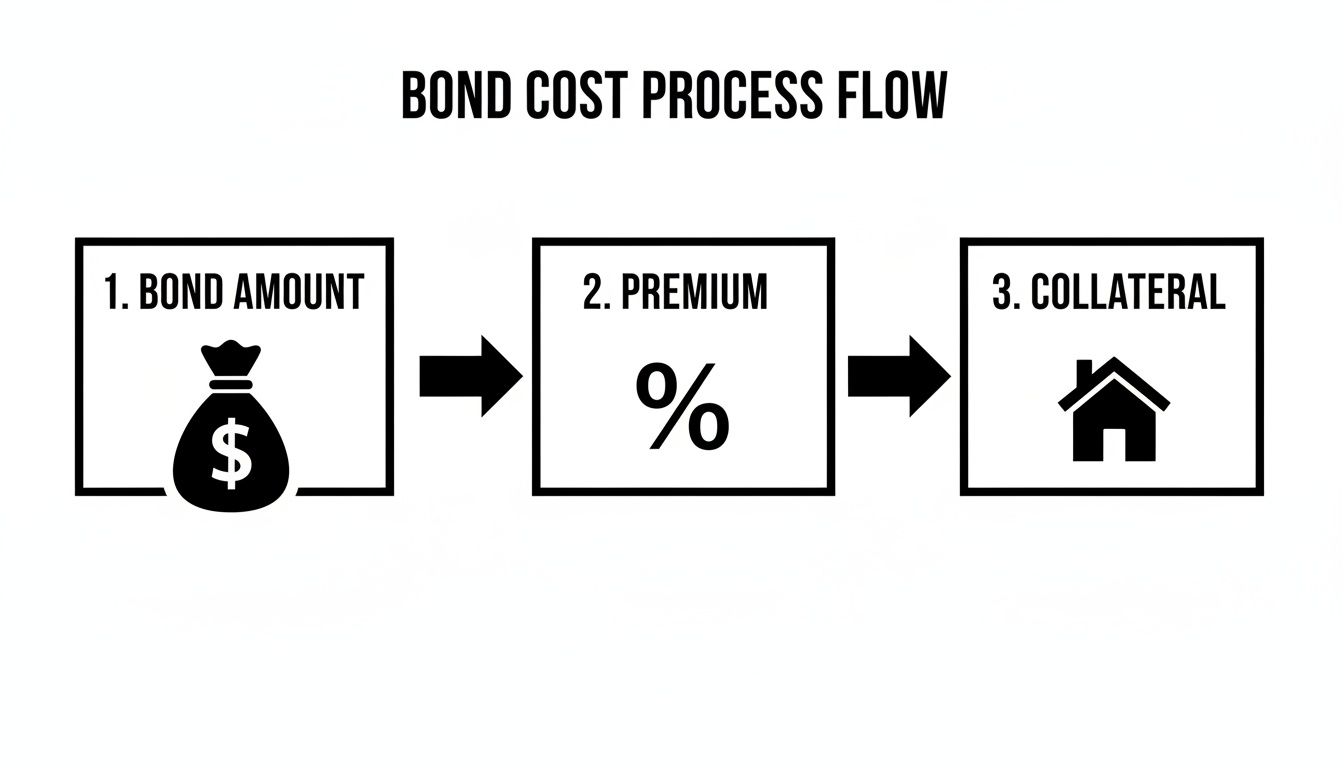
As you can see, you only pay a small fraction (the premium) of the total bail, which makes securing a release financially possible for most families.
Posting the Bond and Waiting for Release
As soon as the paperwork is signed and the premium is paid, our part of the job really begins. A licensed agent will immediately head to the jail where the defendant is being held to post the bond directly with the facility.
From there, the release time can vary. It really depends on how busy the jail staff is at that moment. Once the bond is posted, the facility has to run through its own discharge procedures. We’ll keep in touch with you during this final step, giving you updates until your loved one walks out the door.
If you’re ready to get started, we’re here to help guide you through it. Call or text Express Bail Bonds now at 720-984-2245 for immediate assistance.
Common Questions About Surety Bonds
When you're trying to navigate the bail process, a flood of urgent questions is completely normal. In a high-pressure situation, you don’t need complicated jargon—you need clear, direct answers. Let's tackle some of the most common concerns we hear every day to give you the straightforward information you need to move forward.
You get the basic idea of what a surety bond is, but the practical questions come fast. What if we mess up? Why does it cost this much? How long are we on the hook for this? Getting these answers helps pull back the curtain on the process and can bring some much-needed peace of mind during a tough time. If your question isn't answered here, call us 24/7 at 720-984-2245.
What Happens if a Court Date Is Missed?
This is, without a doubt, the most critical question we get. If the defendant accidentally misses a court date, it's a serious problem, but it doesn't have to be a complete catastrophe—if you act immediately.
The very first thing you need to do is call us, your bail bond agent, right away. I can't stress this enough: time is absolutely crucial here. A missed court date automatically triggers the court to issue a warrant and declare the bond forfeited, but there's usually a very small window to get things back on track.
When you call us immediately, we can often get in touch with the court to reschedule the hearing and have the warrant canceled before things spiral. Taking that one proactive step can prevent the bond from being fully forfeited, which would leave the cosigner responsible for paying the entire bail amount. Honest communication is the key to avoiding a financial disaster.
Why Is the Premium Non-Refundable?
Another question that comes up a lot concerns the premium, which is the fee you pay to the bail bond company. It’s essential to understand that this premium is a non-refundable service fee. It's not a deposit or a down payment that you get back later on.
Think of it like paying for any other professional service, like hiring a lawyer or an accountant. The premium compensates the bail bond agency for two huge things:
- Assuming the full financial risk: We are the ones putting up the entire bail amount with the court, guaranteeing it with our own assets. It's a massive financial liability that we take on so you don't have to.
- Providing professional services: That fee also covers our agent's time, expertise, all the paperwork, court filings, and the ongoing work of monitoring the case until it's officially closed.
The premium is the fee we earn for the immediate service of getting someone released from jail and for providing a long-term financial guarantee to the court. As soon as the defendant is released from custody, our service has been fully delivered.
This is exactly what makes a surety bond such an accessible option for so many families. Instead of coming up with the full bail amount, you pay a small fraction of it to have a professional handle all the risk and logistics for you.
How Long Does a Surety Bond Last?
A surety bond stays active for the entire time the defendant's court case is ongoing. It doesn't just expire after a few weeks or months. The agreement only officially ends when the case is completely closed by the court.
This means the bond remains in full effect from the moment of release until one of these things happens:
- The charges are dropped.
- The defendant is found not guilty after a trial.
- The defendant is sentenced by the judge.
Once the court formally resolves the case and exonerates (releases) the bond, the obligations for everyone involved—the defendant, the cosigner, and our agency—are officially over. At that point, any collateral that was put up would be returned to the cosigner. Understanding the full lifecycle of a surety bond helps set clear and realistic expectations from the very beginning.
Navigating the legal system can feel overwhelming, but you don't have to go through it alone. The team at Express Bail Bonds has been helping families across Colorado for decades, offering clear answers and fast, professional help 24/7. If you have more questions or need immediate assistance, call or text us now at 720-984-2245 for a free, confidential consultation. https://expressbailbonds.com
Article created using Outrank