
When you get that dreaded phone call—the one telling you a loved one has been arrested—your world can feel like it's spinning out of control. It’s a jarring, chaotic moment filled with panic and a million questions. That's completely normal. The best thing you can do is take a deep breath and start thinking methodically. Before you can help, you have to find them, and that starts with gathering the right information.
Your First Steps After A Loved One Is Arrested

Knowing how to find someone in jail is a skill more people need than you might think. With the U.S. incarcerating nearly 1.8 million people as of early 2025, countless families find themselves in this exact situation every year. It’s a confusing process, but a little preparation goes a long way.
The Critical Information You Must Gather
When you’re dealing with official databases, accuracy is everything. Online inmate search tools are incredibly literal—a simple typo or a forgotten middle name can return zero results, leaving you frustrated and worried. Your first priority should be to nail down a few key pieces of information.
To help you stay organized under pressure, we've put together a quick checklist of the details you'll need. Having these on hand will make your search much smoother.
Essential Information Checklist for Your Inmate Search
| Information Needed | Why It's Important | Where to Find It |
|---|---|---|
| Full Legal Name | Jail records use official names, not nicknames. "Michael Smith" will work; "Mike" won't. | Government-issued ID (driver's license, state ID), legal documents, or by asking family members who know it. |
| Date of Birth (DOB) | This is a primary identifier used to separate individuals with common names. | Official records, family members, or personal documents. |
| Arresting County/City | Narrows the search from hundreds of facilities down to a handful of likely locations. | Ask the person who called you, or check news reports if the arrest was high-profile. |
Getting these details right from the start transforms a frantic, scattershot effort into a focused and effective search. This groundwork is the foundation for every step that follows, from locating the right facility to understanding your bail bonds services options.
The single biggest mistake families make is searching with incomplete or incorrect information. A nickname like 'Mike' instead of 'Michael' or guessing a birth year can send you down a rabbit hole of dead ends. Always verify the details before you start looking.
Common Search Mistakes To Avoid
Even with the right data, small errors can derail your search. We've seen it happen time and time again. Be mindful of these common slip-ups:
- Using Nicknames or Aliases: Official records will always use a person's legal name as it appears on their government-issued ID.
- Incorrect Birthdate: Under stress, it's easy to mix up a day or year. Double-check the month, day, and year to be sure.
- Searching the Wrong County: Arrests that happen near a county line can be tricky. If your initial search in one county comes up empty, try broadening it to neighboring jurisdictions.
Taking these first steps also means thinking about the immediate future. If children are involved, you may need to explore temporary guardianship options to ensure they are cared for. Once you’ve gathered your information and are aware of these potential pitfalls, you're ready to start the search.
Using Online Tools to Locate an Inmate in Colorado
Once you’ve gathered the key details, your best bet is to turn to the internet. Your computer or smartphone is easily the fastest tool for tracking down someone in custody. Nearly every county in Colorado offers a direct path to answers through its official websites, making them your first and most important stop.
The most logical place to start is the county where the arrest happened. Most sheriff’s departments in Colorado maintain their own online inmate search tools, and they're usually updated in near real-time. These databases are built specifically to help people like you find out if a loved one is in their facility.
Starting with County Sheriff Websites
Always begin your search with the sheriff's office for the county where the arrest occurred. For instance, if the arrest was in Denver, head straight to the Denver Sheriff Department's website. The same goes for other major Front Range counties like Arapahoe, Jefferson, or Adams.
Look for a link right on their homepage that says something like “Inmate Search,” “Jail Roster,” or “Inmate Lookup.” That's where you need to go.
These search results usually give you more than just a confirmation they're there. You'll often find crucial information like a booking number (their unique ID for this specific stay), a list of the initial charges, and, most importantly, any available bond information. This is the data you need to figure out your next steps.
Broadening Your Search with Statewide Tools
What happens if you're not sure which county it was? Or what if your first search comes up with nothing? This is when a more powerful, statewide tool comes in handy.
Victim Information and Notification Everyday (VINE) is a fantastic, free, and anonymous service that lets you search for people in custody across multiple jurisdictions.
- How It Works: VINE pulls data from countless county jails and state prisons into one massive, searchable database.
- Why It's Useful: If the person was transferred from one jail to another, or if the arrest happened right on a county line, VINE can often find them when a single-county search fails.
- Get Updates: You can also register to get automatic alerts if their custody status changes, like if they're released or moved to a different facility.
VINE is the perfect backup plan if your targeted county searches don't give you the answers you need right away.
A word of advice: online databases only show information after the booking process is complete. This can easily take a few hours. If you're searching right after an arrest and don't see their name, don't panic. Give it some time for the system to catch up.
What About Smaller Municipal Jails?
It’s also good to know that some smaller cities run their own jails, completely separate from the main county facility. These are often used for holding people on minor offenses or just for a few hours before they're transferred to the larger county jail.
If you have a feeling the arrest was for something less serious and happened inside a specific city's limits (like Aurora, Thornton, or Lakewood), it's smart to check that city’s police department website. They might have their own small, separate jail roster that doesn't feed into the main county search.
To make things simpler, we've put together a handy list of Colorado jail and court search tools that links you directly to many of these facilities.
https://www.expressbailbonds.com/bail-bonds-links-to-jails-courts-and-search-tools
Working through these online resources is the most efficient way to find someone. Start local with the county, go bigger with statewide tools if you need to, and don't forget the smaller city jails. Every search gets you one step closer to getting them home.
What to Do When Your Online Search Hits a Wall
Sometimes, even with all the right information, the online inmate locators come up empty. This is a common—and incredibly frustrating—part of trying to find someone who’s been arrested. It doesn’t mean your information is wrong; it just means the digital system hasn’t caught up yet.
This kind of delay happens for a few reasons. The person might have been arrested just a few hours ago and is still being processed, which involves all the necessary paperwork, fingerprinting, and a medical screening. They could also be in a smaller city jail that just doesn't update its online roster as frequently as a large county facility. When the digital tools fail, it's time to switch tactics.
Pick Up the Phone and Call Directly
When an online search hits a dead end, calling the detention facility directly is your most reliable next step. Speaking to an actual person can cut through the digital fog, especially if the arrest was very recent. Jail staff often have access to booking information long before it ever goes live on the public website.
Before you dial, get their full legal name and date of birth ready. The person on the other end of the line is always busy, so being prepared shows respect for their time and helps you get the answers you need quickly.
Pro Tip: Be polite and direct. Jail staff deal with stressed, emotional callers all day long. A calm, straightforward approach like, "Hello, I'm trying to locate someone who may have been brought in recently. Can you help me?" is far more effective than a panicked one.
To help ease the anxiety of making that call, here's a simple script you can adapt:
- You: "Hello, I'm trying to find out if a family member is currently in your facility. Their name is [Full Legal Name], and their date of birth is [Month, Day, Year]."
- Jail Staff: "Let me check… Yes, they are here."
- You: "Thank you. Could you please provide me with their booking number and any bond information you have available?"
This script is simple, professional, and gets you the essential details needed to move forward.
Explore Colorado Court Records Online
In some situations, court records can actually reveal someone’s status before the jail rosters do. As soon as an arrest is made, the legal process kicks off, and a case file is created. This can be another valuable source of information.
The Colorado Judicial Branch website has a public case search feature. By entering the person's name, you might find a newly filed case that confirms their location and gives you details about their charges. This is especially helpful if you think they’ve already had their first court appearance where a judge formally sets the bond amount.
Understanding Local, State, and Federal Custody
It's also important to consider who made the arrest. The vast majority of arrests are handled by local police or county sheriffs, which means the person will be in a city or county jail. However, if they were arrested on federal charges (like bank robbery or drug trafficking across state lines), they won't show up in any local system.
Instead, they would be in federal custody. To find someone in this situation, you'll need to use the Federal Bureau of Prisons (BOP) Inmate Locator. This is a completely separate, national database. If you have any reason to believe federal authorities were involved, this should be your next search.
Navigating these steps can feel overwhelming, especially when you're worried and unsure of what to do next. When you have questions or feel stuck, it's okay to ask for help. The experienced team at Express Bail Bonds is available 24/7 to provide guidance. If you need help understanding the process or want to prepare for the next steps, don't hesitate to contact us. We are here to support you.
Decoding Jail Records and Planning Your Next Steps
So you’ve gone through the tense moments of searching, and you finally found their name on an online roster. A wave of relief hits you, but it’s immediately followed by a new kind of confusion. You're staring at a screen filled with terms like booking numbers, charge codes, and bond amounts that might as well be in a foreign language.
This is the critical turning point. It's the moment you shift from finding them to acting to get them out. Understanding what these records actually mean is your roadmap to bringing them home.
Making Sense of the Inmate Record
The information you see on a jail roster is a snapshot of their current legal situation. Every piece of data is important, but it’s the bond information that really dictates what you do next. Let's break down the most common terms you'll run into.
Imagine getting that frantic call at 2 a.m.—your loved one has been arrested and is sitting in a county jail somewhere in Colorado. With nearly 2 million people incarcerated across the U.S. in various facilities as of 2025, including 1,566 state prisons, 98 federal prisons, and over 3,116 local jails, finding them quickly is crucial before bail options change or expire.
Common Bond Types Explained:
- Surety Bond: This is the one you’ll see most often. It means you can work with a licensed bail bonds agency, like Express Bail Bonds, to secure the release. You pay a percentage of the total bond (the premium), and our agency guarantees the full amount to the court.
- Cash Bond: This means you have to pay the entire bond amount directly to the court, in cash. The money is eventually returned after the case is over, but only if all court appearances have been made.
- No Bond Hold: If you see "No Bond" or a blank space where the amount should be, it usually means the person has to see a judge before a bond is even set. This is common for very serious charges or things like probation violations.
Finding your loved one is only the first half of the puzzle. The next, and most important, step is understanding the specific type of bond set by the court. This single piece of information determines whether you need to pay the full amount in cash or if you can work with a bondsman for a fraction of the cost.
Decoding Jail Information: What It Means and What to Do
When you first look at an inmate roster, the jargon can be overwhelming. This table breaks down what those terms mean and what your immediate next step should be.
| Term/Information Found | What It Means | Your Next Action |
|---|---|---|
| Booking Number | A unique ID assigned to the individual for this specific arrest. | Keep this number handy. It's the fastest way for the jail and your bondsman to locate the person's records. |
| Surety Bond | A bail bondsman is required to post the bond. You pay a percentage (premium) to the bondsman. | Call a bail bondsman immediately. This is the most common and affordable way to get someone out of jail. |
| Cash Bond | The full bail amount must be paid in cash directly to the jail or court. No bondsman is needed. | Be prepared to pay the entire amount yourself. The funds are returned only when the case is completely finished. |
| No Bond / Hold | The person cannot be bailed out at this time. They must appear before a judge first. | Wait for their first court appearance (advisement). A bond may be set at that time. Contact a bondsman to be ready. |
| Charge(s) | The specific crime(s) the person is accused of. This can range from misdemeanors (M) to felonies (F). | Note the charges. The severity will impact the bond amount and conditions of release. |
| Court Date | The date, time, and location of the next scheduled court appearance. | Mark this on your calendar. Missing court is the number one reason a bond is revoked and a new warrant is issued. |
Understanding these key pieces of information empowers you to make the right moves quickly and without confusion.
Your Most Valuable Partner in This Process
This is where a professional bail bonds agency becomes your most important ally. Navigating the complex paperwork, court requirements, and jail procedures is what we do all day, every day. Instead of trying to figure it all out alone under immense stress, you can lean on an expert to handle the logistics.
At Express Bail Bonds, our agents are available 24/7 to immediately start working on your behalf. We know that arrests happen at all hours, and our team is always ready to answer your call or text. We can often clarify confusing bond conditions and explain exactly what’s needed to secure a swift release.
Seamless Support for In-State and Out-of-State Families
One of the biggest hurdles families face is distance. If you live out of state, the thought of handling paperwork and payments from hundreds of miles away can feel impossible. That’s why we’ve perfected our electronic process.
You can complete the entire bail bond application, sign contracts, and make payments right from your computer or smartphone. There’s no need to drive for hours to meet an agent or wait in line at a jail. Our system lets us post the bond quickly at nearly any facility in Colorado while you focus on supporting your loved one.
When you're planning your next steps, especially if they involve legal matters, you might need to send private records to an attorney. Knowing how to find the best secure online fax service can be a useful tool for these sensitive communications.
Once you’ve found your loved one and you’re ready to act, don't wait. The sooner you start the process, the sooner they can be released. Our experienced agents are standing by to guide you through every step, answer all your questions, and handle the details with the professionalism and speed you deserve.
For immediate assistance, call or text Express Bail Bonds at 720-984-2245. We are here to help you now.
Navigating the First 24 Hours After an Arrest
Finding your loved one's name on a jail roster brings a moment of relief, but that feeling is often fleeting. It’s almost immediately replaced by a fresh wave of urgent questions. The first 24 hours after an arrest are a whirlwind of official procedures, confusing timelines, and critical decisions that have to be made fast.
If you’re searching online and can't find them right away, don't panic. The biggest reason for the delay is the booking process. This isn't as simple as just typing a name into a computer. It’s a meticulous, hands-on procedure that involves fingerprinting, taking mugshots, a health screening, and documenting every piece of personal property. On a busy Friday or Saturday night, this can easily take several hours.
The Booking and Processing Timeline
From the moment of arrest, there are several steps before that person ever appears in an online system. First, they are transported to a detention facility. Once they arrive, they're placed in a queue to be processed, which is often where the longest delays happen.
After their information is finally entered into the system, they are typically allowed to make a phone call. This may be the first time you hear from them directly. That call will be short and it will be recorded, so it’s crucial to get right to the point: ask for their location and any booking number they've been given.
This timeline gives you a visual guide for the entire process, from that initial search to taking action.
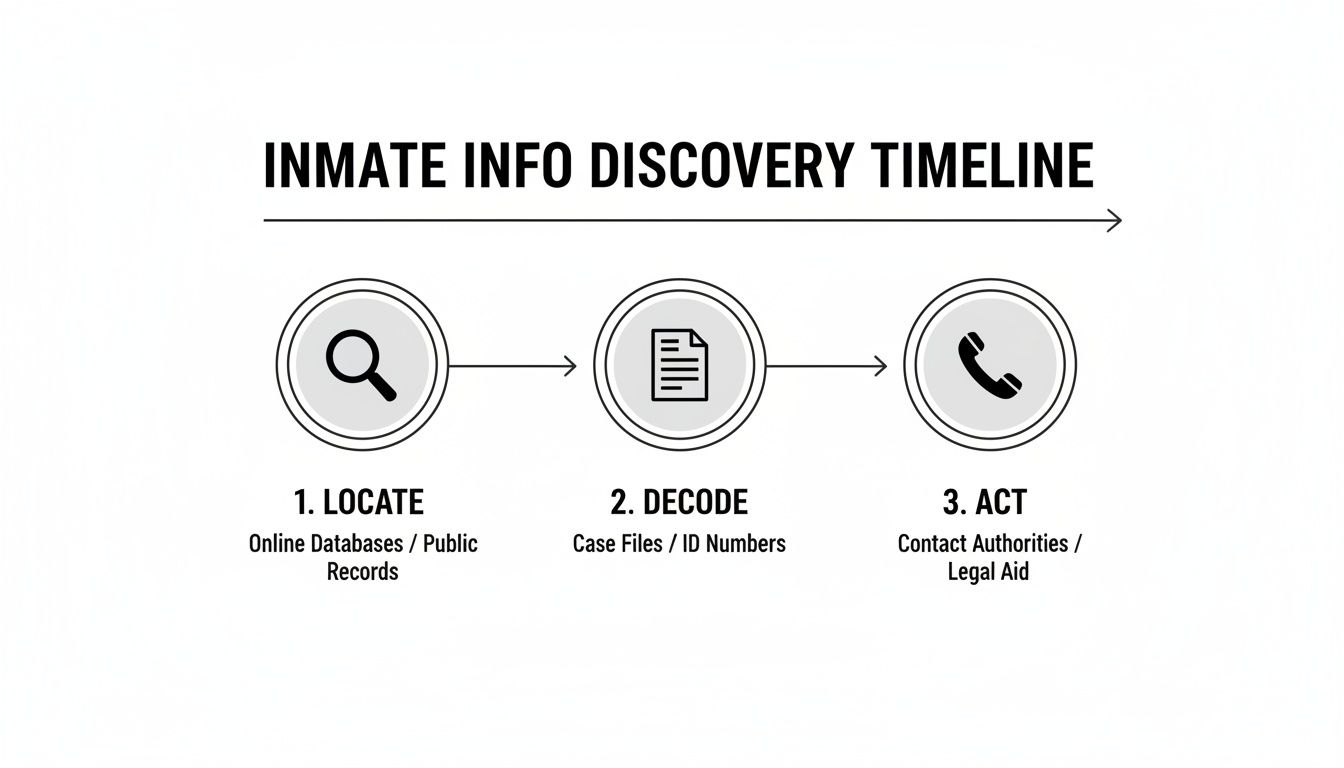
As you can see, finding them is just the first step. Understanding the information you uncover and knowing how to act on it is what really matters.
The First Court Appearance or Advisement
Within a day or two, the individual will have their first court appearance, which is usually called an advisement hearing. This is a quick but incredibly important event where a judge formally reads the charges and, most importantly, sets the official bond amount.
If the jail roster didn't list a bond amount, this hearing is when it gets decided. Knowing the outcome of this hearing is absolutely essential for planning your next move with a bail bonds agent.
Here's a critical piece of advice I give every client: Do not discuss the details of the case over the jail phone. Every single call is recorded and can be used by the prosecution. Keep your conversations focused on their well-being, offering support, and the logistics of getting them out.
What You Can and Cannot Do
During these initial hours, your ability to help is both powerful and limited. You have to know the rules to avoid accidentally making things worse.
- Visitation: You almost certainly cannot visit in person during the first 24-48 hours. Once the person is processed and moved to a housing unit, the facility will have a specific schedule and rules you'll need to follow.
- Phone Calls: You can't call into the jail to speak with an inmate. They have to call you collect or use funds from their account. This is why getting money on their books is so important.
- Putting Money on Their Account: Most jails use a third-party service to handle inmate funds. You can usually add money online or use a kiosk in the jail lobby. This lets them buy essentials from the commissary and, more importantly, make those crucial phone calls to you and their attorney.
Getting through these first hours requires a clear head and a plan. While you're waiting for the system to update and for that first court hearing to happen, the best thing you can do is prepare. Gather all your information and get in touch with an experienced bail bonds agent.
When you’re ready, the team at Express Bail Bonds can walk you through the process and get everything in place to act the second a bond is set. For immediate, 24/7 help, call or text us at 720-984-2245. We’re here to get you through this.
Frequently Asked Questions About Finding an Inmate
When you're frantically trying to find out where a loved one has been taken, a million questions are probably running through your head. The stress and uncertainty can be overwhelming. Getting clear, simple answers can make all the difference, which is why we've put together answers to the most common questions we hear from families going through this for the first time.
That period right after an arrest is always the most confusing. You're clicking through online databases, making phone calls, and it can feel like you're hitting one dead end after another. Understanding how the system works can help you manage your expectations and focus on what to do next.
How Long Until Someone Shows Up in the Jail System?
One of the biggest frustrations is not finding a loved one's name on an inmate search right after an arrest. This is completely normal. It usually takes anywhere from 2 to 8 hours for a person to be fully processed and appear in the online system.
This delay happens because the booking process is detailed—it includes fingerprints, photos, and entering a lot of information into the system. On busy nights, like a Friday or Saturday, it can take even longer. If a few hours go by and you still can't find them online, your best bet is to call the jail directly. The staff on duty can often see who is in the booking process before the information goes public on the website.
What if the Person Was Arrested in a Different State?
If the arrest happened outside of Colorado, you'll need to shift your search to that specific state and county. A quick and easy way to start is by searching online for a phrase like "[County Name] [State] inmate search." That will almost always point you to the right sheriff's office or department of corrections website.
For a wider search that can check multiple places at once, VINELink is an invaluable national resource. While Express Bail Bonds is licensed to operate only in Colorado, our team has been doing this for decades. We can often offer some general advice or help you find a reliable bondsman in another state. You can learn more about how we help families across Colorado on our services page.
Can I See the Specific Charges Online?
Yes, most of the time, the online inmate locator will list the preliminary charges filed against the person. You'll usually see a criminal statute number or a short description of the charge, like DUI, Domestic Violence, or Assault.
This information is incredibly important. It gives you an immediate idea of how serious the situation is and is the biggest factor in determining the bond amount. When you call a bail bonds agent, having these specific charges ready helps us understand the case right away and explain your options clearly.
It's crucial to remember that the charges you see online are just the initial ones. The District Attorney's office can change or add to them as the case progresses. For now, just focus on the information you have to plan your next immediate steps.
Why Would Someone Have No Bond Amount Listed?
Seeing "No Bond" or just a blank space where the bond amount should be can be scary, but there's usually a logical explanation. It often means the person is being held on a 'no bond hold.' This can happen for very serious charges, a probation violation, or if they have an outstanding warrant from another jurisdiction.
In these cases, the person has to see a judge at an advisement hearing before a bond amount can be set. Sometimes, it just means the bond hasn't been determined yet. This is a good time to call an experienced bail agent. We can often find out why there’s a hold and help you get ready to act the moment a bond is set.
Trying to navigate an arrest and the bail process is tough, but you don't have to do it by yourself. If you have questions or you're ready to start the process of bringing someone home, the team at Express Bail Bonds is here to help 24/7. Call or text us anytime for immediate, professional assistance at 720-984-2245, or visit us at https://expressbailbonds.com.
Article created using Outrank