
When someone you care about is arrested, one of the first and most critical decisions you'll face is how to post bail. The choice between a surety bond vs cash bond can feel overwhelming, but it boils down to a simple difference. A cash bond means you pay the entire bail amount directly to the court, while a surety bond lets you pay just a small percentage of that total to a bail bondsman who then covers the full amount.
This decision will have an immediate impact on your finances and how you navigate the release process. If you need help understanding your options, call or text Express Bail Bonds at 720-984-2245 for a free, confidential consultation.
Navigating Bail Options: A Quick Colorado Guide

After an arrest, a judge sets a bail amount. This isn't a fine; it's a financial guarantee that the defendant will show up for all their court dates. To get them released from jail, you have two main options, and each one comes with its own set of financial and practical implications.
The most straightforward choice is a cash bond. This means you pay the entire bail amount—whether it's $5,000 or $50,000—in full, directly to the court or the jail. While you stand to get this money back at the end of the case (minus any court fees or fines), it demands a massive upfront payment that can tie up your personal assets for months, or even years.
The more common route is a surety bond. This is where you work with a licensed bail bond agent. Instead of coming up with the entire bail amount yourself, you pay a non-refundable fee, known as a premium. Here in Colorado, that premium is typically 10-15% of the total bail. Your bail bond company then posts a bond for the full amount, taking on the financial risk if the defendant doesn't appear in court.
Surety Bond vs Cash Bond At-a-Glance Comparison
To make the choice clearer, here’s a quick rundown of the fundamental differences between these two primary bail options in Colorado.
| Attribute | Surety Bond (Through a Bondsman) | Cash Bond (Directly to Court) |
|---|---|---|
| Upfront Payment | Pay a small, non-refundable fee (10-15%). | Pay the full 100% of the bail amount. |
| Financial Risk | The bail bond company assumes the primary risk. | You assume the full financial risk of forfeiture. |
| Refundability | The premium is a non-refundable service fee. | The principal amount is returned after the case. |
| Process | Handled by an experienced, licensed agent. | Requires you to deliver funds to the court/jail. |
This table gives you a clear snapshot of how the two options stack up. For most families, the surety bond is a far more accessible and manageable path to getting a loved one released quickly without liquidating savings or assets.
Understanding the broader bail process is also key. While the specifics can vary by state, learning about what happens at a bond hearing can provide valuable context.
For immediate, professional help with surety bonds in Colorado, call or text Express Bail Bonds anytime at 720-984-2245.
How a Surety Bond Preserves Your Finances

When a judge sets a high bail amount, the financial pressure on a family can feel overwhelming. A surety bond is a lifeline in these situations, allowing a defendant to be released from custody without forcing their family to drain savings accounts or liquidate valuable assets. Instead of coming up with the full bail amount, you hire a bail bond company to post it for you.
This works through a simple, three-party legal agreement between the court, the defendant (and their cosigners), and the bail bond company—also known as the surety. The surety guarantees the court that the defendant will show up for all their hearings. By making this guarantee, the bail bond company takes on the full financial risk of the bail.
The Role of the Premium
Of course, this service comes at a cost. The bail bond company charges a non-refundable fee called a premium. Here in Colorado, the standard premium is set between 10% and 15% of the total bail amount. This fee is how the bondsman gets paid for shouldering the massive financial risk involved.
You can think of it like an insurance premium. You pay a much smaller, predictable fee to protect yourself from a potentially devastating financial loss.
A surety bond essentially transfers the financial risk from you to the bail bond agency. You pay a predictable fee to avoid tying up thousands of dollars of your own capital, ensuring your money remains available for legal defense and essential living expenses.
Let’s look at a common scenario to see just how big of a difference this makes.
Practical Example: A $30,000 Bail Amount
Imagine a judge sets bail at $30,000. If you wanted to post a cash bond, you’d have to deliver the full $30,000 in cash to the court. With a surety bond, your out-of-pocket cost is a fraction of that:
- Standard 15% Premium: You would pay a non-refundable fee of $4,500.
- Reduced 10% Premium: For bonds over $5,000, many people qualify for a 10% rate, bringing the premium down to just $3,000.
In this situation, you keep $25,500 to $27,000 of your own money free and clear. This is the single biggest difference in the surety bond vs cash bond debate.
Securing the Agreement with Cosigners and Collateral
To protect themselves from loss, bail bond companies need a financially responsible person, called a cosigner (or indemnitor), to sign the agreement. The cosigner makes a legal promise to repay the bondsman for the full bail amount if the defendant fails to appear in court. This is usually a family member, close friend, or employer who has a steady job and good credit.
For very large bonds or situations where a cosigner's finances are less certain, collateral might be required. Collateral is a physical asset—like a piece of real estate or a vehicle—that is pledged to secure the bond. However, for most standard bonds with a strong cosigner, collateral isn't necessary. This flexibility helps families secure a release quickly, even if they don't own major assets.
By using a surety bond, you protect your family's financial stability during an already stressful time. The money that would have been locked up with the court can instead be used for hiring a lawyer, paying the mortgage, and handling everyday expenses.
To learn how this process works with different local jails, you can check out our detailed Colorado jail information pages. For immediate, confidential help, call or text Express Bail Bonds anytime at 720-984-2245.
The True Cost of a Cash Bond
On the surface, a cash bond looks like the most straightforward path to getting someone out of jail. You pay the full bail amount set by the court, and when the case is over, you get it back. Simple, right? But the reality is that choosing a cash bond often comes with significant hidden costs and financial burdens that can put a massive strain on a family's resources for a long, long time.
The most immediate hurdle is the huge amount of cash you need upfront. If bail is set at $20,000, you have to produce $20,000 in cash and deliver it to the court or jail right then and there. For most families, that means draining savings accounts, cashing out investments, or even borrowing from retirement funds—all of which have their own penalties and lasting consequences.
The Opportunity Cost of Frozen Funds
Once you hand over that cash, it's no longer yours to use. The court holds onto it for the entire duration of the legal case, which could drag on for months or, in more complex situations, even years. During all that time, those funds are completely frozen and untouchable. This creates a serious opportunity cost—you lose out on what that money could have been doing for you.
Your money isn’t sitting in a savings account earning interest or growing in an investment portfolio. More importantly, it can't be used for the critical, time-sensitive expenses that almost always pop up during a legal battle.
The real cost of a cash bond isn't just the dollar amount you pay; it's the inability to use that money when you need it most. Having thousands of dollars locked away means you can't pay your mortgage, cover an unexpected medical bill, or, most critically, afford the best possible legal defense for your loved one.
This isn't just a problem in criminal bail situations. The same principle applies in other industries where financial guarantees are needed. A contractor who opts for a cash bond has to deposit the full amount upfront, and that cash stays tied up for the entire project, directly impacting their working capital. Imagine a construction company bidding on a $150,000 project; they might have to deposit $15,000 in cash, making those funds unavailable for payroll or equipment.
The Uncertainty of a Full Refund
While the main amount of a cash bond is refundable, it's a common misunderstanding that you’ll get every single dollar back. Courts automatically deduct their own administrative fees and court costs right off the top. On top of that, if any fines are ordered as part of the sentencing, those will also be taken directly from the cash bond you posted before you ever see a penny.
This means you could wait over a year to get your money back, only to find it's several hundred or even thousands of dollars short of what you originally paid. This is a critical point to consider when weighing a surety bond vs cash bond. The non-refundable premium for a surety bond is a known, fixed cost. The final "cost" of a cash bond, however, remains a complete unknown until the very end. Getting a clearer picture of how much bail costs in different scenarios can help you understand these financial trade-offs.
If you're facing this decision and want to avoid tying up your personal assets, a surety bond is the most financially responsible choice. Call or text Express Bail Bonds at 720-984-2245 to discuss your options with an expert.
Analyzing Cost, Speed, and Financial Risk
When you're trying to get someone out of jail, the choice between a surety bond and a cash bond often comes down to three things: how much it costs right now, how fast it works, and who is on the hook if something goes wrong. Looking closely at these factors usually reveals why a surety bond is the most practical and secure path for families here in Colorado. Our guide offers a straightforward comparative analysis to help you make the right call during a stressful time.
Upfront Financial Impact
The biggest and most immediate difference between these two options is the out-of-pocket expense. For many people, this single factor makes the choice pretty clear.
With a cash bond, you have to pay 100% of the bail amount directly to the court. So, if bail is set at $20,000, you need to come up with $20,000. For most families, that’s a devastating financial hit that can mean draining savings accounts, selling assets, or even taking out high-interest loans just to get someone released.
A surety bond, on the other hand, only requires a small fraction of that amount. You pay a non-refundable premium to a licensed bail agent, which in Colorado is typically 10-15% of the total bail. For that same $20,000 bond, your actual cost would be between $2,000 and $3,000. This makes the process much more accessible and keeps a temporary legal issue from spiraling into a long-term financial crisis.
Long-Term Cost Versus Refundability
At first glance, a cash bond seems appealing because it's "refundable." You pay the full amount, and once the case is over and all court dates have been met, the court returns your money. But the reality is a bit more complicated. That money can be tied up for months or even years, and it almost never comes back in full. The court will deduct its administrative fees and any fines or restitution the judge orders.
In contrast, the premium for a surety bond is a non-refundable fee for a service. You are paying the bail bond company to guarantee the entire bail amount to the court and to take on all the risk. While you don't get that fee back, it's a fixed, known cost. You know exactly what you’re paying from the very beginning, which brings some much-needed predictability to a very unpredictable situation.
The surety bond premium is a one-time, predictable expense. A cash bond ties up a massive amount of your capital for an unknown duration, with the final returned amount subject to deductions you cannot control.
Risk Allocation: Where Does the Burden Lie?
This is a crucial, and often overlooked, part of the surety bond vs cash bond decision. When you post a cash bond, you are personally taking on 100% of the financial risk. If the defendant misses a court date for any reason, the court can forfeit the entire bail amount. Just like that, your $20,000 could be gone for good.
With a surety bond, that risk is transferred to the bail bond company. The bondsman is the one who has guaranteed the full $20,000 to the court. If the defendant fails to appear, the bondsman is the one responsible for paying the forfeiture. This is exactly why we're so invested in making sure defendants show up for court, often providing reminders and support. That professional oversight is a huge benefit. If you’re worried about this, it’s good to understand what happens if you miss court and the serious consequences.
This decision tree breaks down the direct financial path you have to take with a cash bond.
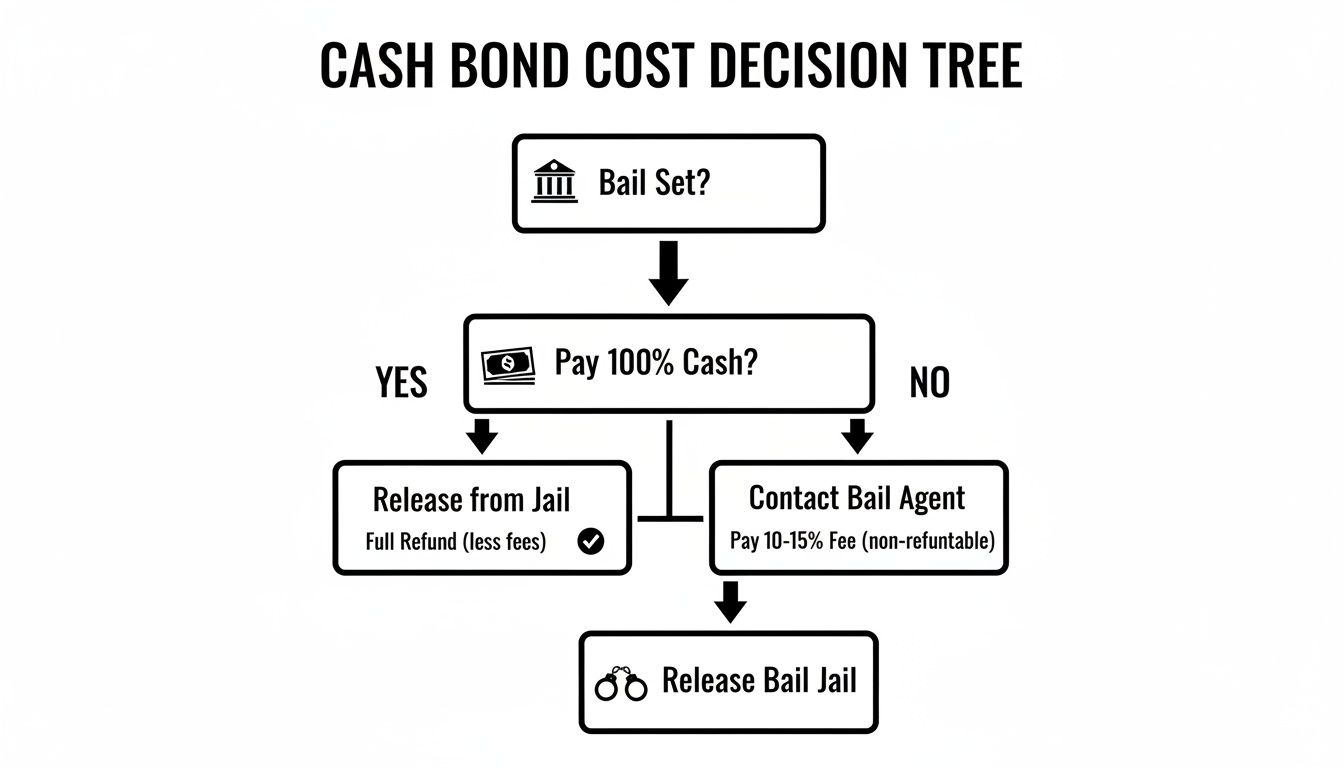
As the visual shows, the only way forward with a cash bond is paying the whole amount, a commitment that can have major financial fallout.
Process and Convenience
Finally, let's talk about the actual logistics. Posting a large cash bond can be a bureaucratic nightmare. It means physically taking a huge amount of cash to a specific jail or courthouse—often during very limited hours—and figuring out all the required paperwork on your own.
Working with a bail agent is a much more guided and streamlined experience. Here at Express Bail Bonds, we handle everything for you. A lot of the paperwork can be done electronically from your home, and we're available 24/7. Our agents know exactly where to go, who to see, and which forms are needed to get your loved one out as quickly as possible, saving you a ton of time and stress.
Detailed Feature Breakdown: Surety Bond vs. Cash Bond
To make it even clearer, here’s a side-by-side look at how these two options stack up on the most important factors for families in Colorado.
| Decision Factor | Surety Bond | Cash Bond |
|---|---|---|
| Upfront Cost | Pay 10-15% of the total bail. | Pay the full 100% of the total bail. |
| Financial Risk | Transferred to the bail bond company. | Fully assumed by the individual posting bail. |
| Refundability | The premium is a non-refundable service fee. | The principal is returned, minus fees and fines. |
| Capital Access | Keeps your personal capital liquid and available. | Freezes a large sum of money for months or years. |
| Process | Handled by an expert 24/7, often remotely. | Requires you to handle logistics and paperwork in person. |
Ultimately, the choice comes down to balancing a smaller, non-refundable fee against the massive burden of tying up a large sum of your own money and shouldering all the risk. For most families, the affordability, risk transfer, and sheer convenience of a surety bond make it the clear and responsible choice.
If you need fast, professional help with a surety bond anywhere in Colorado, call or text Express Bail Bonds at 720-984-2245 for a free consultation.
When a Surety Bond Is the Smartest Choice
Deciding between a surety bond and a cash bond isn't just about the money; it’s a strategic choice you make based on your specific situation. While a cash bond has its place, some scenarios make a surety bond the unquestionably smarter, more practical option. Let's move beyond generic advice and look at real-world situations where partnering with a bail bond agent gives you a clear and powerful advantage.
These situations go beyond a simple cost comparison. They touch on your family's financial stability, the need for expert guidance, and making things easier during what is already a very stressful time. If you find yourself in any of the following scenarios, a surety bond is likely your best path forward.
When Bail Amounts Are Substantial
The most obvious reason to choose a surety bond is when the bail is set high. For most families in Colorado, coming up with $25,000, $50,000, or more in cash on short notice is just not realistic. Even if you technically have that value tied up in assets like home equity or retirement accounts, liquidating them quickly is often impractical and can come with huge financial penalties.
A surety bond closes this gap. Instead of draining your life savings, you pay a manageable premium—typically 10-15% of the total bond amount. It’s a financial tool designed to make release accessible, preventing a temporary legal problem from turning into a permanent financial catastrophe.
Preserving Your Liquid Capital for Critical Needs
Even if you can afford to pay a cash bond, the bigger question is, should you? Tying up thousands of dollars with the court system for an unknown amount of time—often months or even years—carries a heavy opportunity cost. That money is completely frozen, unavailable for the expenses that matter most while fighting a legal case.
The most critical reason to preserve your cash is for your legal defense. A strong defense costs money, and using your available funds for a bail bond premium instead of the full cash amount ensures you have the resources to hire the best possible attorney.
Beyond legal fees, life doesn’t stop. You still have a mortgage, car payments, and daily bills to worry about. A surety bond lets you keep your financial life intact, providing stability when you need it most. This is a common approach in the business world, too; surety bonds don’t appear on a company's balance sheet or reduce their credit lines, which preserves their borrowing capacity for essential operations. You can discover more about how surety bonds protect financial health on projectfinance.law.
Navigating a Complex System with an Expert Guide
The bail process can be incredibly confusing and intimidating. It’s filled with specific procedures, paperwork, and deadlines that change from one jail to another. If you try to post a large cash bond on your own, you're left to navigate this bureaucracy alone, which often leads to frustrating delays and costly mistakes.
When you work with a licensed bail agent from Express Bail Bonds, you gain an expert advocate.
- We know the system: Our agents understand the specific protocols at every jail and courthouse in Colorado.
- We handle the details: We take care of all the required documentation, making sure it's done correctly and efficiently.
- We expedite the release: Our experience allows us to post the bond quickly, minimizing the time your loved one spends in custody.
This professional guidance is invaluable, turning a complicated ordeal into a managed, straightforward process.
Providing Support from a Distance
Life is mobile, and it’s common for the person who can help post bail—a parent, sibling, or close friend—to live in another city or even out of state. Trying to coordinate a cash bond from afar is a logistical nightmare.
This is where our modern process makes all the difference. Express Bail Bonds offers a fully electronic system, allowing a cosigner to complete all the necessary applications and payments securely online from anywhere. You can arrange for a loved one's release right from the comfort of your home, without ever having to set foot in Colorado.
If any of these situations sound familiar, the choice in the surety bond vs cash bond debate becomes clear. Don't let financial strain or logistical hurdles prolong an already difficult time. Call or text Express Bail Bonds now at 720-984-2245 for immediate, expert assistance.
Your Step-by-Step Guide to Securing a Surety Bond
When you decide a surety bond is the right move, you need a clear, no-nonsense path to get your loved one home as quickly as possible. We’ve refined our process at Express Bail Bonds to be fast, secure, and straightforward, taking the stress off your shoulders. This guide lays out exactly what to expect when you work with us, so you can feel confident from start to finish.
The whole system is built for speed and simplicity. You can secure a release without ever setting foot in a jail. From your first call to the moment they walk free, our expert agents handle the heavy lifting so you can focus on what matters—your family. Here’s a look at our simple, four-step process.
Step 1: The Initial Contact
First things first, you just need to reach out to our team. We’re available 24/7 by call or text. All we need to get started is the defendant’s full name and the city or county jail where they’re being held. With that basic info, we can immediately get to work locating them and confirming the bond amount.
Step 2: Information and Agreement
Once we have the details, one of our licensed bail agents will give you a call to explain everything. We’ll confirm the total bond amount, calculate the non-refundable premium, and walk you through what it means to be a cosigner. We make sure to take the time to answer all of your questions, so there are absolutely no surprises down the road.
Our promise is complete transparency. We make sure you understand the agreement, the exact costs involved, and your role in the process before anything moves forward. This kind of clarity is crucial when you’re weighing a surety bond vs cash bond.
Step 3: Secure Digital Paperwork
We use a modern, secure system that lets you handle all the necessary paperwork and payments online from any device—your phone, tablet, or computer. This completely removes the need to drive to our office or the jail, which saves a ton of time and stress, especially if you’re trying to help from out of state.
Step 4: Posting the Bond for Release
As soon as the paperwork and payment are squared away, we get to work immediately. One of our agents will head straight to the detention facility to post the bond with the court. We handle all the final steps with the jail staff to finalize the release, getting your loved one back home as fast as possible. For a little more detail, our article on how to bail someone out offers some extra context.
For immediate, confidential help anywhere in Colorado, call or text Express Bail Bonds at 720-984-2245 anytime.
Frequently Asked Questions
When you're trying to figure out the difference between a surety bond and a cash bond, a lot of questions pop up. Here are some straightforward answers to the things we hear most often from families across Colorado.
What Happens if We Miss a Court Date With a Surety Bond?
If a defendant misses a court appearance, the bond immediately goes into forfeiture, and the court will issue a warrant for their arrest. This sounds serious, and it is, but our first goal as your bail agent is to help you fix it.
We'll get in touch with the cosigners right away to track down the defendant. From there, we work with you to get everything back on track with the court, which often helps avoid having to pay the full, painful financial penalty.
Is the Surety Bond Premium Refundable if the Charges Are Dropped?
No, the premium you pay to a bail bond company is a non-refundable fee for our services. Think of it like an insurance premium—it covers the service of us guaranteeing the entire bail amount and taking on the financial risk for the court.
That fee is considered earned the moment we post the bond and your loved one is released, no matter how the case turns out in the end.
Can You Help With a "Cash-Only" Bond?
Unfortunately, we can't. When a judge orders a "cash-only bond," they are specifically saying the court will not accept a surety bond from a bail agent like us.
This means the full bail amount has to be paid directly to the court, in cash, by the defendant or their family.
The distinction is critical: a standard cash bond gives you the choice between paying in full or using a surety, whereas a "cash-only" order removes that choice entirely.
How Long Does the Bail Process Take in Colorado?
Once all the bond paperwork is signed and the premium is paid, the actual release from jail can take anywhere from 2 to 8 hours. The exact timing really depends on the specific facility.
Things like the jail's staffing levels, how busy they are at that moment, and their own internal procedures all play a big part. Our agents move as fast as possible on our end to post the bond and keep any delays to a minimum.
Making the right choice for your family's situation is crucial. For fast, professional advice and immediate help with a surety bond anywhere in Colorado, you can trust the experts at Express Bail Bonds. Our team is available 24/7 to walk you through every step.