
At 2 a.m., a spouse may be staring at a jail website with one question: How much will it cost to get my loved one released? The answer usually involves two different numbers, the court's bail amount and the bail rate charged by a surety agent. Confusing those figures can make an already stressful call feel impossible.
Colorado families also need to know that the headline bond amount isn't necessarily what they pay out of pocket. The 15% premium cap, the possible 10% co-signer pathway, and lawful extra charges all affect the final cost. The sections below explain those numbers in plain language, using Colorado rules and verified pretrial data so you can ask better questions before signing anything.
The 2 A.M. Phone Call That Starts the Search
The phone rings while the house is quiet. A spouse hears that their loved one has been booked at a county jail, perhaps on a DUI, assault, or drug charge. The caller may say the jail listed the person as “without bond,” “cash only,” or subject to a set bond, but nobody explains what those labels mean.
The family member starts searching from a phone. One page shows a bond amount. Another mentions a premium. The jail employee says paperwork must be completed before morning court, while relatives are still trying to determine whether they need cash, collateral, a co-signer, or a licensed bail agent. The panic comes from uncertainty as much as from the arrest.
The first distinction matters: the court sets the bail amount, while a surety agent charges a premium for posting a bond on the defendant's behalf. Those numbers are connected, but they aren't interchangeable. Colorado's rules also limit the professional premium and identify the kinds of additional charges that may be collected.
A useful preparation resource is this criminal intake form guide, especially for organizing names, contact details, charge information, and prior case documents before speaking with a lawyer or bond agency. Accurate information can reduce delays when a family is answering questions under pressure.
The information to gather first
Before calling a bondsman, write down:
- The defendant's full legal name: Include spelling exactly as the jail records it.
- The booking location: Colorado counties use different jail and court procedures.
- The listed charge: The charge category can affect whether a bond is available and what review is required.
- The bond status: Ask whether the person has a set bond, a cash-only condition, a personal recognizance option, or a hold.
- The next court event: A hearing, another agency hold, or a weekend closure can change the timeline.
The numbers behind bail rates aren't random. Once you separate the court's decision from the agent's fee, the process becomes easier to follow, and you can request a written explanation instead of guessing.
What a Bail Rate Actually Means
Most families encounter two numbers.
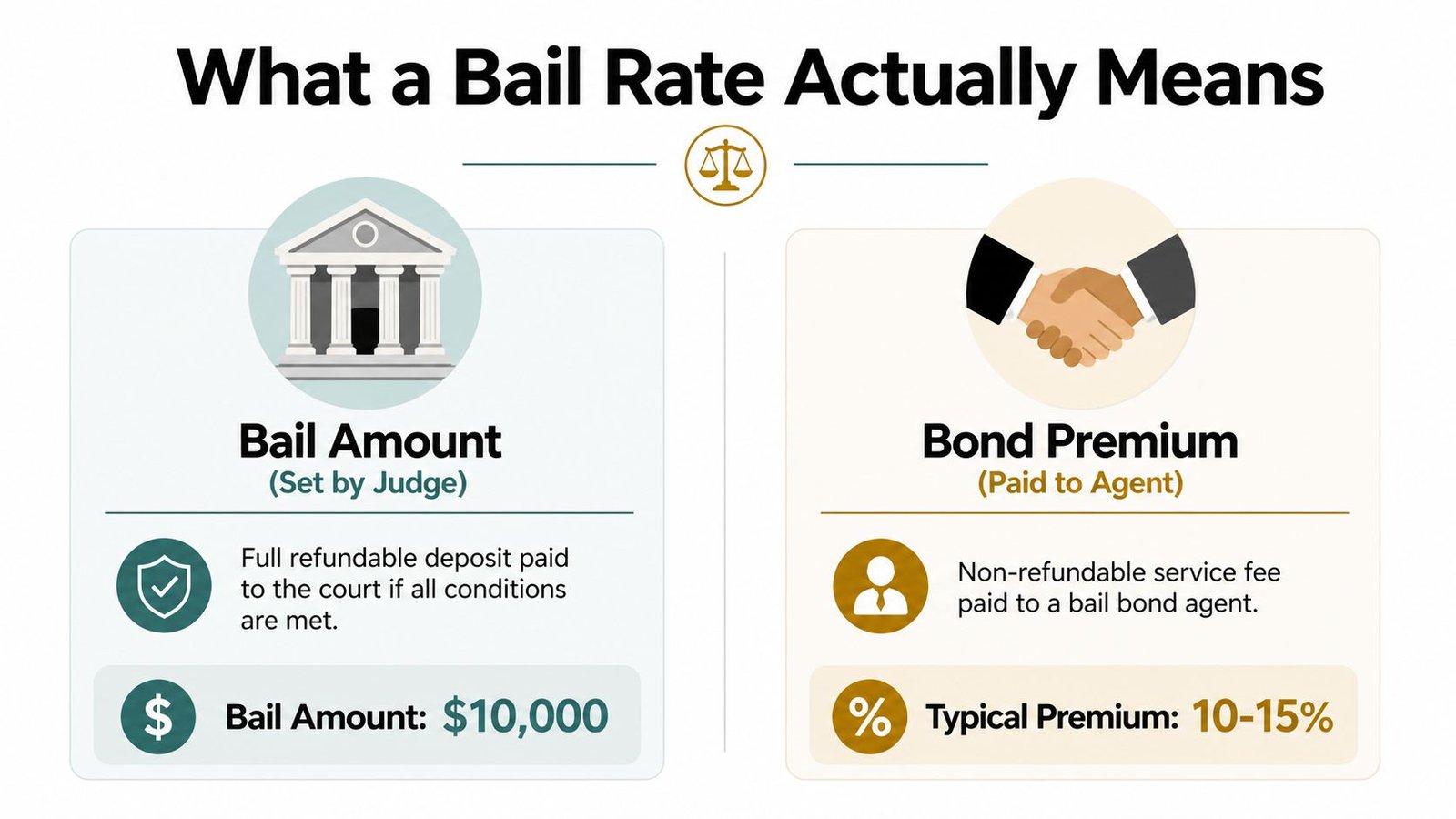
The bail amount is the amount the court sets as a condition of release. The bond premium is the fee paid to a licensed surety agent for furnishing a bond. The bail rate is the percentage used to calculate that premium. It applies to the service fee, not to the entire financial obligation in the same way.
Think of the court's bail amount as a refundable deposit, subject to the court's rules and the defendant's compliance. A surety premium is different. It's a non-refundable service fee paid for the agent's undertaking, generally earned when the defendant is released. The full bond amount becomes the central risk if the defendant fails to appear or violates the agreement, while the family's immediate out-of-pocket payment is usually the premium and any lawful disclosed charges.
Four terms that prevent expensive confusion
- Surety bond: A licensed agent posts a guarantee to the court on behalf of the defendant.
- Cash bond: The required amount is paid directly under the court or jail's cash-bond procedure. A surety agency may not handle every cash-only situation.
- Personal recognizance bond: The court releases the defendant based on a promise to appear, without requiring a financial surety premium.
- PR bond: This is commonly used as shorthand for personal recognizance.
Colorado caps a professional bail bond premium at the greater of $50 or 15% of the amount of bail furnished, according to the Colorado premium and charge rules. The same rule limits extra charges to specified items, such as court filing fees, actual collateral storage costs, or premium financing fees.
For a fuller explanation of the business side of premiums, review how bondsmen make money. The important point is simple: a 15% bail rate doesn't mean the family pays 15% of every possible cost, and it doesn't mean the court lowered the bond by 15%.
How Courts Decide the Headline Bail Amount
A judge or magistrate decides the headline bail amount by considering the charge, the defendant's background, the likelihood of appearing in court, and any public-safety concerns allowed under the applicable rules. The court, not the bondsman, controls that decision.
A misdemeanor DUI may receive different treatment from a felony assault allegation because the court is evaluating different alleged conduct and potential consequences. A drug-distribution case may raise different concerns from either example. The charge label matters, but it's only one part of the decision.
Factors that can move the amount
The court may examine:
- Prior failures to appear: A history of missing court can increase concern about future attendance.
- Previous convictions: The record can affect how the court evaluates risk and supervision.
- Open warrants: An unresolved warrant may signal that other proceedings need attention.
- Probation or parole status: A defendant under supervision may face additional conditions or holds.
- Local ties and stability: Address, employment, family connections, and community history can provide context.
- The facts alleged: The circumstances surrounding the arrest can matter more than the charge name alone.
Two people accused of the same offense can therefore receive different bond amounts. One may have no prior record and strong local ties. Another may have repeated missed court dates or an active supervision matter. Judicial discretion is why a family shouldn't assume that a friend's bond amount predicts its own case.
The following table is a decision worksheet, not a verified statewide schedule. Colorado bond ranges vary by county, charge facts, criminal history, and judicial order. Because the provided verified data doesn't establish reliable Colorado low-end or high-end ranges for these categories, no invented dollar ranges belong here.
| Charge Category | Low-End Bond Range | High-End Bond Range | Premium at 15% |
|---|---|---|---|
| Misdemeanor DUI | Varies by case and court | Varies by case and court | Calculated from the court-set amount |
| Felony assault | Varies by case and court | Varies by case and court | Calculated from the court-set amount |
| Drug distribution | Varies by case and court | Varies by case and court | Calculated from the court-set amount |
Once the court sets the headline amount, the premium math becomes straightforward. The family's next question is whether the standard capped rate applies or whether an approved co-signer can qualify for the lower pathway.
Colorado's 15% Premium and the 10% Cosigner Path
Suppose the court sets a $25,000 bond. At the Colorado statutory ceiling of 15%, the premium calculation is:
$25,000 × 0.15 = $3,750
That $3,750 is a non-refundable premium, not a deposit that automatically comes back when the criminal case ends. The court-set bond remains the amount secured by the surety undertaking. The family pays the premium to obtain that service, subject to the written contract and applicable law.
Colorado information also identifies a possible 10% premium for larger bonds when an approved co-signer is accepted. The lower rate isn't automatic. It depends on underwriting and on a co-signer who satisfies the agent's requirements. The Colorado statutory text on bonding-agent premiums is the place to review the legal framework, while the agent explains how approval works in the particular case.
What the co-signer contributes
A co-signer, sometimes called an indemnitor, takes contractual responsibility for the defendant's obligations under the bond agreement. An agent may request proof of identity, residence, employment, income, assets, contact information, and authority to provide collateral. The exact documents depend on the bond and the agency's underwriting process.
A stable job, established local ties, and limited prior court contact may help an application, but no agent can promise approval without reviewing the facts. The co-signer should understand that a lower upfront premium doesn't eliminate responsibility if the defendant fails to appear.
| Bond Amount | 15% Premium | 10% Premium | Savings |
|---|---|---|---|
| $25,000 | $3,750 | $2,500 | $1,250 |
Both figures in this example are non-refundable premium amounts. The difference is $1,250, but the 10% figure applies only if the agent accepts the co-signer and the bond qualifies. Ask for the rate, required collateral, payment terms, and every additional charge in writing. You can also review information about premium processing fees before committing to an agreement.
Reading the Fine Print on Extra Fees
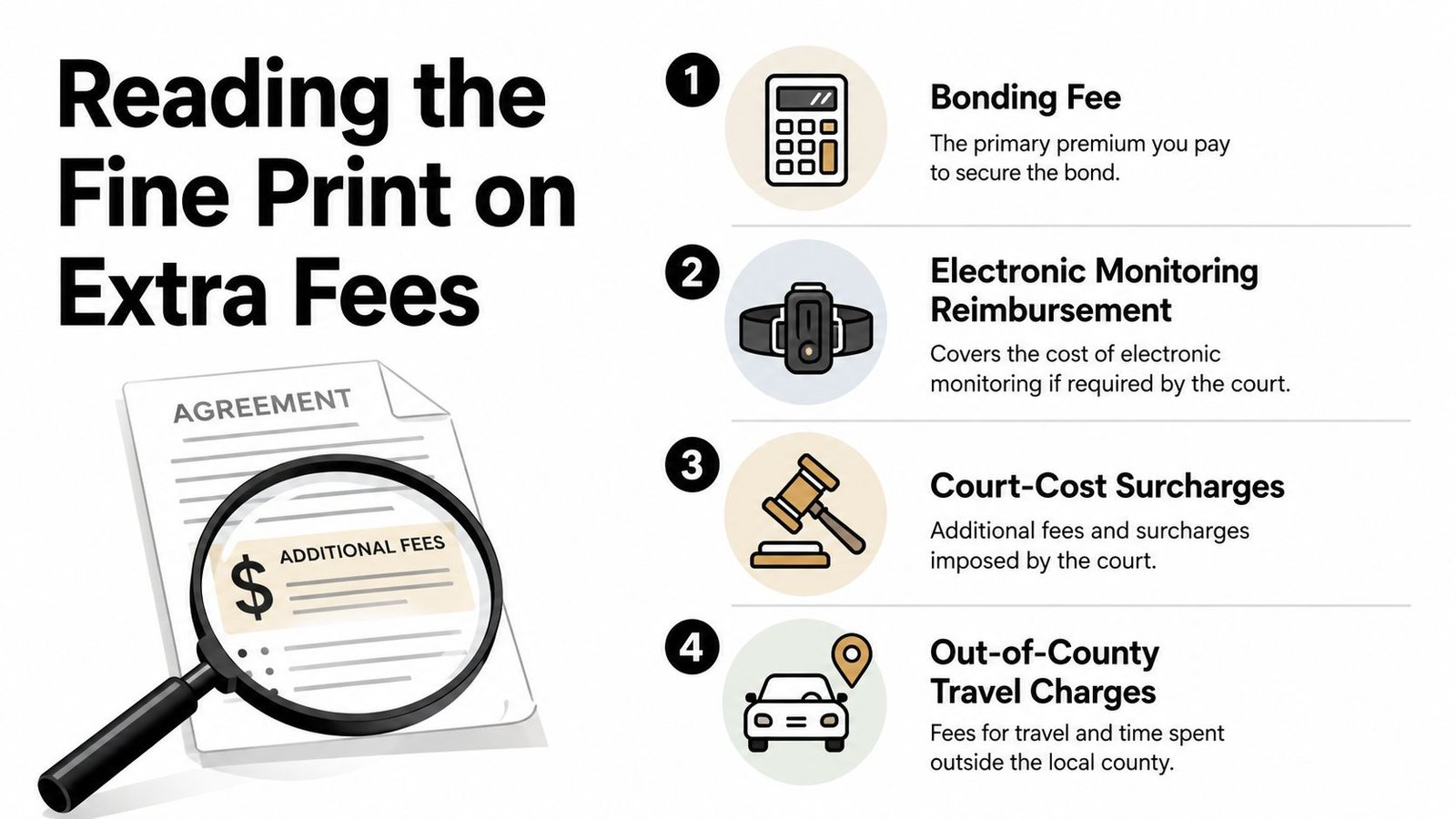
Colorado law doesn't treat every line on a bail invoice as interchangeable. The principal premium is the main charge, while certain additional expenses may be allowed when they fit the governing rules and are disclosed clearly. The verified Colorado information identifies court filing fees, actual collateral storage costs, and premium financing fees as examples of permitted extra charges.
That doesn't mean an agency can attach unexplained costs to every file. A family should ask what each line represents, why it applies, and whether it appears in the written contract.
How to read a sample invoice
| Invoice line | What to ask |
|---|---|
| Bonding fee | Is this the premium calculated from the court-set bond? |
| Electronic monitoring reimbursement | Is monitoring required by the court, and is this reimbursement supported by an actual cost? |
| Court-cost surcharge | What filing or administrative court expense does it cover? |
| Out-of-county travel charge | Why is travel needed, and how is the amount calculated? |
| Collateral storage cost | Is the charge tied to actual storage rather than a general markup? |
| Premium financing fee | Is the family financing the premium, and are the terms written clearly? |
The most useful warning signs are not a particular number. They're vague descriptions, pressure to sign without a copy, mandatory monitoring that no court has ordered, unclear collateral-release language, or a so-called processing charge with no explanation. A legitimate charge should have a purpose that the signer can understand.
Before signing, ask:
- Total due today: What amount must be paid before filing?
- Refund policy: Which amounts are non-refundable, and under what narrow circumstances could money return?
- Collateral: What is required, who holds it, and when can it be released?
- Missed court: What fees and duties arise if the defendant fails to appear?
- Written contract: Can I receive and review a complete copy first?
The Colorado bail bond contract guide can help families identify questions before they authorize a bond.
Why Higher Bail Rates Quietly Lock People Up
The headline bail amount strongly affects whether release is financially achievable. A major Bureau of Justice Statistics study of felony defendants in the 75 largest counties found that 62% of state-court felony defendants were released before case disposition between 1990 and 2004. The same study found that about 7 in 10 defendants were released when bail was under $5,000, while release fell to 1 in 10 when bail reached $100,000 or more. BJS data on felony defendants and pretrial release show how sharply the financial threshold can change the practical result.
The family may not need to produce the entire headline amount for a surety bond, but it still needs the premium and may need an approved indemnitor or collateral. A higher bond therefore creates a higher immediate barrier, especially for households with limited liquid cash or no access to a qualified co-signer.
The probability changes with the amount
| Bail Amount | Approx. 15% Premium | Estimated Release Rate | Detention Risk |
|---|---|---|---|
| Under $5,000 | Calculated from the court-set amount | About 7 in 10 | Lower than at higher bail levels |
| $5,000 to under $100,000 | Calculated from the court-set amount | Varies substantially by amount | Increases as the amount rises |
| $100,000 or more | Calculated from the court-set amount | About 1 in 10 | High |
A separate BJS summary found that only 18% of defendants secured release when bail was $20,000 or more, compared with 66% when bail was under $2,500, and 38% when bail was between $10,000 and $19,999. Those figures are reported in BJS pretrial release research.
The practical bottleneck is often the ability to satisfy the financial condition, not a clear judicial command that the person must remain jailed. Families looking at broader detention pressures can also review jail overcrowding solutions, but the immediate lesson is financial: a larger court-set amount usually means a larger premium threshold and a smaller chance that release can happen quickly.
From Phone Call to Release in a Few Hours
A Colorado release can involve several separate handoffs. The family's first call may happen before the jail has finished booking, so the agent may begin by confirming whether the defendant is in custody, whether a bond has been entered, and whether another agency has placed a hold.
The usual sequence
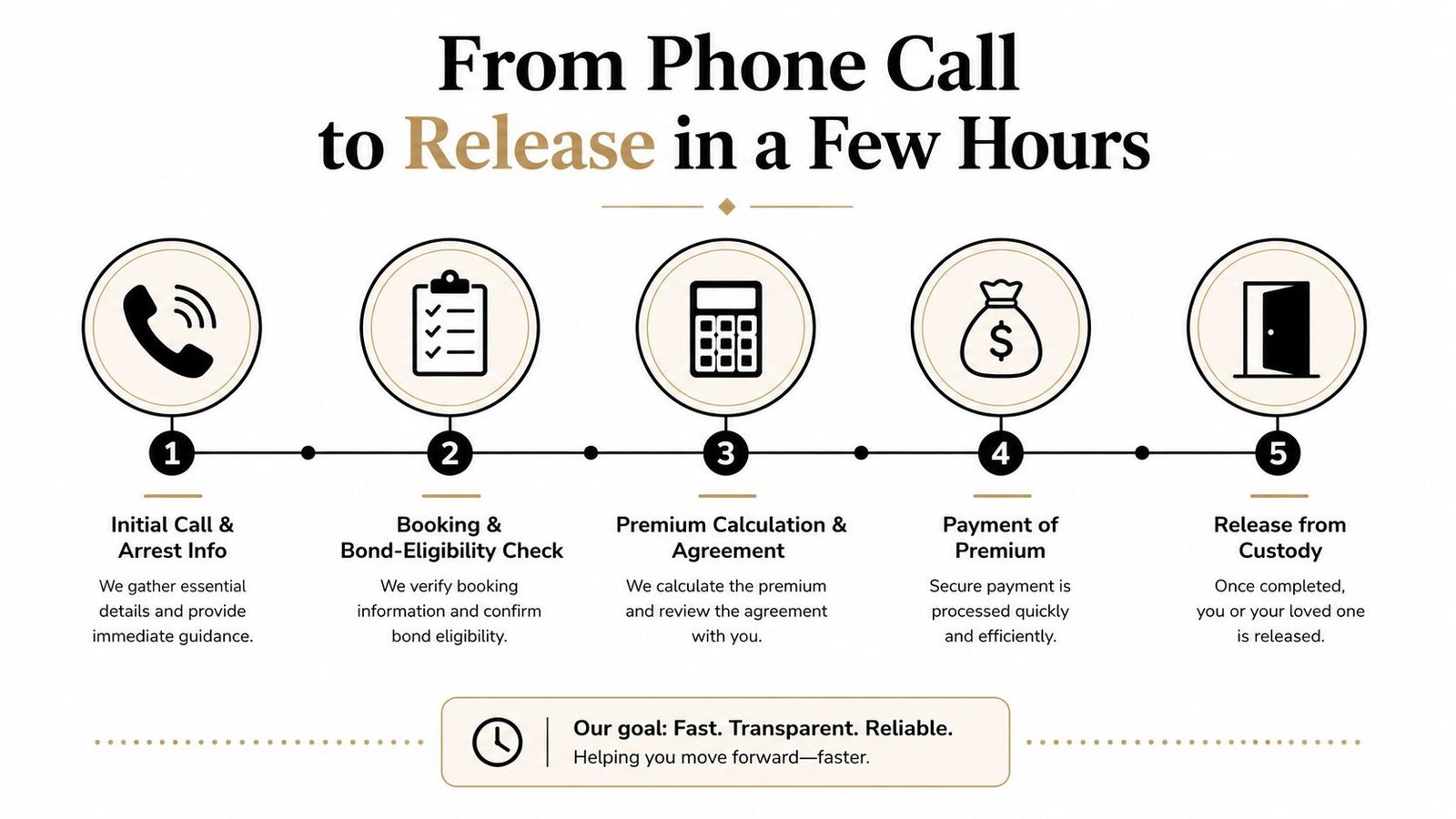
- Initial call and arrest information: The family provides the defendant's name, jail, booking details, charge, and contact information.
- Booking and bond-eligibility check: The jail confirms whether the person is processed and whether a bond can be posted.
- Premium calculation and agreement: The agent calculates the applicable premium, reviews the 15% rate or possible 10% co-signer pathway, and explains collateral and contract duties.
- Payment of premium: The signer pays the agreed amount and supplies requested documents.
- Bond filing and release processing: The agent files the bond with the appropriate authority, then the jail completes its own release steps.
The jail's release processing may take one to four hours after paperwork clears, but that timeframe is not guaranteed. After-hours filings, out-of-state signers, weekend court closures, incomplete booking information, and holds from another agency can extend the wait.
A clear explanation of the processing stage is available in how long bail takes to process. Families should ask whether the delay is with the bondsman, the court, or the jail, because each location controls a different part of the timeline.
This video offers another visual overview of the process:
The premium is generally earned when the defendant is released, regardless of the eventual case outcome. A family shouldn't assume that dismissal, acquittal, or a later reduction in charges automatically returns the premium. Separate rules can apply to narrow cash-bond refund situations, so ask the court or a qualified professional about the specific payment method before choosing it.
Smart Money Decisions Before You Sign Anything
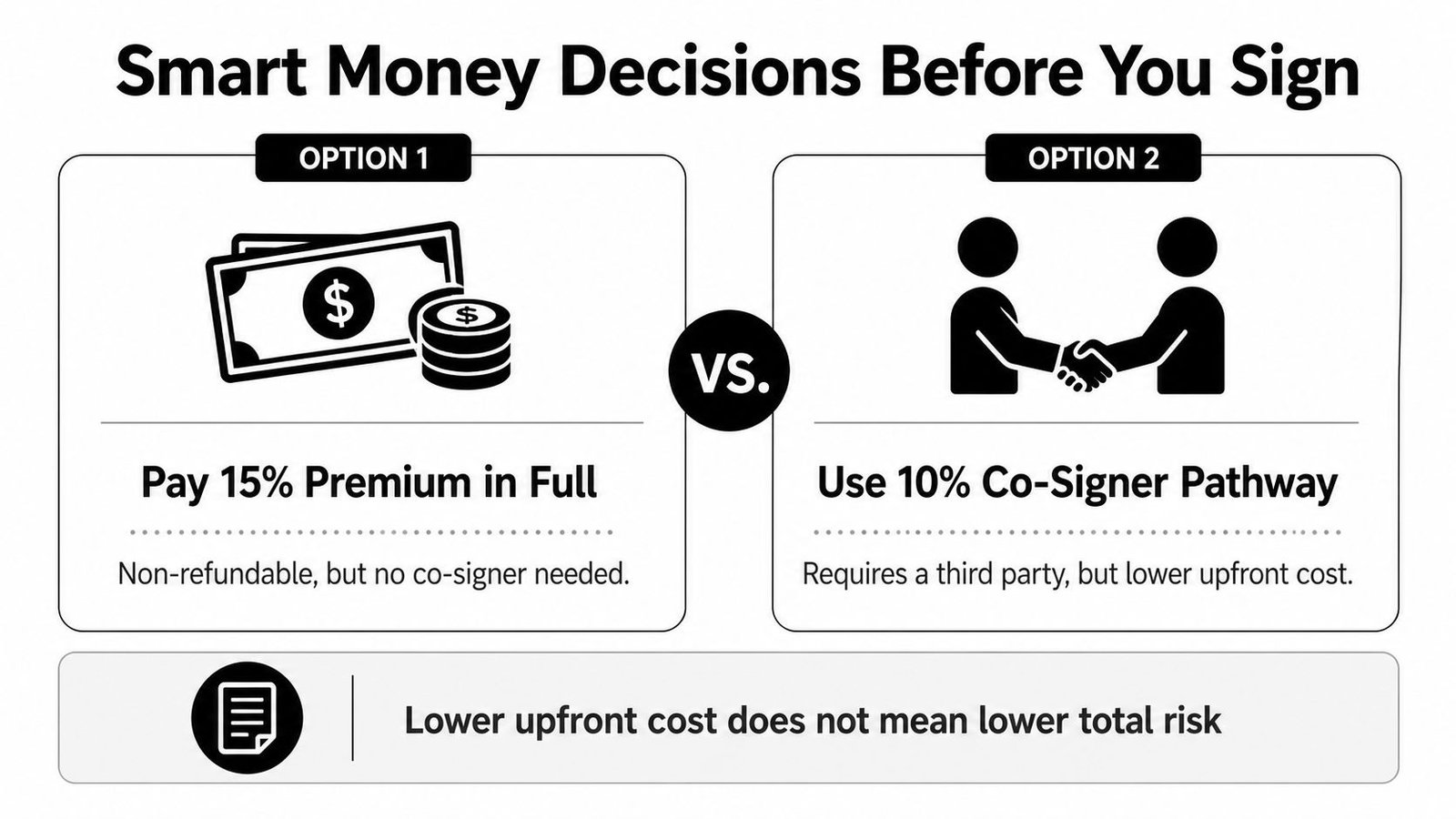
The cheapest immediate option isn't always the safest overall decision. Paying the full 15% premium may avoid finding a co-signer, while the 10% pathway can preserve more cash if an approved indemnitor is available. The lower rate also creates another responsible party who must understand the contract and the consequences of missed court.
A co-signer should review the agreement as carefully as the defendant. The agent may require collateral, and the contract may address reinstatement fees, surrender charges, or interest if the premium is financed. Those terms should be written in plain enough language that the signer can explain the financial exposure to another family member.
Compare the available paths
- Surety bond: The family pays a premium to a licensed agent, then follows the contract and court requirements.
- Direct cash bail: The payer deals directly with the court or jail under its cash-bond rules. This may involve different refund conditions and isn't the same as a surety premium.
- Collateral-only arrangement: A private arrangement may avoid a conventional premium, but it can place substantial property at risk and may not be available for every case.
- 10% co-signer pathway: An approved third party may reduce the upfront premium, but that person accepts contractual responsibility.
A common misconception is that part of the 15% premium is automatically refundable. It isn't. Another is that a bondsman can negotiate the underlying bail amount. The court sets that amount. An agent can explain available bond options, but changing the court's condition requires the appropriate legal or judicial process.
Before signing, confirm:
- License and identity: Verify that you're dealing with a Colorado-licensed surety agent or agency.
- Written rate: Request the exact premium percentage and calculation.
- Total charges: Ask for every fee, including financing, filing, storage, travel, and monitoring-related costs.
- Collateral terms: Identify what is pledged, who controls it, and how release works.
- Court obligations: Confirm the defendant's court dates and reporting requirements.
- Default consequences: Read what happens after a missed appearance, surrender, or revocation.
- Copies: Keep the signed contract, receipts, and payment records.
Express Bail Bonds provides Colorado surety-bond processing, electronic document handling, and guidance on premiums and court requirements for families seeking release. If you need to compare the 15% calculation with a possible co-signer rate, request a written quote and review the agreement before paying.
If someone you care about has been arrested in Colorado, Express Bail Bonds can explain the court-set bond, the applicable premium, co-signer requirements, and next paperwork steps. Contact the agency with the defendant's full name, booking location, and bond information so you can receive clear guidance before signing.