
About 16% of defendants are released on financial conditions, while 49% are released without financial conditions, so the “right” option may be a surety bond, cash, property, recognizance, unsecured, signature, monitored, or federal release arrangement. The court's order, your available resources, the court's risk assessment, and the conditions attached to release determine which path is available.
A family may learn about an arrest in Denver, Golden, or Centennial and immediately face unfamiliar terms on a Colorado release order. One document may mention a surety bond, while another case may involve cash, property, personal recognizance, or supervision instead. The phrase types of bail bonds often includes both bonds paid to the court and release options that require no upfront payment.
The practical differences come down to five questions: Who secures the obligation? What must the defendant or family risk? How quickly can release occur? Who approves the arrangement? What happens after a missed court date? Local Colorado procedures can also affect payment, documentation, collateral, and posting.
The court controls eligibility and release conditions. A qualified bail professional can explain the surety process, but neither a bonds agency nor a family member can replace the court's order or an attorney's legal advice. Express Bail Bonds is a Colorado agency serving detention facilities statewide, with support by phone, text, and online processing. The agency is available around the clock at 720-984-2245, helping families understand the surety process and next steps.
Understanding Surety Bail Bonds via Express Bail Bonds
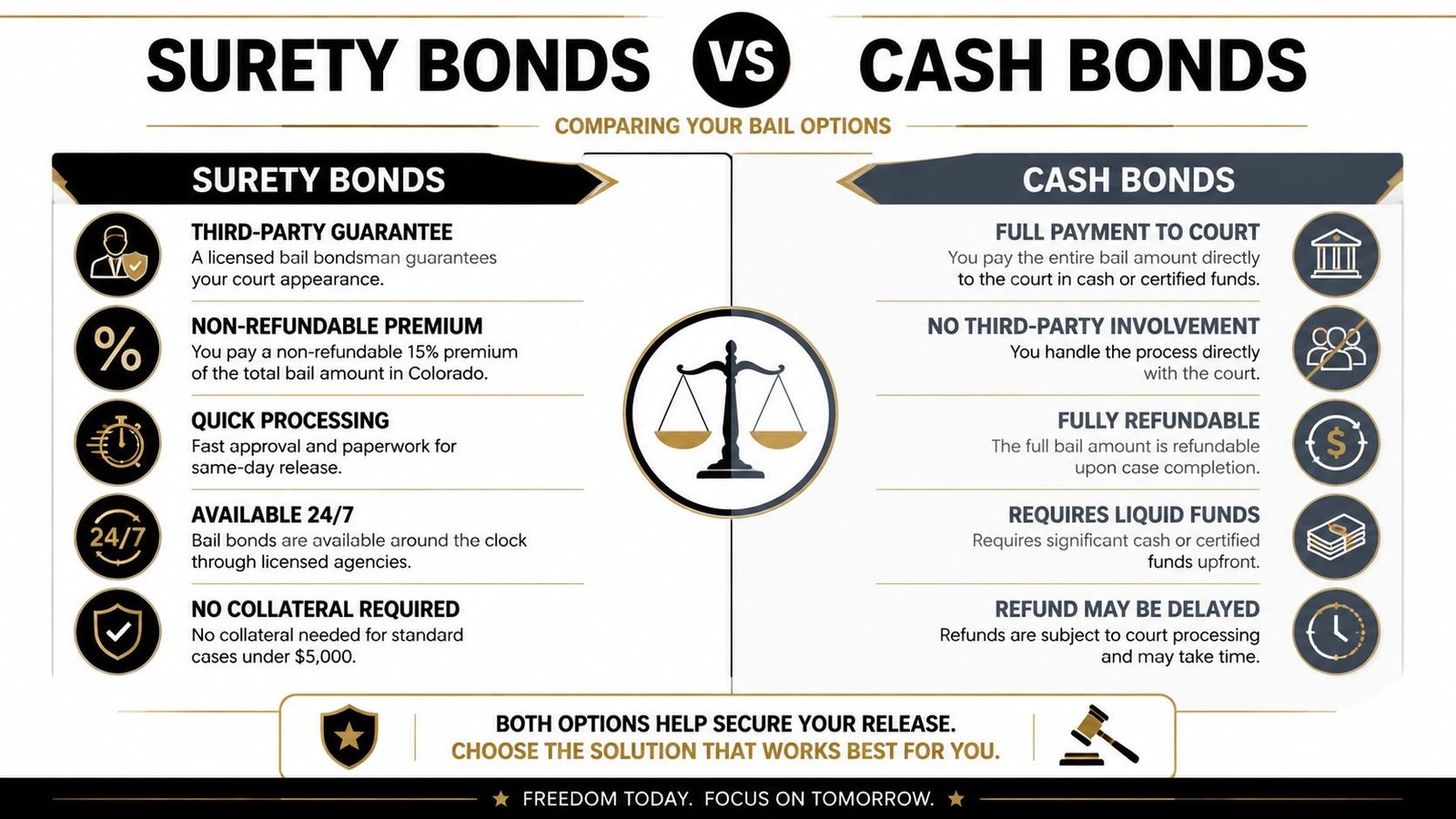
A surety bond places a licensed bail agency between the defendant and the court. The agency promises the court that the defendant will appear as ordered and can be required to pay the full bail amount if the defendant fails to appear. The defendant or cosigner usually pays a nonrefundable premium for that service, and the agency may also require collateral depending on the circumstances.
In many U.S. jurisdictions, the premium is about 10% of the bail amount according to this overview of bail in the United States. Colorado uses a specific statewide rule. The premium is capped at the greater of $50 or 15% of the amount of bail furnished under Colorado's bail-bond pricing statute. Express Bail Bonds states that Colorado's standard premium is 15%, and that approved cosigners may sometimes qualify for 10% on bonds over $5,000. Ask the agency to explain the actual charge before signing.
Practical rule: A premium is a service fee, not a deposit toward the court's bail amount.
A Denver family might call Express Bail Bonds at 720-984-2245 after a loved one's arrest. Out-of-state relatives may complete applications and contract documents electronically for a defendant held in Jefferson County or Centennial. The agency says its electronic process can support quick posting at most Colorado jails, but the jail and court still control the final release timing.
Have the defendant's booking number, charges, detention facility, and release amount ready. Read every condition, confirm who is responsible for the contract, and make sure the defendant understands all court dates and restrictions. For a direct comparison of the two arrangements, review surety bonds versus cash bonds.
2. Cash Bonds
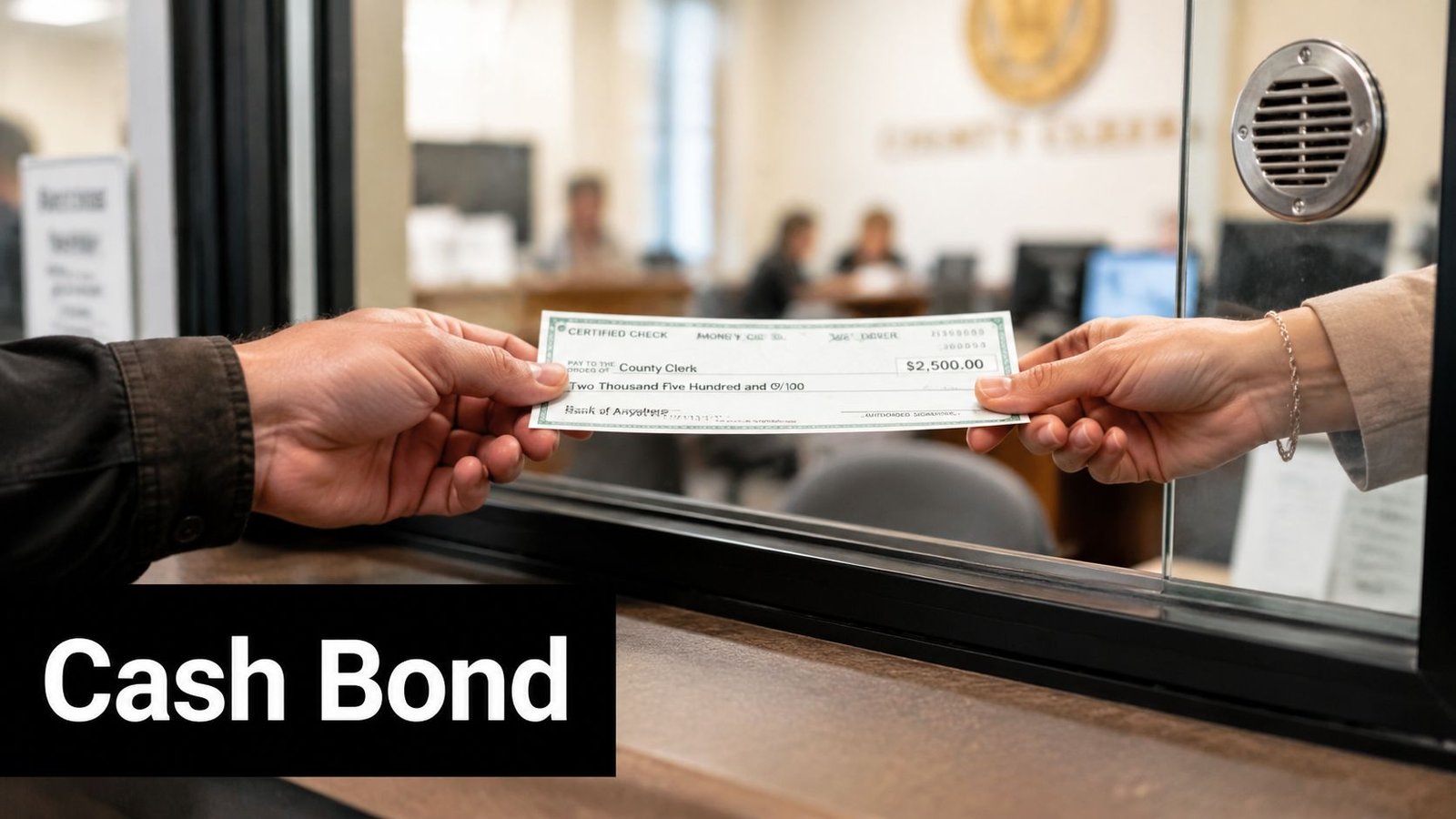
A cash bond requires the defendant or another person to provide the full bail amount directly to the court. No bail agency guarantees the obligation. The court holds the money as security for appearance, subject to the court's rules about refund, deductions, and case completion.
This option can fit someone with immediate access to liquid funds who wants to avoid a surety premium. A family with substantial savings might pay directly, while a professional or business owner might use available cash reserves. The trade-off is straightforward. The payer must commit the entire amount rather than paying a smaller premium to a surety agency, and those funds may remain unavailable until the court processes the case and any refund.
The explanation of cash-bond meaning can help distinguish the payment structure from a surety arrangement. A cash bond also isn't automatically faster. Court acceptance, jail procedures, payment verification, and release processing all affect timing.
Before paying the court
Confirm the required payment method with the relevant clerk or detention facility. The court may specify whether it accepts cash, certified funds, a money order, or another approved method. Don't assume a regular personal check or an electronic transfer will be accepted.
Keep the receipt and case reference information in a secure place. Refund processing can depend on the court's procedures and the resolution of the defendant's obligations, so the payer should ask where refund requests go and what documentation is required.
A person paying cash also assumes direct responsibility for tracking every hearing. If the defendant misses court, the court may take action against the bond under its rules. A cash payer should therefore treat the release order as an active obligation, not merely a financial transaction.
3. Property Bonds
A property bond uses real estate or another approved asset as security for the defendant's court appearance. Federal rules allow secured appearance bonds backed by real property, cash, a percentage deposit, a corporate surety, or a third-party cosigner. The court's focus is whether the proposed security is legally available, sufficient, and enforceable.
A homeowner might offer a residence, land, vacation property, or investment property. The court may review ownership records, title information, liens, mortgages, current value, and available equity. The person offering the asset must also have legal authority to pledge it.
The main risk is the asset itself. The court may place a lien or otherwise secure its interest, which can complicate a sale, refinance, or transfer while the bond remains active. If the defendant misses court and the bond is enforced, the property owner could face a substantial financial loss.
Prepare for a slower approval process
Property bonds often require more documentation than a routine surety application. A family should collect proof of ownership, current valuation information, and details about existing liens before asking the court to approve the arrangement. An attorney or real estate professional can explain possible title and lien consequences.
Property security can protect cash flow, but it puts an important asset at risk.
Property may seem practical when the family cannot provide cash, yet review and processing can take longer than a standard surety arrangement. The court decides whether the asset qualifies and what paperwork it requires. A Colorado bail agency can explain surety alternatives and how bail-bond collateral works, but it cannot approve the property or remove court requirements.
Before choosing this option, confirm who owns the property, whether another lender has a claim, and what happens if the defendant fails to appear. A lower immediate payment does not remove the appearance obligation.

4. Own Recognizance Release
Own recognizance, or OR release, doesn't require a cash payment, property pledge, or surety company. The defendant signs a promise to appear and agrees to follow the court's release conditions. The court relies on the defendant's personal commitment and its assessment of the person's likelihood of returning.
A defendant with stable housing, employment, family connections, community ties, and a limited record may be considered for this type of release. Those factors don't guarantee approval. The judge or authorized court process controls the decision, and the charge, history, safety concerns, and proposed conditions can all affect the result.
A college student facing a minor charge might point to enrollment, housing, and family support. A long-time employee with stable residence and no significant record might also be considered. In either situation, the defendant should discuss the possibility of OR release with a defense attorney rather than assume that no payment means no responsibility.
No premium doesn't mean no consequences
The guide to release on own recognizance explains why this arrangement differs from a commercial bond. The defendant still has to appear, comply with restrictions, and respond to court notices. A missed hearing can lead to a warrant, new release decisions, or other consequences.
Useful preparation includes:
- Document community ties: Gather employment, housing, school, family, or treatment information that the court may consider.
- Understand every condition: Ask the attorney or court representative to explain check-ins, travel limits, and required appearances.
- Create a reliable reminder system: Put each date on a calendar and arrange transportation before the hearing day.
- Stay reachable: Update the court and attorney if contact information changes.
OR release is not a softer version of a surety bond. It is a different court decision based on trust, assessment, and compliance.
5. Unsecured Bonds
An unsecured bond allows release without an upfront payment or pledged collateral. The defendant signs an agreement acknowledging an appearance obligation and may become responsible for the ordered amount if they fail to appear. No cash or property secures the agreement at the moment of release, but the financial exposure can arise after nonappearance.
This distinction matters because unsecured release isn't identical to OR release. OR release centers on a personal promise to appear without a stated secured financial pledge. An unsecured bond can include a financial obligation that remains uncollected unless the defendant violates the appearance requirement. The exact terms come from the court's order.
The Bureau of Justice Statistics reported that, among defendants released without financial conditions, 61% were released on unsecured bond and 30% on personal recognizance, as described in its pretrial release data. These figures help explain why unsecured and recognizance mechanisms are important parts of release practice, even though families often focus first on commercial surety bonds.
Treat the signature as a serious obligation
A defendant released on an unsecured bond should mark every hearing, maintain contact with counsel, and avoid conduct that could suggest an intention to flee. Family members can help by arranging reminders, transportation, and a consistent way to share court notices.
No money changes hands at release, but the defendant still has a real legal obligation.
The personal-bond explanation can help families compare unsecured arrangements with other no-upfront-payment options. If the defendant doesn't understand the order, they should ask their attorney or the court for clarification before relying on assumptions.
6. Signature Bonds
A signature bond is a signed court agreement promising that the defendant will appear and follow the release order. Depending on the specific arrangement, a cosigner or responsible adult may also sign, accept supervision duties, or agree to help the defendant remain compliant.
That cosigner role distinguishes many signature arrangements from a simple personal recognizance release. A parent may sign for a juvenile, while a family member, employer, mentor, or caregiver may provide accountability for an adult defendant. The responsible person should understand exactly what they are signing before accepting the role.
Signature bonds can make sense when the court wants a person in the defendant's life to help support compliance. The arrangement may include check-ins, communication expectations, or other conditions. A cosigner shouldn't treat the document as a formality. If the defendant fails to appear or violates the order, the cosigner may face consequences specified in the agreement or imposed by the court.
Choose accountability carefully
A suitable cosigner should be reliable, reachable, and capable of maintaining honest communication. The defendant and cosigner should write down court dates, transportation plans, contact information, and any restrictions. They should also agree on what happens if the defendant receives a new notice or cannot attend a required appointment.
The court remains in control. A cosigner can't privately change a condition, excuse a missed appearance, or guarantee that the defendant won't be detained again. Questions about the legal effect of the signature belong with the defense attorney or the court.
For families, the main trade-off is personal responsibility. The defendant may avoid an upfront financial payment, but the cosigner accepts a role that requires attention, communication, and a clear understanding of potential consequences.
7. Conditional Release with Monitoring
Conditional release with monitoring uses supervision instead of, or alongside, financial security. The court may order electronic monitoring, regular check-ins, drug testing, treatment, travel limits, or other conditions. Pretrial services, probation, or a private provider may oversee compliance.
This option fits cases where release is possible but ordinary recognizance or an unsecured agreement provides too little structure. For example, a defendant in a DUI case may wear an alcohol-monitoring device. Someone facing a nonviolent charge may have GPS restrictions and scheduled check-ins, while a drug-related case may require treatment and testing.
Data from other states shows that supervision-based releases can rise significantly after policy changes, even when financial bail declines. That comparison does not establish Colorado results, because each court system sets its own procedures.
In Colorado, a county pretrial services program may require scheduled office or telephone check-ins, testing, or location restrictions as conditions of release. The judge's order controls the details. A Colorado surety agency may help when the court requires a commercial surety bond, but a monitoring condition does not automatically create a bond that an agency can post.
Build the release plan around compliance
Monitoring can affect employment, transportation, family care, treatment, and travel. Before accepting release, the defendant should confirm who operates the device, when check-ins occur, which areas are restricted, and whom to contact if equipment fails or circumstances change.
Keep records of check-ins, testing, treatment attendance, and communications with the supervising officer. Ignoring an alert or missing an appointment can lead to re-arrest or a new bail decision. Report technical problems and unavoidable conflicts immediately.
The court's conditions remain binding even when no premium is charged. Supervision may reduce the need for secured commercial bail, but it replaces an upfront financial risk with daily duties. The defendant should read every condition, plan transportation, and attend every required court appearance.
8. Federal Bail Bonds
Federal bail bonds apply to defendants prosecuted in federal court rather than ordinary state or county cases. Allegations may involve drug trafficking, weapons violations, bank fraud, tax offenses, or interstate conduct. The release process depends on the charge and the U.S. District Court handling the case.
Federal courts may approve secured appearance arrangements using cash, a percentage deposit, a corporate surety, a third-party cosigner, or real property. The court decides whether release is allowed, what security it will accept, and which conditions apply.
For example, a white-collar defendant may need to coordinate release through federal counsel and a federal detention facility. Someone charged in a federal drug case may face travel limits, reporting duties, monitoring, or other conditions. Before contacting a bonding provider, the family should gather the federal case number, exact charges, detention location, and attorney's instructions.
Confirm the court before choosing a provider
Federal release operates under a separate set of rules and procedures from Colorado county bail practices. Documents, approval steps, court personnel, and conditions may differ. A local surety agency can explain whether it handles the relevant federal arrangement, while defense counsel coordinates the legal strategy.
The court controls the release plan. Do not rely on state-court assumptions about payment, collateral, timing, or supervision. Ask which official can approve release, what security the court requires, how quickly documents can be reviewed, and how the defendant must report after leaving custody.
A Colorado surety agency may help only when the federal court permits a commercial surety arrangement. Other cases may depend on cash, property, a cosigner, or court-ordered conditions instead. The right provider starts with the federal court's order, not the label attached to the charge.
Bail Bond Types: 8-Point Comparison
| Type | Implementation complexity 🔄 | Resource requirements ⚡ | Expected outcomes ⭐📊 | Ideal use cases 📋 | Key advantages 💡 |
|---|---|---|---|---|---|
| Surety Bonds | Moderate, licensed bail agent, paperwork & underwriting | Low upfront cash for defendant; non‑refundable premium (~15% CO) | ⭐ High, typically fast release; surety guarantees appearance | Defendants without cash who need quick release | Fast processing, professional guidance, flexible payment |
| Cash Bonds | Low, direct payment to court; simple admin | High liquidity required, full bail in cash/certified funds | ⭐ Refundable if compliant (minus fees); refund delay possible | Wealthy defendants or those preferring no bondsman fees | Full refund potential; no premium; direct court control |
| Property Bonds | High, appraisal, lien filing, court approval | Significant equity and title documentation; longer processing | ⭐ Moderate, can cover large bail but slower release | Homeowners with sufficient equity for high bail amounts | Avoids cash/premium; uses existing assets; ownership retained |
| Own Recognizance (OR) Release | Minimal, judicial discretion based on risk/ties | No financial resources required; proof of community ties helpful | ⭐ High for eligible defendants, immediate, no‑cost release | Low‑risk, first‑time or minor‑offense defendants | No financial burden; fastest option; reduces incarceration |
| Unsecured Bonds | Low, court agreement, no collateral or surety | No upfront funds; defendant personally liable for full amount if no‑show | ⭐ Conditional, immediate release but high personal liability | Low‑risk defendants with stable ties and employment | No fees or surety; immediate release for approved cases |
| Signature Bonds | Low–Moderate, requires cosigner and signed agreement | No cash typically; cosigner assumes financial/legal responsibility | ⭐ Good, supervised release with cosigner accountability | Juveniles, defendants needing supervision or family oversight | Adds accountability via trusted cosigner; minimal immediate cost |
| Conditional Release with Monitoring | Moderate–High, tech setup, supervision protocols | Ongoing monitoring costs, agency supervision, device installation | ⭐ High compliance potential; release without full bail | Moderate‑risk defendants needing GPS, drug testing, curfews | Balances release and public safety; enables work/family continuity |
| Federal Bail Bonds | High, federal rules, stricter underwriting & procedures | Higher premiums; specialized federal bondsmen; complex paperwork | ⭐ Variable, possible release but stricter conditions & costs | Defendants charged with federal offenses in U.S. District Court | Specialized federal expertise; navigation of federal requirements |
Match the Bond to the Court's Order
The eight options differ most clearly by who provides security, what the family risks, and what the defendant must do after release. A surety bond trades a premium for professional assistance and a promise from the agency to the court. A cash bond requires the full amount to be paid directly to the court. A property bond ties up real estate or another approved asset.
OR and unsecured releases may require no upfront payment, but they aren't interchangeable. OR release rests on the defendant's personal promise, while an unsecured bond can create a financial obligation if the defendant fails to appear. A signature bond may involve a cosigner who accepts a separate accountability role. Monitored release adds supervision, testing, electronic monitoring, treatment, or travel restrictions. Federal cases follow a separate court process and should be handled with federal counsel and the appropriate court or detention facility.
Policy changes can alter the balance between release types and detention. For example, federal data reported that pretrial detention without bail increased from less than 2% before the Bail Reform Act of 1984 to 19% after the Act, as described in the Bureau of Justice Statistics report on the Act. New York's analysis reported that release rose from 74% to 83% of criminal cases not resolved at arraignment from 2019 to 2020, while bail-setting fell from 24% to 15%. These figures come from different systems and aren't predictions for an individual Colorado case. They show why the governing court order matters more than a general internet list.
A practical Colorado checklist
- Identify the facility: Confirm whether the defendant is held in a Denver, Jefferson County, Centennial, or another Colorado detention facility.
- Gather booking information: Have the booking number, legal name, charges, and court information ready.
- Confirm the ordered release type: Ask whether the order permits surety, cash, property, unsecured, recognizance, or monitored release.
- Ask about requirements: Confirm the premium, payment method, collateral, cosigner responsibilities, monitoring conditions, and required documents.
- Record every obligation: Save court dates, check-ins, testing appointments, travel restrictions, and attorney instructions in more than one place.
Express Bail Bonds serves Colorado detention facilities statewide and focuses on surety solutions rather than cash-only bonds. Families and out-of-state cosigners can ask about phone, text, and electronic processing, while attorneys can coordinate release information with the agency. For local guidance, see Jefferson County and Golden bail bonds and Centennial bail bonds.
If someone you care about has been arrested, call Express Bail Bonds at 720-984-2245 or visit the agency's website. Have the facility and booking information ready, ask the court or attorney to confirm the release order, and don't sign a bond agreement until you understand its financial and appearance obligations.
Express Bail Bonds offers Colorado families 24/7 phone, text, and online support for surety-bond applications, electronic contracts, payment coordination, and questions about the next steps. If you need help comparing a surety arrangement with the release type ordered by the court, contact Express Bail Bonds and provide the defendant's booking details.