
When a loved one gets arrested, the first question on everyone's mind is always the same: how much is this going to cost?
The good news is, you don't have to pay the full bail amount. Instead, you pay a non-refundable fee to a bail bond agent. In Colorado, this is typically 15% of the total bail. This fee is what secures a fast release without you having to come up with the entire cash amount the court has set. If you need help now, don't hesitate to call or text Express Bail Bonds at 720-984-2245 for a free consultation.
Understanding the True Cost of Bail in Colorado
Seeing a huge bail amount set by a judge can feel like a punch to the gut. But a surety bond from a professional agency like ours makes the whole process much more manageable.
Think of it like a down payment. If the judge sets bail at $10,000, you don't need to scramble to find $10,000 in cash. You simply pay a bail bond agent, like Express Bail Bonds, a $1,500 fee (15%), and we guarantee the full $10,000 to the court.
This system is a lifeline for so many families. The median bail for felony charges has hit $10,000, a nearly impossible sum for most people to pay out of pocket. That financial gap is exactly why bail bond services are so critical. We bridge that gap, making a fast release affordable.
This diagram shows you the direct comparison between the total bail amount and the much smaller fee you actually pay.
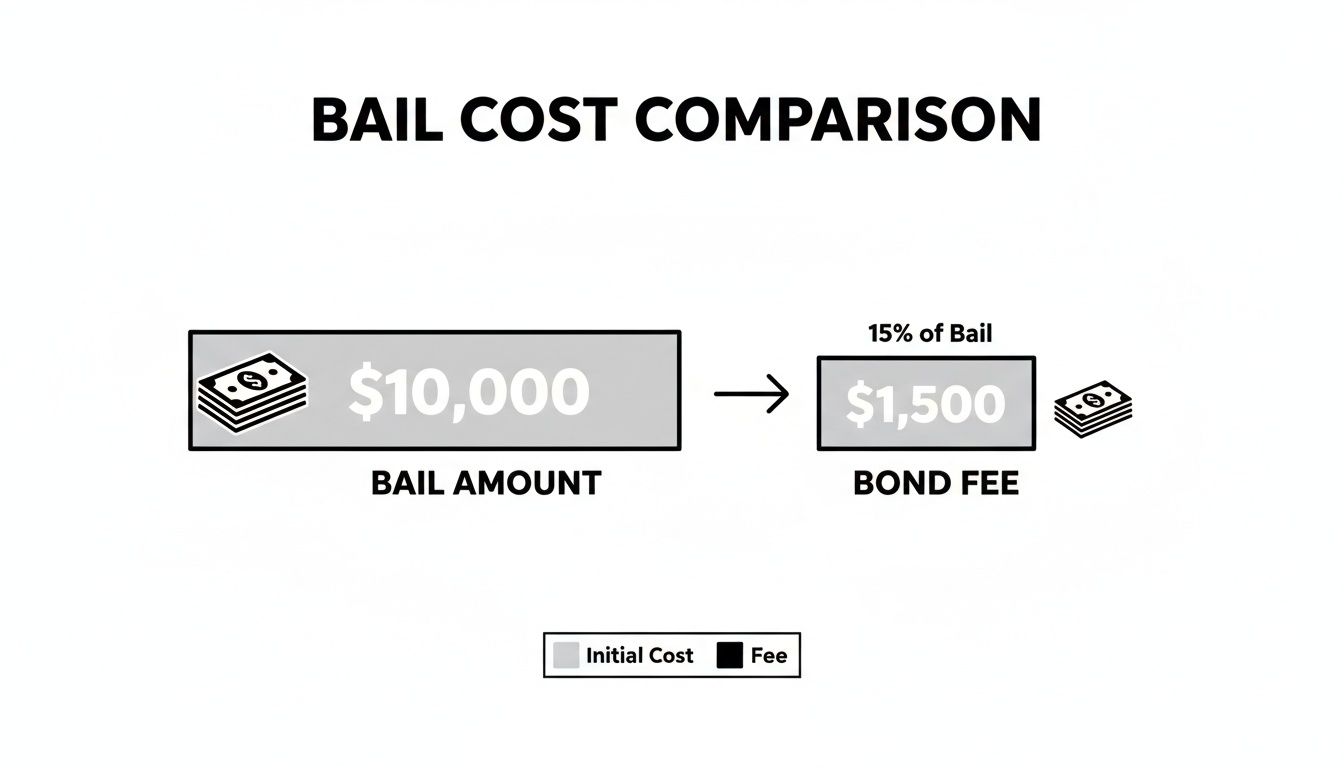
The bottom line is that a professional bail bond service immediately reduces your financial burden by 85%.
Potential Savings on Higher Bail Amounts
For bail amounts set at $5,000 or more, there’s often a chance for significant savings. With a qualified co-signer, Express Bail Bonds can frequently secure a reduced premium of just 10%. This can make a huge difference in your out-of-pocket costs.
When you're figuring out the finances, it's smart to look at all the related expenses, a bit like the concept of Total Cost of Ownership, to get the full picture. Our team is here to help you understand every cost and see if you qualify for any discounts.
At Express Bail Bonds, we believe in being completely upfront. Our experienced agents will walk you through all the costs, explain your options, and find the most affordable way to move forward. Contact us today to see how we can help.
The table below gives you a clear idea of what to expect for different bail amounts.
Sample Bail Bond Costs in Colorado
This table shows the non-refundable fee you would pay to us for various bail amounts, comparing the standard 15% rate with the potential 10% rate for those who qualify.
| Total Bail Amount Set by Court | Bail Bond Fee at 15% (Standard) | Bail Bond Fee at 10% (If Qualified) |
|---|---|---|
| $1,000 | $150 | $150 (15% is standard under $5k) |
| $2,500 | $375 | $375 (15% is standard under $5k) |
| $5,000 | $750 | $500 |
| $10,000 | $1,500 | $1,000 |
| $25,000 | $3,750 | $2,500 |
| $50,000 | $7,500 | $5,000 |
As you can see, the savings can be substantial on larger bonds if you have a strong co-signer.
Trying to navigate this process alone is confusing and stressful. Let us provide the clarity and support you need to get through this.
For immediate, 24/7 help, call or text Express Bail Bonds now at 720-984-2245.
How Judges Determine the Bail Amount
When a judge sets a bail amount, they aren't just picking a number out of thin air. The whole process is a careful balancing act, with one primary goal: making sure the defendant shows up for all their required court dates. The final dollar amount is a financial guarantee—a promise that the person will see their case through to the end.
This is exactly why two people facing almost identical charges can walk away with drastically different bail amounts. The final number is highly personalized, reflecting the unique circumstances of both the alleged crime and the individual involved.

A judge’s decision is shaped by a very specific set of factors designed to predict a defendant's behavior. If you want to get a sense of how much bail might cost in your situation, you have to understand these core elements. Our team at Express Bail Bonds can provide a free, confidential consultation based on your specific case.
Key Factors Influencing Bail Decisions
At the end of the day, judges are trying to weigh two main things: the likelihood the person will flee (flight risk) and the potential danger they pose to the community (public safety).
To figure that out, they look at several key pieces of information:
- Severity of the Alleged Crime: More serious charges, especially violent felonies, almost always mean higher bail. The more severe the potential penalties, the greater the incentive for someone to skip town and avoid trial.
- Defendant's Criminal History: A track record of prior convictions is a major red flag for a judge. If that history includes failing to appear in court, you can bet the judge will set a higher bail to ensure it doesn’t happen again.
- Ties to the Community: Strong local connections are a huge plus. Things like holding a steady job, owning a home, or having family nearby all suggest a person is less likely to flee. This can often lead to a more reasonable bail amount.
Think of it like a lender sizing up someone for a loan. A stable history and deep roots in the community make someone a much safer bet.
The Role of Bias in Bail Setting
While the process is supposed to be objective, research has shown that personal and systemic biases can unfortunately play a big role in the outcome. Study after study has demonstrated that judges often set higher bail amounts for Black defendants compared to white defendants charged with very similar offenses.
In one comprehensive study, Black defendants were 3.6% more likely to be assigned bail, and when it was imposed, the amounts averaged $7,280 higher than those for their white counterparts. This disparity feeds a cycle where nonrefundable fees create permanent economic losses in communities of color, even when charges are later dropped.
This is a tough reality of the system, highlighting how implicit biases can affect how much bail costs and create an unequal financial burden. You can read the full research about these bail disparities to get a deeper understanding of the issue.
When you're navigating this process, having an expert guide who knows the system inside and out is invaluable. The experienced agents at Express Bail Bonds can help you make sense of the court's decision and find the most affordable path forward. Call or text us 24/7 at 720-984-2245 for immediate, confidential assistance.
Choosing Between a Cash Bail and a Surety Bond
Once a judge sets the bail amount, you’ve reached a fork in the road. There are two primary ways to post bail, and the path you choose will have a major impact on your finances and how quickly you can get your loved one home.
The decision really boils down to how much cash you need to come up with right now. If you're unsure which path is best, our agents can provide clear, no-obligation advice. Call us at 720-984-2245.
Paying a Cash Bail
The first option is what’s known as a cash bail. This route is exactly what it sounds like—you pay the entire bail amount directly to the court, in cash. If the judge sets bail at $20,000, you would have to hand over $20,000 to the jail or courthouse to secure a release.
The main upside here is pretty clear: you get the money back. As long as the defendant shows up for every single court appearance and follows all the rules, the court returns the full amount after the case is over.
But the downside is just as obvious. Very few families have that kind of money sitting in a bank account, ready to go. It often means draining savings accounts, selling assets, or scrambling to borrow from relatives during an already incredibly stressful time.
The Surety Bond: A More Accessible Solution
This is where the second option, a surety bond, becomes a lifeline for most people. Instead of trying to come up with the full bail amount yourself, you work with a licensed bail bonds agency like Express Bail Bonds. A surety bond is basically a formal promise between you, our agency, and the court.
You pay us a much smaller, non-refundable fee—that 10-15% premium we talked about earlier. In return, we post a bond with the court that guarantees the full bail amount.
Using that same $20,000 bail, you would pay our agency a premium of $3,000 (at 15%). We then take on the financial responsibility for the entire $20,000 if the defendant doesn't make it to court.
You can think of a surety bond as an insurance policy for the court. The non-refundable premium you pay is the fee for our agency to take on the massive financial risk of the full bail amount on your behalf.
This approach makes getting someone out of jail far more affordable and realistic. It keeps you from having to liquidate your assets or empty your bank account when your focus should be on your family. For those who need to act fast, you can learn more about our simple and secure process for obtaining online bail bonds from anywhere in Colorado.
This table breaks down the core differences at a glance:
| Feature | Cash Bail (Paid to Court) | Surety Bond (Paid to Agent) |
|---|---|---|
| Upfront Cost | 100% of the total bail amount | A 10-15% non-refundable premium |
| Refundable? | Yes, if all court dates are met | No, the premium is the service fee |
| Financial Risk | You risk losing the entire bail amount | The bail agency assumes the risk |
| Best For | Individuals with significant liquid assets | Most families needing an affordable option |
For the vast majority of families we work with, a surety bond is the only practical and immediate solution. It closes the financial gap and lets you focus on what really matters: supporting your loved one.
If you have questions about which option is right for your situation, our team is available 24/7 to provide clear, honest advice. Call or text Express Bail Bonds at 720-984-2245 for immediate help.
Our Fast and Simple Bail Bond Process
When you get that call—the one saying a loved one is in jail—your world can feel like it's spinning out of control. It's a chaotic, overwhelming moment, and the last thing you need is a confusing process to get them home. At Express Bail Bonds, we’ve cut through the noise to create a straightforward path to get your family member released as quickly as possible.
We designed our entire system to be fast and stress-free so you can focus on what really matters: your family.

It all starts with a single phone call or text. When you reach out to our 24/7 helpline at 720-984-2245, you’re instantly connected to a real, experienced bail agent who is ready to jump into action. No automated menus, no long holds—just a person who understands exactly what you're going through and knows how to help.
Our Simple Steps to a Fast Release
Once we’re on the line, we get to work right away. Our entire goal is to handle everything for you, letting you stay in the comfort and privacy of your own home. You won't have to make a late-night drive to a jail or come to an office to get the ball rolling.
Here’s a quick look at what you can expect:
- Initial Call and Info Gathering: We'll start by asking for some basic information, like the defendant's name and which jail they're in. From there, we immediately contact the facility to verify the exact bail amount and any conditions the court has set.
- Electronic Paperwork: We handle all the necessary documents electronically. You can review and sign everything right from your smartphone, tablet, or computer, which shaves critical time off the process.
- Flexible Payment Options: We’ll walk you through the most affordable payment options, including any potential discounts you might qualify for. We accept various payment methods to make things as simple as possible.
Our remote process is built entirely around your convenience. By removing the need for you to travel, we can start working on the release the second you call, dramatically speeding up the entire timeline.
Posting the Bond and Securing Release
As soon as the paperwork and payment are squared away, our work is far from over. An Express Bail Bonds agent will head directly to the detention center to post the bond in person. We have agents positioned to serve every single jail in Colorado, guaranteeing a rapid response no matter where your loved one is being held.
Once the jail staff processes our bond, your family member is released. The exact release time can vary depending on how busy the facility is, but our direct, in-person action ensures it happens as quickly as the system allows. You can learn more about the specifics in our guide on how to bail someone out of jail in Colorado.
Don't spend another minute wondering what to do next. Take the first step toward bringing your loved one home. Call or text Express Bail Bonds at 720-984-2245 now.
When a Bail Bond May Not Be Needed
While a surety bond is often the fastest and most affordable way to get someone out of jail, it’s good to know that it isn't always the only path. For some situations, especially with minor offenses, a judge might decide that a financial guarantee simply isn't necessary. This is where a few alternatives to traditional bail bonds come into the picture.
Understanding these other options gives you a fuller perspective on the pretrial system. They aren't granted in every case, of course, but knowing they exist helps you see the full range of possibilities.

Release on Recognizance and Other Options
The most common alternative is called a Release on Recognizance (ROR), which you might still hear referred to as a Personal Recognizance (PR) Bond. You can think of it as a release based purely on trust. Instead of putting up money, the judge releases the defendant on their written promise to show up for all future court dates.
This option is typically reserved for people who check certain boxes:
- They are charged with a minor, non-violent offense.
- They have strong ties to the community, like a steady job or family living nearby.
- They are considered a low flight risk and have little to no criminal history.
Another possibility is a citation release. This usually happens right on the spot for very minor infractions. Instead of making an arrest, an officer just issues a ticket with a court date. Both ROR and citation releases let someone avoid jail time and the need for any kind of bail payment.
The Value of Bail Alternatives
These alternatives are more than just convenient; they have a real, positive impact on the justice system and the taxpayers who fund it. When states explore options beyond just cash bail, they can lower their jail populations and save a tremendous amount of money without risking public safety.
For example, recent bail reform in New York has resulted in about 3,000 fewer people being held in jail before their trial on any given day. This shift has created annual savings of over $247 million for taxpayers. These kinds of outcomes prove that smart alternatives can cut incarceration costs while still upholding the principle of "innocent until proven guilty." You can discover more insights about these bail reform findings and their effects.
While these alternatives are ideal, they are granted entirely at a judge's discretion. For more serious charges or in cases with other complicating factors, a surety bond from a professional agency remains the most reliable path to securing a release.
These options show that there are many factors that influence pretrial release beyond just the cost of bail. However, when a judge does set a bail amount, a professional bail bond is often essential. If you find yourself in a situation where these alternatives aren't on the table, call or text Express Bail Bonds at 720-984-2245 for immediate help.
Your Responsibilities After Posting Bail
Getting that call saying your loved one is out of jail is a huge moment of relief. But it's important to understand that posting their bail isn't the final step—it's the beginning of a new phase with its own set of rules.
Think of it as a formal agreement. When you post bail, you're entering into a contract with both the court and the bail bond agency. This creates specific responsibilities for the person who was released and for you, the person who co-signed for them. Following through on these obligations is the key to keeping the bond active and protecting the money and trust you've put on the line.
The Defendant's Core Duties
Once they're released, the defendant has two jobs that are absolutely non-negotiable. The court system takes these duties incredibly seriously, and dropping the ball has major consequences.
- Attend All Court Dates: This is the big one. The defendant has to show up for every single scheduled court hearing. Not just show up, but be on time and ready to go.
- Comply with Release Conditions: The judge often sets ground rules for the release. These might include things like no-contact orders, staying within a certain county, or attending specific classes or counseling. The defendant must follow every one of these rules to the letter.
A good way to look at it is that posting bail is like making a promise. The defendant promises to see the legal process all the way through, and the co-signer promises to make sure they do it. If that promise gets broken, things get serious for everyone involved, and fast.
The Co-signer's Role and Financial Risk
As the co-signer, you're the financial backbone of this agreement. Your main job is to do everything you can to ensure the defendant meets all their legal obligations, especially making it to court.
If the defendant misses a court date, the bond is forfeited. That means you are suddenly on the hook for the full bail amount. This isn't just a small penalty—it's a massive financial commitment that can be financially devastating. To get a clearer picture of just how serious this is, take a look at our guide on what happens if you miss a court date.
At Express Bail Bonds, we know how stressful this can be. That's why we offer support like court date reminders to help keep everyone on track. If you ever have questions about your responsibilities or just need some guidance, call or text our team at 720-984-2245. We're here to help.
Frequently Asked Questions About Bail Costs
When you're trying to get a loved one out of jail, a million questions can race through your mind. It’s an urgent, stressful situation, and the last thing you need is confusing information. Here, we’ll tackle the most common questions we hear from families about the real costs of bail and what their options are.
Our aim is to give you clear, straightforward answers so you can make the best decision for your family with confidence. If your question isn't answered here, call us 24/7 at 720-984-2245 for immediate help.
What Payment Methods Do You Accept?
When you need to act fast, you need flexibility. We’ve made our payment process as simple as possible so you can focus on what matters most.
We accept:
- Credit and Debit Cards: We take all major credit cards. This is often the fastest way to handle the payment right over the phone or online, getting the release process started immediately.
- Cash: If you’d rather pay in person, that’s perfectly fine. Just let us know, and we can make arrangements to meet you.
- Financing: We know that a large bond premium can be a sudden, unexpected expense. We frequently work with families to set up a payment plan that fits their budget.
The most important thing is to get the process started. We’ll work with you to find a payment solution that makes sense for your situation. Contact us today to discuss flexible financing options.
Is the Bail Bond Premium Refundable?
This is a critical question, and the answer is simple: no, the premium is not refundable.
Think of the premium—that 10-15% of the total bail amount—as the fee for our service. It's what you pay us for taking on the full financial risk of the bond with the court and for getting your loved one released quickly and professionally.
It’s a lot like paying for an insurance policy. You pay for the coverage and the guarantee, and that fee is earned once the service is provided, regardless of what happens with the case later. Even if the charges get dropped the very next day, the premium was for the service of securing the release. This is different from paying the full cash bail amount directly to the court, which is refundable once the case is over and all court dates have been attended.
What Happens if the Defendant Misses Court?
If someone misses a court date, the situation gets serious—fast. For everyone involved. The court immediately issues a warrant for their arrest, and the bail bond is forfeited.
What does "forfeited" mean? It means the co-signer—the person who signed the bail agreement—is now on the hook for paying the entire bail amount to us. So, on a $20,000 bond, the co-signer would suddenly owe us the full $20,000.
This is the single biggest financial risk in the entire process. It’s why we do everything we can to help, like sending out court date reminders. It also highlights just how essential it is for the defendant to show up for every single hearing, no exceptions. You can learn more about your responsibilities as a co-signer on our site.
Facing a tough situation and need clear answers right now? The team at Express Bail Bonds has been helping Colorado families for decades. We provide fast, professional, and confidential service 24/7 to get your loved one home as quickly as possible. Don't wait—call or text us anytime for immediate assistance at 720-984-2245 or visit our website to learn more at https://expressbailbonds.com.