The phone rings after midnight. Your family member is in custody, the bond amount is on a jail roster, and nobody has the full premium sitting in a checking account. The immediate questions are practical: How much is required, how fast can the bond be posted, and can the premium be paid over time?
Flexible payment terms can help, but they don't erase the bond obligation or Colorado's rules. A payment schedule must fit the indemnitor's income, the defendant's court responsibilities, and the surety company's risk. The right arrangement gives the family a clear path forward instead of creating a second emergency when an installment comes due.
When a Late-Night Call Brings Up Bail and Money
A worried relative usually starts with a number. The bond might be listed as $2,500, $10,000, or far more, but that isn't automatically the amount the family must hand over. A surety bond involves a premium, paperwork, underwriting, and an indemnity agreement. The premium is the charge for the bond service, while the cosigner accepts responsibility for the defendant's compliance and the financial obligations created by the contract.
Colorado law sets the ceiling before any payment discussion begins. The state's statute caps a commercial bail bond premium at the greater of $50 or 15% of the amount of bail furnished, and it restricts additional charges to permitted items such as court filing fees, actual collateral storage costs, or premium financing charges. Review the Colorado bail bond premium statute before signing anything.
Practical rule: A payment plan can change when the premium is collected. It can't authorize a premium above the legal cap or turn restricted fees into ordinary add-ons.
The 15% figure isn't a sales gimmick. International export-credit rules have used structured down payments, scheduled installments, and capped repayment periods for decades to balance affordability with lender risk, as shown in the OECD export credit framework. Bail bonds operate on the same basic discipline. Someone has to assess the risk, document the obligation, and set terms that can be maintained.
What the first call should accomplish
Start with facts, not promises. Have the defendant's full legal name, date of birth, booking information, facility, bond amount, charges, and court details available. Tell the agent who will indemnify the bond, where that person lives, how income is earned, and whether anyone has prior bail history or unresolved obligations.
An intake-first review protects three parties. The defendant needs a bond that remains active through the court process. The indemnitor needs terms that won't collapse after the first payment. The agency needs reliable information so it can decide whether flexible payment terms are appropriate.
For a visual reference on the information families may need during an urgent intake, see this Colorado bail instructions resource. Don't wait for perfect paperwork before making the call, but don't guess at critical details either.

Payment Plan Structures and Colorado Premium Standards
Payment plans aren't all the same. A bondsman may approve one of several structures after reviewing the bond, the indemnitor, and the available documentation.
Common ways the premium gets collected
Full payment upfront is the cleanest arrangement. The indemnitor pays the entire premium before posting, signs the contract, and avoids future installment management.
A split premium uses a down payment followed by scheduled installments. The exact down payment depends on underwriting, but many plans use an initial payment in the range of 30% to 50% of the premium. That range is an operational example, not a statutory requirement. The remaining balance is documented in the agreement and may be collected weekly, biweekly, or monthly.
A deferred arrangement ties some payment timing to the defendant's first court date or another agreed milestone. This structure requires stronger documentation because the agency is carrying more collection risk while the bond remains active.
Colorado's standard premium is generally 15%, subject to the statutory minimum for very small bonds. Industry guidance also describes a common 10% rate for bonds of $5,000 or more when an approved cosigner is attached, but approval isn't automatic. The agency must still evaluate the applicant and contract terms. See the Colorado bail law overview from a local bail agency for context on the 10% and 15% tiers.
Worked examples
The table shows how the premium calculation works before a payment plan is split. The down payment examples use 30% of the premium only to illustrate the math. An actual agency may require a different amount.
| Bond Amount | Premium Rate | Premium Owed | Typical Down Payment | Remaining Installments |
|---|---|---|---|---|
| $2,500 | 15% | $375 | $112.50 at 30% | $262.50 |
| $10,000 | 10% with approved cosigner | $1,000 | $300 at 30% | $700 |
| $25,000 | 10% with approved cosigner | $2,500 | $750 at 30% | $1,750 |
If the $10,000 bond doesn't qualify for the reduced tier, the 15% premium would be $1,500, not $1,000. That difference is why cosigner quality and documentation matter before anyone promises a monthly figure.
Set the payment frequency in writing. Auto-pay reduces missed dates, but it doesn't excuse a failed charge. A default can trigger late charges if authorized by the agreement, collection activity, a demand for additional security, or action to surrender the bond. Before signing, read the indemnity agreement carefully, including due dates, collateral language, and what happens after a missed payment.
Families often delay signing because the paperwork feels intimidating. The practical lessons in why clients don't sign retainers apply here too, clear fees, defined obligations, and a direct explanation of next steps reduce avoidable hesitation. For a related visual on Colorado licensing and bond requirements, review this bail bond guide illustration.

Paperwork Needed to Qualify for Flexible Terms
Flexible payment terms are a credit decision. If you want approval quickly, prepare the documents before the agent asks for them.
The core document checklist
Government-issued photo ID: Every indemnitor should provide current identification. It confirms identity and helps prevent someone else from signing a financial contract in the wrong person's name.
Social Security verification: The agency uses this information to match the applicant's identity and complete its underwriting process. Send it through the agency's secure channel, not an unprotected public message.
Recent pay stubs or income proof: Gather pay records covering the recent 30 to 60 days. Self-employed applicants should ask what substitute records are accepted, such as business statements or other reliable income documentation.
Bank statements: Statements help show whether the proposed schedule is sustainable. A payment plan that looks affordable on paper can still fail if the account routinely runs short before payday.
Proof of Colorado residence or an in-state service address: Residence gives the agency a dependable location for notices and contract enforcement. An out-of-state cosigner may need a documented address and additional verification.
Defendant's booking information: Provide the full legal name, date of birth, booking number, facility location, bond amount, charges, and jurisdiction. Booking information ties the paperwork to the correct person and case, which matters when several facilities are processing releases at once.
Why preparation changes the timeline
Underwriting slows down when the agent has to chase missing information. A blurred ID, an incomplete address, or a bond amount copied from the wrong jail record can send the application back for correction. Clear files let the agency evaluate identity, income, residence, and case details in one pass.
Don't hide a past charge, prior bond, or income problem. An incomplete application creates more risk than a difficult fact disclosed early. The agent can sometimes work around a weakness, but can't responsibly work around information that wasn't provided.
Families arranging release from a distance can use this jail release forms guide to organize documents before contacting a bondsman. Keep the originals available and confirm which files must be uploaded, emailed, or signed electronically.

Cosigner Considerations and Who Qualifies
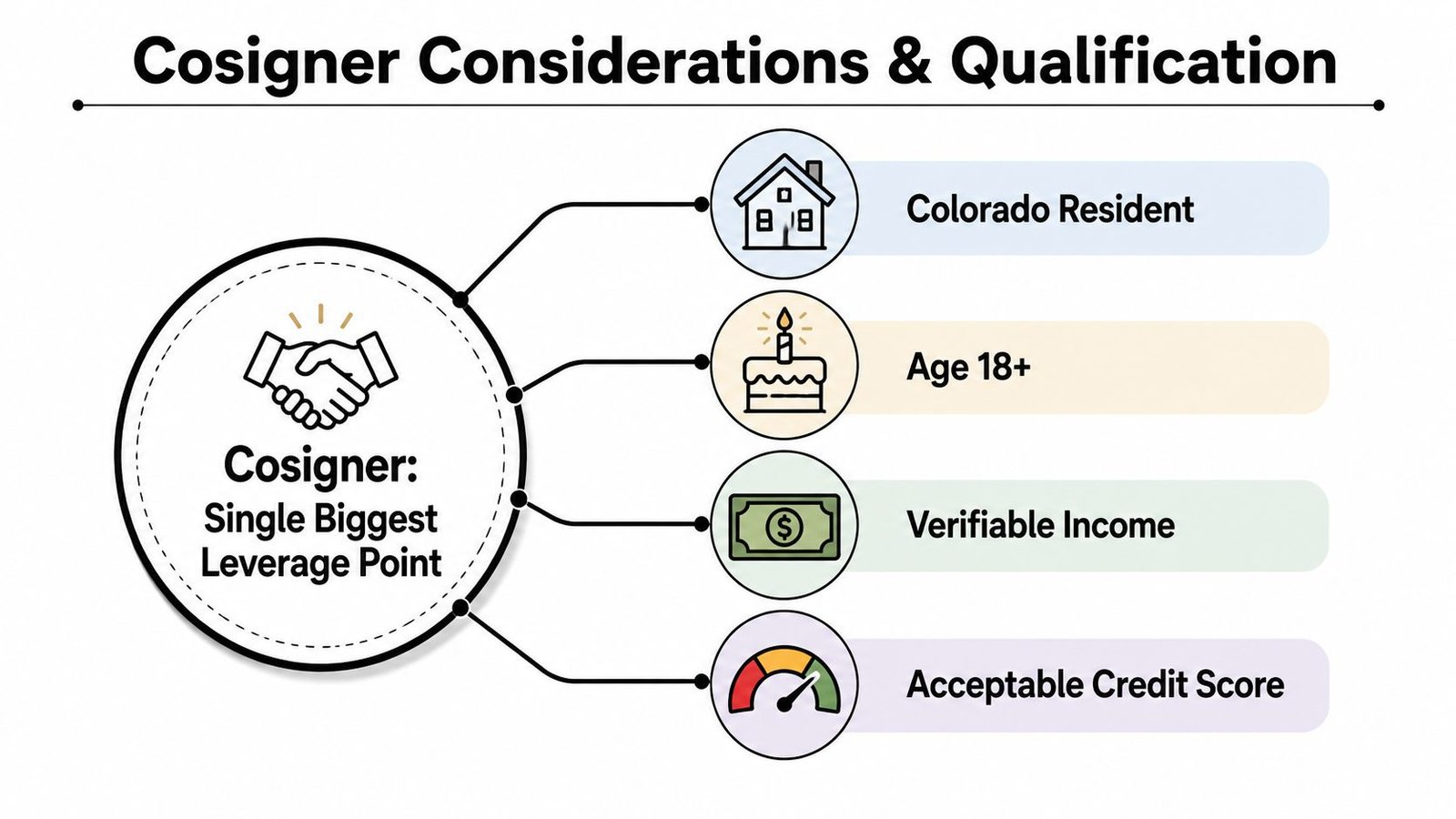
The cosigner is often the biggest advantage in a flexible payment application. A strong cosigner gives the agency a verified person who can make payments, receive notices, help locate the defendant, and respond if the defendant violates the court's requirements.
A typical qualifying profile includes a Colorado resident who is at least 18, has verifiable income, maintains acceptable credit standing, and has no recent felony convictions. Stable employment helps, and many agencies look favorably on someone with six or more months at the same job, although approval remains case-specific.
What the cosigner is actually accepting
The indemnity agreement isn't a courtesy signature. It creates financial exposure if the defendant fails to appear, violates release conditions, or causes the surety to incur costs. The cosigner may also be responsible for unpaid premium installments and expenses authorized by the contract.
Collateral can strengthen an application when income alone isn't enough. A vehicle title or property deed may provide additional security, but collateral doesn't replace careful review. The agency must confirm ownership, value, liens, and the legal ability to accept the asset.
The reduced premium tier is tied to the risk profile, not just the bond amount. Colorado guidance commonly describes 10% on bonds of $5,000 or more with an approved cosigner, compared with the standard 15% rate. A cosigner who can't verify income or address won't necessarily qualify for the lower rate.
Documents and remote signing
A cosigner should be ready with photo identification, Social Security verification, recent pay stubs, proof of address, and any collateral records. The agency may request additional documents if the case, charge, or payment structure creates added risk.
Out-of-state cosigners can often complete the process remotely through electronic document delivery, identity checks, and notarized signatures when required. Remote processing doesn't mean lower responsibility. The cosigner still needs to understand every obligation before signing and should keep copies of the completed agreement.
For a visual checklist of the role, review this cosigner requirements resource. If you're arranging release from another state, say that immediately. It lets the agent choose the correct verification path instead of discovering the issue after the defendant's paperwork is prepared.
Negotiation Tips That Actually Work With a Bondsman
Negotiation works when it reduces risk. Asking an agent to “just make it cheaper” gives the conversation nowhere to go. Show that the payment schedule will be honored, the defendant will attend court, and the indemnitor will respond quickly if a problem develops.
Put useful information on the table
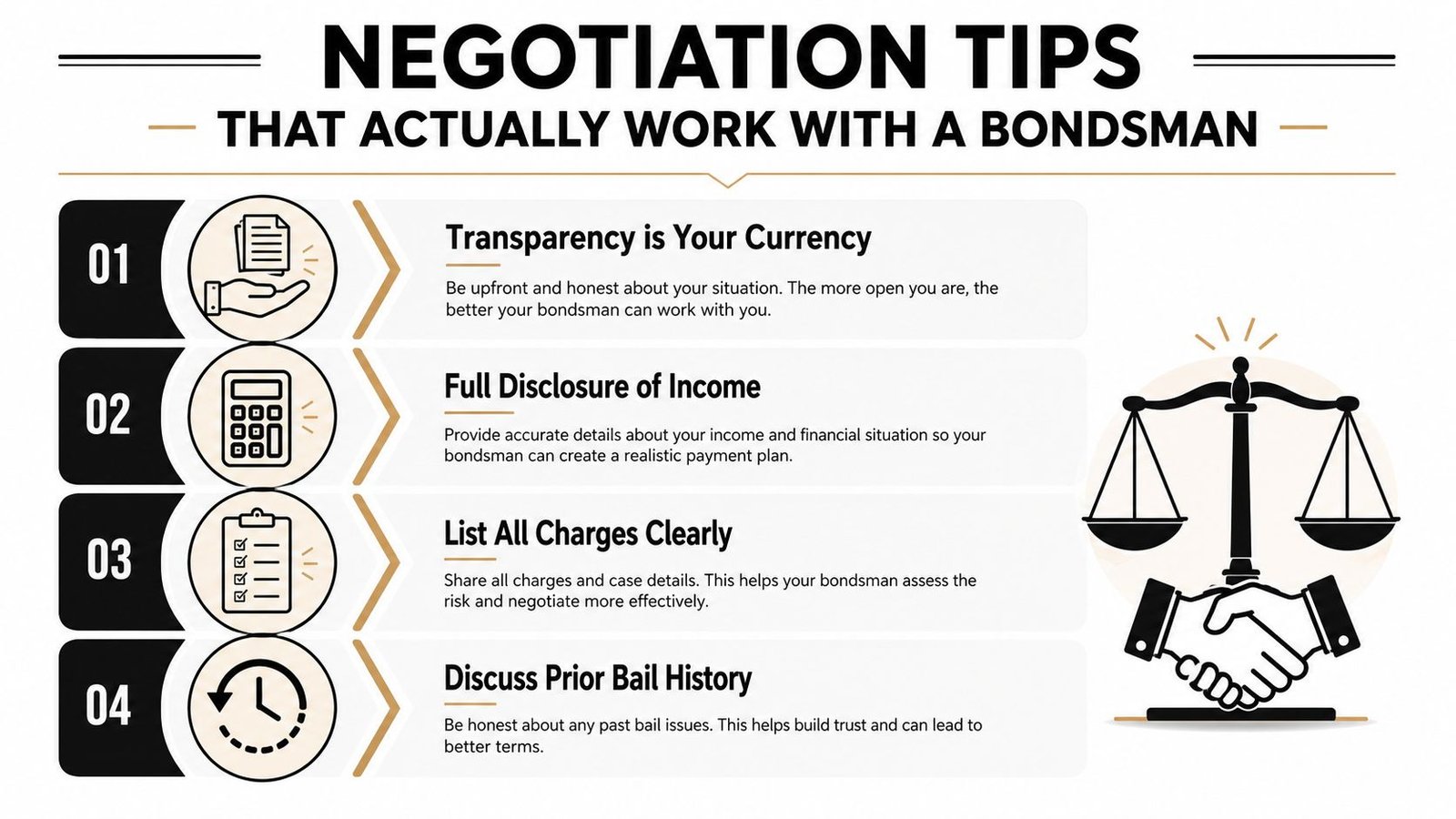
Disclose income completely: Explain wages, self-employment, benefits, and existing payment obligations. Underwriting improves when the agent sees the full picture.
List every charge clearly: Ask for the premium, authorized pass-through charges, financing charges, due dates, and consequences of late payment in writing.
Discuss prior bail history: Previous missed court dates or bond issues don't automatically end the conversation, but hiding them damages credibility.
Offer a stronger structure: A larger initial payment, shorter repayment window, automatic payments, or reliable collateral may make the application more workable.
Ask whether the agency offers senior, military, union, or government-employee discounts. Ask whether financing is in-house and interest-free or arranged through a third-party lender. Those are reasonable questions, but the answer depends on the agency's policy and the specific contract.
An agent can't waive Colorado's premium ceiling, promise a release time controlled by the jail, or guarantee approval without reviewing the indemnitor. An agent also can't remove every collateral requirement because the family is under pressure. The productive request is specific: “If I provide these documents and set up automatic payments, what payment schedule can you approve?”
The strongest negotiation position is a file that is complete, honest, and easy to verify.
If travel is a concern, ask whether the indemnitor can voluntarily surrender a passport or agree to travel restrictions. Never offer a condition you won't follow. The point is to demonstrate control, not to make a dramatic promise.
Electronic Applications and Payment Timelines
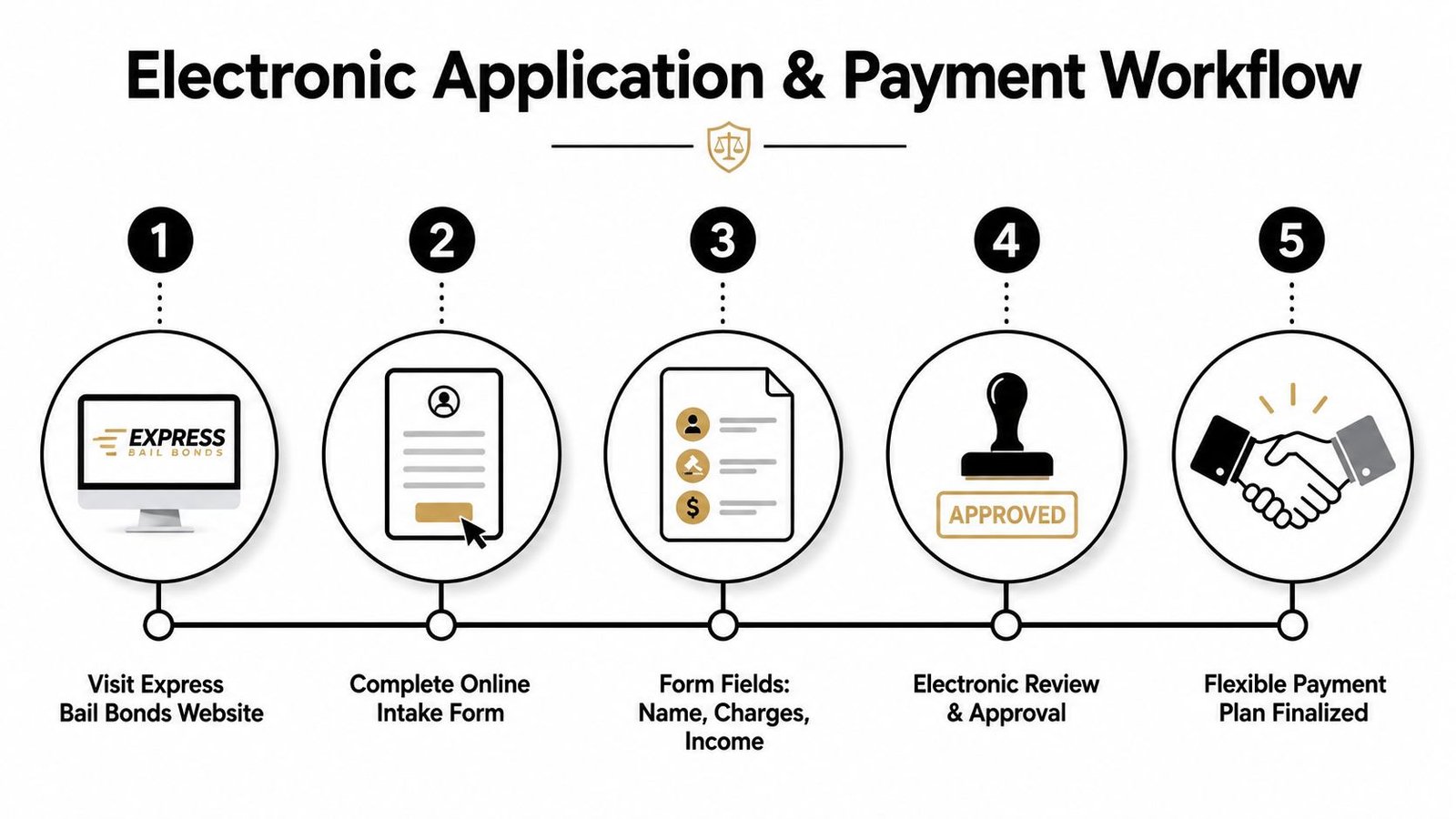
Remote processing can remove the unnecessary trip to a detention center. The workflow starts with an online intake form, followed by document review, electronic signatures, payment, and bond posting.
The remote workflow
Complete the intake form: Enter the defendant's name, bond amount, charge class, booking details, and jurisdiction. Accuracy matters more than speed at this stage.
Upload supporting records: Provide identification, income documents, address proof, and cosigner paperwork through the agency's requested channel.
Review the indemnity agreement: Read the premium, installment schedule, collateral terms, appearance obligations, and default provisions before signing.
Complete electronic signatures: The indemnitor and cosigner sign the required documents electronically when remote execution is available. Some situations may still require notarization.
Submit payment: Depending on the approved arrangement, payment may be made by debit card, ACH transfer, or a major credit card. Confirm whether the selected plan has processing fees and whether any financing charge applies.
What affects the timing
The application itself may take about 10 minutes, with underwriting review taking about 30 minutes during business hours, e-signature confirmation arriving within about an hour, and posting at the detention facility taking roughly one to three hours after approval, according to the stated workflow. These are operating targets, not guarantees. Jail staffing, booking status, court holds, transport, and incomplete paperwork can extend the process.
A jail doesn't release someone merely because the application was submitted. The agency must approve the bond, receive required signatures and payment, post the bond, and wait for facility processing. Track the defendant through the relevant jail roster, but call the facility if the roster doesn't update promptly.
For an example of the payment side of electronic processing, review this electronic bank transfer bail payment guide. Keep your phone available after submitting documents. Missing a verification call can delay an otherwise complete application.
Flexible Payment Terms Frequently Asked Questions
What happens if I miss an installment?
Contact the agency before the due date if you know a payment will fail. Depending on the contract, a missed installment may lead to late charges, collection activity, a request for additional security, or potential bond surrender. Don't wait for the agency to discover the problem through a declined payment.
Is the premium refundable if charges are dropped?
Generally, no. The premium pays for the surety service and is treated as non-refundable once the bond is posted, even if the defendant appears in court or the case ends favorably, as described in this Colorado surety bond consumer resource. A payment plan changes collection timing, not the nature of the premium.
How does an out-of-state cosigner sign?
The cosigner usually provides identity, income, and address documents remotely, then completes electronic signatures or notarized paperwork when required. Tell the agent the cosigner's state at intake so the correct verification process can be arranged.
Can collections affect credit?
If an unpaid balance is sent to collections, the account may affect the cosigner's credit profile, depending on reporting and applicable practices. Ask what happens after default, how notices are delivered, and whether a payment arrangement can prevent escalation.
Can terms be changed if income drops?
Possibly, but never assume an informal conversation changes the contract. Contact the agency immediately, provide updated income information, and request written approval for any revised schedule before skipping a payment.
Flexible payment terms should make a difficult night manageable, not hide the true cost or responsibility. If your question isn't covered, use the agency's 24/7 intake line and give the agent the bond details, defendant information, and available cosigner documents.
Express Bail Bonds offers Colorado surety bond intake, electronic paperwork, remote cosigner processing, and payment-plan discussions for families who can't cover the full premium at once. Visit Express Bail Bonds now with the defendant's booking details and your cosigner information ready, or call or text 720-984-2245 for direct guidance.