A late-night arrest call changes the whole tone of a household. Someone is scared, the clock is loud, and every minute feels expensive.
That's exactly when a Colorado bail bonds license stops being a legal detail and starts being a safety check. If the person on the phone is licensed, regulated, and allowed to post bond in Colorado, your family gets a real professional. If they aren't, you could be handing money and sensitive information to someone the state hasn't approved.
Why a Colorado Bail Bonds License Matters at 2 A.M.
The phone rings after midnight. A brother, daughter, spouse, or friend has been booked, and the first question isn't philosophical, it's practical. Who can get them out, what will it cost, and how do you know the person asking for payment is legitimate?
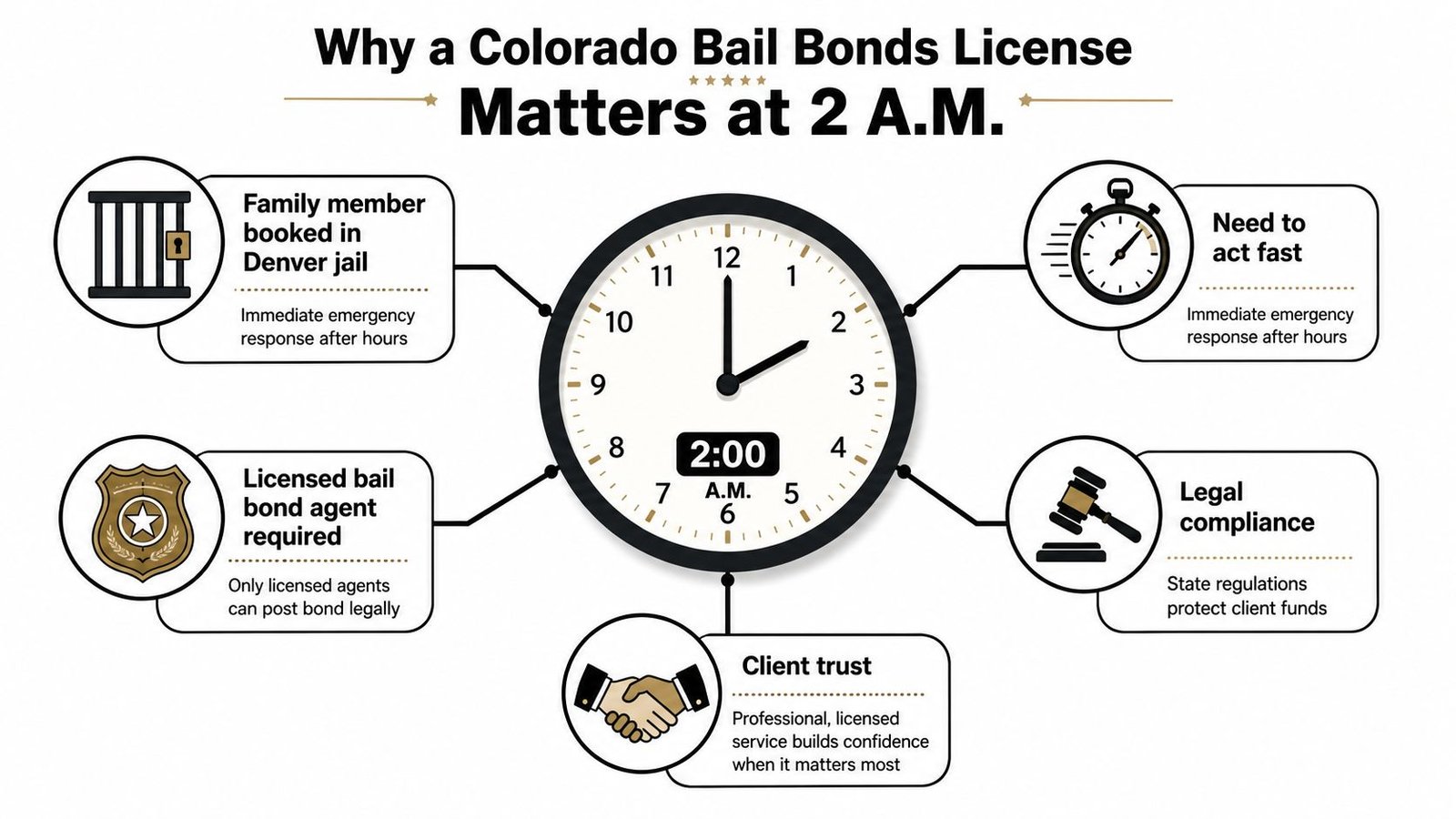
A licensed Colorado bail agent gives you something a random operator can't, a state-backed permission slip to do the work. Colorado places bail bonding under the Division of Insurance, not the sheriff's office or the court clerk, because the state treats it as a regulated line of insurance production, not a casual side gig. That matters in a crisis, because the person taking your call should already have passed the state's entry rules before they ever touch your bond paperwork.
Practical rule: if a bail agent can't show a real Colorado license status, you're not dealing with the kind of professional the state expects you to trust with bond money.
Families usually feel the pressure first, then the paperwork second. A licensed agent is supposed to sit in the middle of that chaos and keep the process orderly, which is why Colorado's system ties the license to training, appointment, and renewal rather than leaving things to chance. If you want a fast overview of how the release process is supposed to work after an arrest, this local guide on 24-hour booking and release can help you understand the timing.
The point isn't just speed. It's speed with guardrails.
What a Colorado Bail Bonds License Actually Is
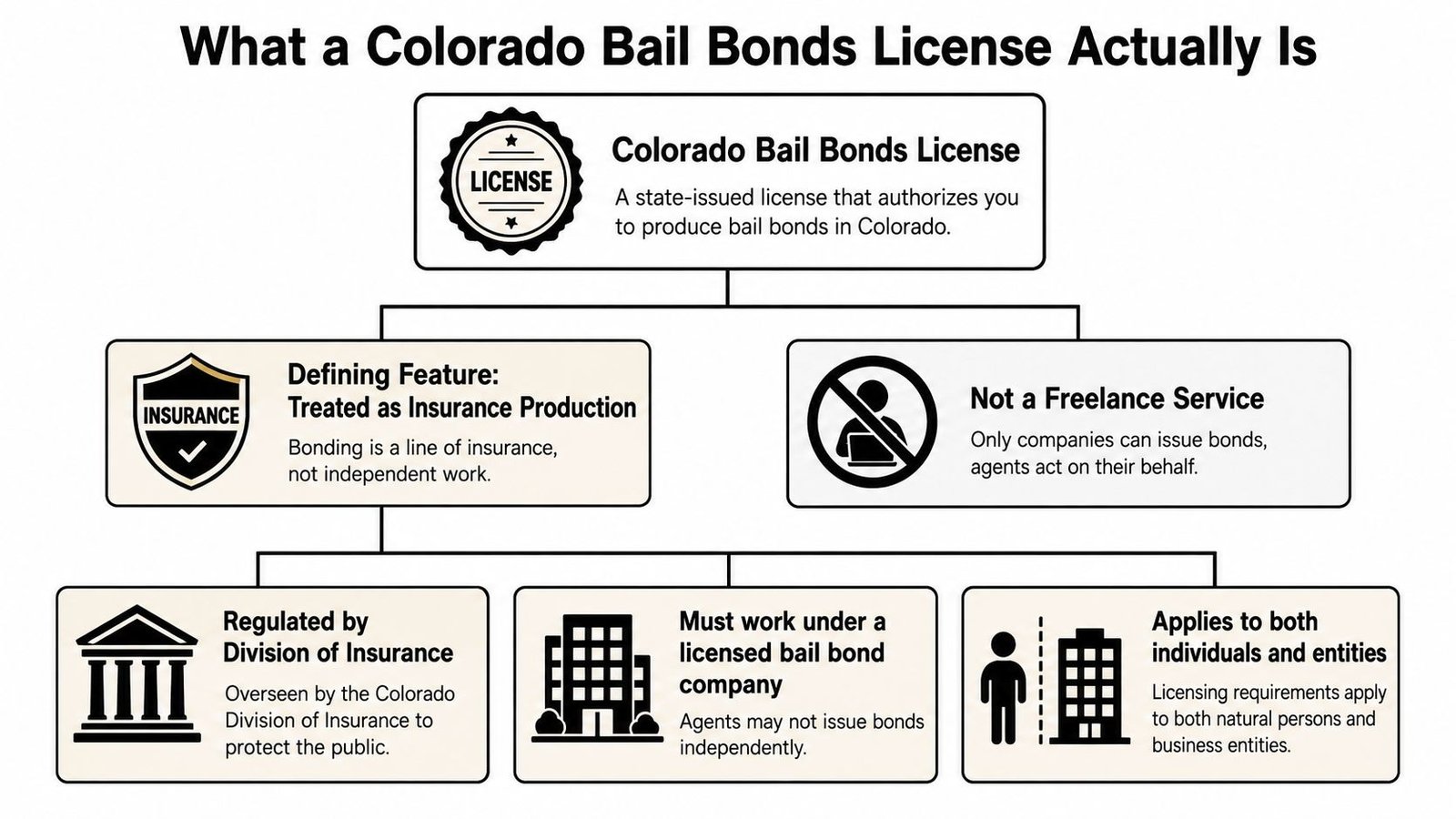
A bail bonds license Colorado residents hear about is not a freelance permit and not a general “I know the system” credential. In plain English, it's the state's way of saying a person or company can participate in bail bonding under insurance rules, while staying inside the boundaries set by Colorado law.
The licensing stack in plain language
Think of the system like a set of nested permits. At the bottom is the resident producer license. On top of that sits the casualty line of authority, which is the broader insurance authority an applicant must already have for the professional cash bail path. Then comes the bail-bond appointment, which links the person to a bail insurance company that can write business in Colorado.
That structure matters because Colorado isn't licensing somebody to “help with jail release” in the abstract. It's licensing them to act under a recognized insurance framework, with a company relationship and state oversight attached. The Occupational Information Network describes the role as a stand-alone license with a state exam required and a specific course required, which is another way of saying the state expects a defined profession, not an informal favor business.
A few words in the bail world help keep the rest of this clear. The principal is the arrested person. The cosigner is the person who helps guarantee the bond and often signs the contract. The surety is the company or financial backing standing behind the promise to the court. If those roles blur, families can end up signing things they don't understand.
That's why the regulator is the Division of Insurance. Insurance law is built around qualification, appointment, and consumer protection, and Colorado uses that framework to control who can write bail bonds and how they can do it. For a plain-English explanation of the job itself, see what a bail bondsman does.
Eligibility and the Application Process
Colorado doesn't hand out bail authority just because someone wants to work nights and answer phones. Applicants have to fit into the state's insurance structure first, which usually means already having, or being in the process of getting, the right resident producer setup and casualty line.
What the paperwork trail looks like
The application package is straightforward on paper, even if it feels intimidating at first. Colorado's process calls for a completed application, an exam score report, and training certificates. NIPR also notes that the professional cash bail agent path sits on top of an active Colorado resident producer license with the casualty line of authority, so the entry point isn't standalone.
That layered setup keeps the business from turning into a rush job. The state wants the applicant to show they've studied the job, passed the test, and attached themselves to an authorized company before they can start posting bonds. In practice, that means the process has a rhythm, first qualification, then documentation, then appointment.
A simple example helps. Someone decides to move from general insurance work into bail bonding. They complete the required education, pass the exam, gather the certificates, and submit the file through the normal licensing channel. Only after the appointment with a Colorado-authorized bail insurance company is in place can they step into the role in a meaningful way.
Where NIPR fits
NIPR, the National Insurance Producer Registry, handles the licensing infrastructure side of the process. The Division of Insurance sets and enforces Colorado's standards, while NIPR helps move the paperwork through the licensing system. That division of labor keeps the state rules separate from the administrative filing system.
Good rule of thumb: if the applicant can't explain the difference between education, exam, and appointment, they probably don't understand the license well enough to work under it.
For a consumer reading this, the big takeaway is simple. A real bail agent doesn't appear by luck or personality. They come through a paper trail, and that trail should be visible enough to confirm before money changes hands. A helpful overview of the application side is available through the bail bond application process.
Background Checks, Education, and the State Exam
Colorado's screening process leans harder on education and exam structure than on some of the fingerprints-and-badge style steps people expect from other occupations. The Division of Insurance states that fingerprints are not required for this license path, which shifts the emphasis toward training, qualification, and appointment review.
| Colorado Bail Bond Training and Screening Snapshot | Hours or Rule | Stage |
|---|---|---|
| Bail-bonding education | 8 hours | Before appointment |
| Bail-recovery education | 16 hours | Before appointment |
| Continuing education | 24 hours every two years | Renewal cycle |
| Fingerprints | Not required | Insurance-licensing stage |
The 8 hours of bail-bonding education is the entry lesson. It gives the applicant the baseline language of the job, how bonds work, what the company is responsible for, and how to stay inside the rules when dealing with a principal or cosigner. The 16 hours of bail-recovery education is heavier, and that makes sense because recovery work carries more risk, more judgment, and more legal exposure.
The state exam is the checkpoint that turns studying into a regulated qualification. Passing it tells the state the applicant has moved beyond casual familiarity and can work within Colorado's insurance rules. Since the fingerprints step isn't part of this insurance licensing stage, the exam and training records carry more of the verification load.
That doesn't mean the state is being loose. It means Colorado is choosing to screen through formal instruction, test performance, and appointment oversight. The trade-off is less administrative friction at the front end, but more reliance on documented compliance and ongoing supervision.
One thing new applicants often miss is that the recovery training isn't window dressing. Colorado requires 16 hours before licensure because the state is signaling that recovery work needs a clear legal and operational framework. That's a useful clue for consumers too, because a properly trained agent should be able to explain the process without improvising.
How Licensing Shapes Pricing and Bond Operations
Colorado's licensing rules don't just decide who can work. They shape what the work costs and how the work is allowed to happen. That's why families should think about licensing and pricing together, not as separate topics.
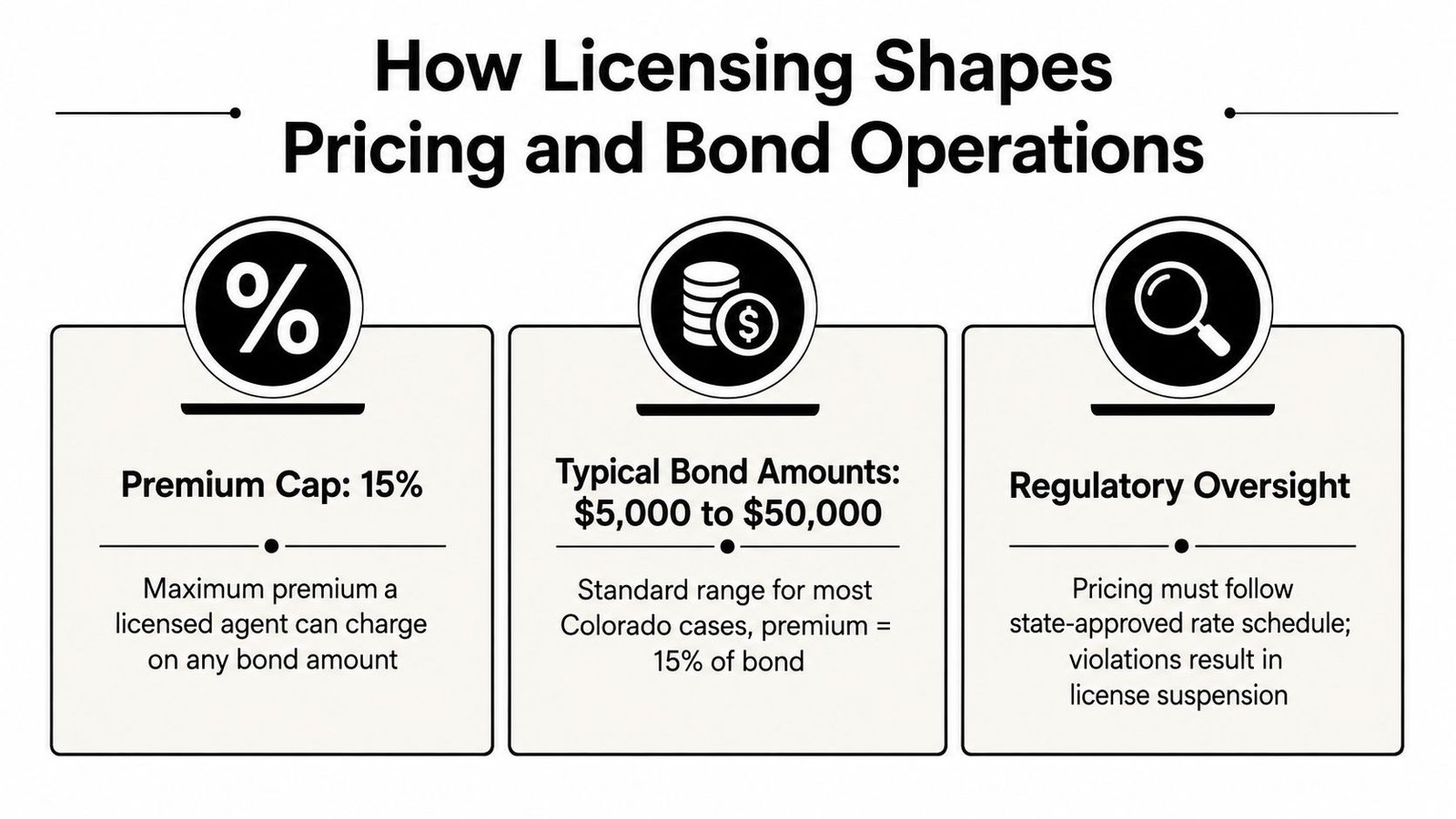
Colorado law caps the premium for an insurance producer who writes bail bonds at the greater of $50 or 15% of the bond amount, and it also limits extra court-posting charges to narrow situations like actual court filing charges, storage of collateral, or premium financing. That means a $10,000 bond can generate no more than a $1,500 premium under the statutory cap, so the 15% figure becomes the statewide pricing anchor for most conversations. The Colorado Division of Insurance explains the cap and the restricted fee structure on its bail-bonds page: Colorado bail bond rules and premium limits.
The practical effect is easy to see. A licensed agent doesn't get to improvise a fee because the family is stressed or because the jail is busy. The law decides the ceiling, and the licensee has to stay inside it.
Why cash bonding is a different animal
Colorado also recognizes a cash-bonding pathway with a separate capital obligation. The state's 2025 sunset review says cash-bonding agents must post a minimum $50,000 cash qualification bond with the Division of Insurance. That is a real reserve requirement, not a slogan, and it separates that category from ordinary surety-style bail work.
The distinction matters because it tells you the business model is different. A cash-bonding operation has to prove it can back the obligation before it operates, while a surety agent works through the licensed bond structure and the premium cap. Colorado's oversight is built to keep those categories from collapsing into each other.
A license in this market is more than permission. It's a fence around pricing, collection practices, and what category of bond an agent may write.
If you're trying to understand how agents earn money within those rules, this local overview on how bondsmen make money is a practical companion piece.
Renewing, Continuing Education, and Keeping the License Active
A Colorado bail license isn't a one-and-done achievement. It has to stay alive through renewal, continuing education, and a current appointment relationship with the bail company that's authorized to write business in the state.
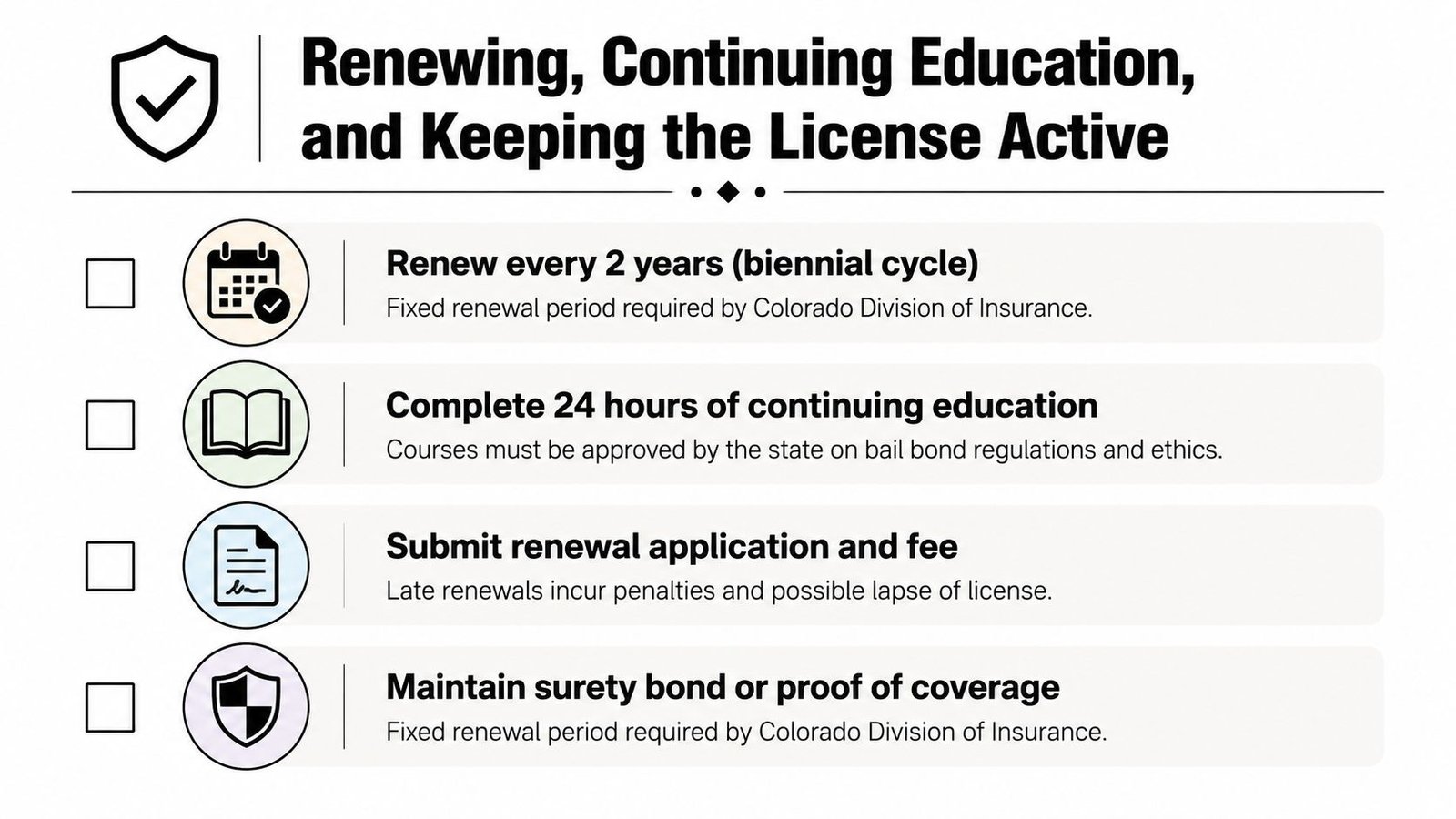
The renewal cycle is every two years, and Colorado requires 24 hours of continuing education every two years. That keeps the license tied to current rules, current ethics, and current procedures instead of whatever the agent learned years ago. The continuing education piece also gives the state a way to keep the field from drifting away from the standards that protect consumers.
A simple maintenance routine works better than panic filing. Keep the renewal date visible, track CE hours as they're completed, and confirm the appointment is still active with the company that sponsors the license. If the business address changes, ownership changes, or the appointment relationship shifts, those records need to stay current too.
Here's the part licensees should treat seriously. A license can run into trouble if continuing education lapses, if renewal is filed late, or if later-discovered legal or compliance issues surface. Colorado's system is built to reward steady compliance, not last-minute scrambling.
A clean annual rhythm helps:
- Track CE early: Don't wait until the renewal window opens to start collecting hours.
- Check appointment status: Make sure the bail company relationship is current and authorized.
- File on time: Late paperwork creates avoidable problems and can interrupt work.
- Keep records updated: Any business change should be reflected in the file quickly.
The best licensees treat this like vehicle maintenance. You don't wait for the engine light to appear if you can schedule the service ahead of time.
Verifying a License and Spotting Red Flags as a Consumer
Families don't need to be licensing experts to protect themselves. They just need a short verification routine and a healthy suspicion of anything that feels rushed, vague, or overly personal.
The first step is to use the Colorado Division of Insurance producer lookup and confirm three things, active status, the bail line of authority, and a current appointment. If any one of those is missing, you should slow down before signing anything. A proper license check takes minutes, and it can save you from paying the wrong person.
Red flags that deserve attention
Some warning signs are obvious once you know what to look for. If an agent refuses to show a license number, pushes for cash without a written contract, or asks for extra “court” or “processing” fees that don't make sense under Colorado's rules, that's a problem. If they suggest a specific attorney, the issue gets more serious.
Colorado law makes it unlawful for a person writing bail bonds to suggest a particular attorney to the principal or to give anything of value to jailers, peace officers, court employees, prosecutors, or anyone with arrest or custody power. That restriction is part of the state's consumer-protection logic, because it keeps the process neutral and reduces the chance that influence, favors, or side payments creep into the bond relationship. The legal language is in Colorado law here: Colorado's restrictions on referrals and payments.
A careful family member should treat any off-script behavior as a signal to slow down. Licensed agents can explain fees, paperwork, and the next step. They shouldn't need to lean on pressure tactics or backchannel referrals.
For a practical consumer-facing checklist and more plain-language help, this local resource on how to verify a bail bond license in Colorado fits well with the steps above.
Next Steps and How a Licensed Agent Helps You Tonight
The most useful things to remember are simple. Licensing is real and verifiable, 15% is the statewide premium benchmark, and a licensed Colorado agent is the safer path when an arrest happens after hours.
If you need help now, work with a licensed agency that can explain the bond, the paperwork, and the court side without making things harder. Express Bail Bonds offers statewide Colorado bail bond services, electronic applications, and 24/7 phone or text support at 720-984-2245. You can also start with the main site, then use the local pages for Jefferson County and Golden or Centennial if that's where the arrest happened.
If you need a licensed Colorado bail bond agency that can walk you through the process tonight, visit Express Bail Bonds and start with a real conversation, not guesswork. A legitimate license, clear pricing, and a fast electronic process can make a hard night more manageable.