
If you're sitting in county jail or helping someone who is, the first question is usually the same. Can they get out early for good behavior, or is that just wishful thinking? The answer depends on where they're held, what kind of sentence they're serving, and whether the facility awards credits for compliance, programs, or both.
That's why people get tripped up so often. Jail and prison are not the same system, and neither one works like a free pass. In federal custody, qualifying inmates can earn good conduct time under 18 U.S.C. § 3624(b), with up to 54 days of credit for each year served, and the First Step Act of 2018 clarified that framework for eligible inmates (U.S. Sentencing Commission). In many local jails, the rules are entirely different and depend on the county, the sentence, and the offense.
Families usually don't need theory first. They need to know what to ask, what paperwork matters, and whether a bond, a release program, or a sentence credit is the most viable path forward. The practical answer starts with the rules that govern the person's custody, then moves to the habits and records that protect whatever credit they've earned.
Understanding Good Behavior Credits
A person in custody can follow the rules for weeks and still lose time if a write-up lands in the file, a program is missed, or an intake condition is ignored. That is why good behavior credits matter. They reward compliance, but they are also easy to lose, so the person inside has to treat every day as part of the sentence calculation.
What good behavior really buys
In federal custody, good behavior is tied to good conduct time, not parole-style discretion. Under federal law, qualifying inmates can earn up to 54 days per year served, and the First Step Act of 2018 is the modern milestone that expanded this earned-release framework (U.S. Sentencing Commission). The practical value is straightforward, it reduces the sentence when the person stays compliant. The Government Accountability Office reported that at the end of fiscal years 2009, 2010, and 2011, about 87% of inmates had earned all of their available good-conduct credit, which shows how widely this mechanism is used in federal custody (GAO).
Practical rule: if the person inside is eligible for credits, the cleanest path is boring consistency, no infractions, no skipped assignments, and no attitude with staff.
That is different from parole. Parole is a conditional release decision. Good conduct time is a sentence-reduction mechanism earned by staying within the rules. Families often assume a clean record means immediate release, but the credit only changes the date if the facility and sentence structure allow it.
Credits are not a loophole. They are part of the sentence structure. In practice, they work best when the incarcerated person stays infraction-free and joins whatever education, treatment, or work programs the facility allows.
Read the facility's rules before you assume anything. A county jail handbook, intake packet, or inmate guide can tell you more than rumors ever will. If a loved one is still early in the process, the legal illustration on pretrial services and custody status is a useful reminder that release timing often depends on status, not just behavior.

Eligibility and Common Restrictions
Eligibility is where most families get misled. One jail may offer local credits, another may offer none, and a prison system may award credits only after certain milestones are met. The person asking for help needs to know three things immediately, sentence length, offense type, and disciplinary record.
County jail, state prison, and federal custody do not follow one rule
A 1996 survey found wide variation across states. Some offered up to a 50% reduction for good behavior, others offered no good-time credits at all, and the most common structure was about 1 day of credit for every 3 days of behavior, roughly 10 days per month (University of New Mexico report). That range is exactly why people get burned by generic advice.
Federal custody is more defined. Under 18 U.S.C. § 3624(b), inmates serving more than one year can earn up to 54 days of good conduct time per year served, and the Bureau of Prisons applies that credit as sentence reduction for compliance with institutional rules (Congressional Research Service). But even there, the person has to qualify. Disciplinary history can reduce or destroy the benefit, and the wrong assumption about sentence length can create a fake release date.
In county systems, the restrictions are often more local and more immediate. Pretrial status, holds, warrants, and pending court issues can block release entirely, even if the person has been cooperative. Some facilities award credits only after a threshold number of days. Others bar certain offenses from earning meaningful reductions. A clean record helps, but it's not enough by itself if the sentence type or offense category excludes the person from credit eligibility.
The same phrase, “good behavior,” can mean very different things depending on custody. In Washington, county jail early-release credits for most offenses can't exceed one-third of the total sentence, while certain serious violent or class A sex offenses are capped at 15% of the sentence (Washington RCW 9.92.151). In Ohio, jail and prison both have their own credit mechanics, including jail sentences of 10 days or more that may be reduced at the rate of one day for every two served (Ohio jail credit overview).
Families should ask the jail, not the internet, whether the person's current status is pretrial, sentenced, or on a hold. That one detail changes the whole answer.
The same careful approach applies when comparing county jail intake with prison classification. If the facility won't confirm the person's category, ask the court clerk or defense lawyer to identify the sentencing structure, then match it to the local credit rule before anyone starts counting release days.
Actions to Earn and Protect Credits
The biggest mistake I see is treating good-time credit like it happens on autopilot. It does not. Credits have to be earned, preserved, and documented, and the record inside has to stay clean long enough for the facility to recognize the full benefit.
Build the record every day
The first job is avoiding infractions. That means no disciplinary reports, no rule challenges that turn into paperwork, and no shortcuts that look harmless but still create a file. A single violation can trigger a loss of already-earned credits in some systems, so a steady routine matters more than a burst of good behavior near the end.
The second job is program participation. Many systems reward or preserve credits only when the person completes education, vocational training, or treatment. The practical move is to ask, in writing if possible, what programs are available, how waitlists are handled, and whether completion certificates are entered into the institutional record. If the person finishes a class and nobody logs it, the credit may never show up where it should.
The third job is documentation. Keep copies of program completions, grievance responses, disciplinary outcomes, and any credit-related notices. If the facility makes a mistake, those records support a request for correction or appeal.
Practical rule: one bad hearing can matter more than ten good weeks. If a violation charge shows up, respond fast and keep a paper trail.
Federal calculations can also trip people up. In federal practice, inmates often overestimate early release by multiplying 54 days by the full sentence instead of the actual time served, which Columbia Law's formula guidance identifies as a common mistake (Columbia Law). That error can make a release date look much earlier than it really is, especially when the sentence is long or other credits are in play.
For families, the best workflow is chronological. Check classification first, confirm program eligibility second, request records third, then follow up if a completion or credit has not been reflected. A practical guide to getting out of jail free in Colorado can help families sort out the early-release questions that come up while the person is still in custody. The internal guide on how to search arrest records in Colorado is useful when you are trying to verify where someone is held and what the case status shows.


The process only works if someone follows through. If the person inside is eligible, ask the case manager or classification officer what the next credit review date is, then make sure every class, program, and conduct issue is tracked against that date. That is the difference between a paper promise and an actual release calculation.
How Credits Are Calculated and Applied
A release date can look simple on paper and still be wrong once jail credit, prison credit, and program credit all start interacting. Families often see the number in one place, then hear something different from booking, classification, or the case manager. The safest approach is to treat every credit as its own line item and confirm how the local facility applies each one.
Federal time is based on served time, not a shortcut estimate
Federal good-conduct credit is tied to time served, not a flat subtraction from the sentence. Families should read the judgment, then ask how the institution is counting the sentence day by day. The distinction matters because behavior credit, program credit, and custody credit can each move a release date in a different way.
| Comparison of Earned Credit Structures | |
|---|---|
| System | Credit Formula |
| Federal good conduct time | Up to 54 days for each year served under 18 U.S.C. § 3624(b) |
| Washington county jail | Most offenses capped at one-third of the sentence, serious violent and certain class A sex offenses capped at 15% |
| Ohio jail sentences of 10 days or more | One day for every two served |
That table shows why a family cannot rely on a quick estimate. A county jail sentence may use a local reduction rule, while a federal case may turn on served time, disciplinary status, and the order in which credits are posted. Under the First Step Act, separate time credits can also affect prerelease custody or supervised release, while other credits only reduce the custodial part of the sentence. For a plain-language summary of how those federal credits work in practice, see the Federal early-release guidance.
The order of calculation matters. Program credits do not replace conduct credits, and a person can qualify for one without automatically receiving the other. If someone in federal custody completes approved programming, the next question is whether the facility has entered the credit correctly and whether the person can use it for prerelease placement or another authorized step. If language access is getting in the way during intake, classification, or program review, the guide to legal language access in 2026 is a useful reference for families who need to make sure forms and hearings are understood.
Colorado families also need to watch the handoff between county jail and DOC processing. Time served before transfer should be credited, but the facility still has to post it in the right place and at the right stage. The best habit is to ask for the written time-calculation sheet, then compare jail credit, DOC credit, and any program-based adjustment line by line. If the calculation looks off, ask who entered the numbers, what document they used, and when the record will be reviewed again.
A small paperwork gap can change the date. One missed class, one unrecorded disciplinary note, or one intake error can leave a person waiting longer than the sentence sheet suggests. Families usually get better results when they check the records early, keep copies of completion slips, and ask the case manager to explain every credit before assuming the release date is final.
Bail Bonds Parole and Release Alternatives
A family may be waiting on a release date, but the person inside needs to get out sooner for work, childcare, or a case hearing. In those moments, the right answer is often a different release path, not more time spent chasing sentence credits. Bail, parole, and medical or compassionate release each solve a different problem, and the facility's paperwork rules decide which path applies.
Three paths, three different purposes
Earned-time credits apply after custody has started and depend on behavior, program participation, and accurate recordkeeping. They can shorten time served, but only if the jail or prison records the credit correctly and the person remains eligible long enough to use it. In practice, families often have to ask which office tracks the credit, which form proves it, and whether the person is in a jail system, a prison system, or a transfer stage where the rules change.
Surety bail bonds serve a different purpose. They are for temporary release while a case is still pending, not for reducing a sentence after conviction. In Colorado, Express Bail Bonds is one option for surety bonds, and its standard structure includes a 15% premium with 10% options over $5,000 when an approved cosigner is available, which is a very different financial model from earned credits. Families dealing with urgent release often care less about the long-term cost structure and more about whether a bond can be posted quickly enough to prevent another missed shift, another childcare gap, or another delay before court.
Supervised parole sits in a separate lane. It is structured release under conditions, not an automatic reward for good behavior. The Sentencing Project reported that among people released early under the First Step Act, nearly 9 in 10 were not rearrested or reincarcerated, compared with a typical federal recidivism rate of 43%. That kind of supervision model matters because it ties early release to monitoring, reporting, and a defined set of conditions rather than simple time served.
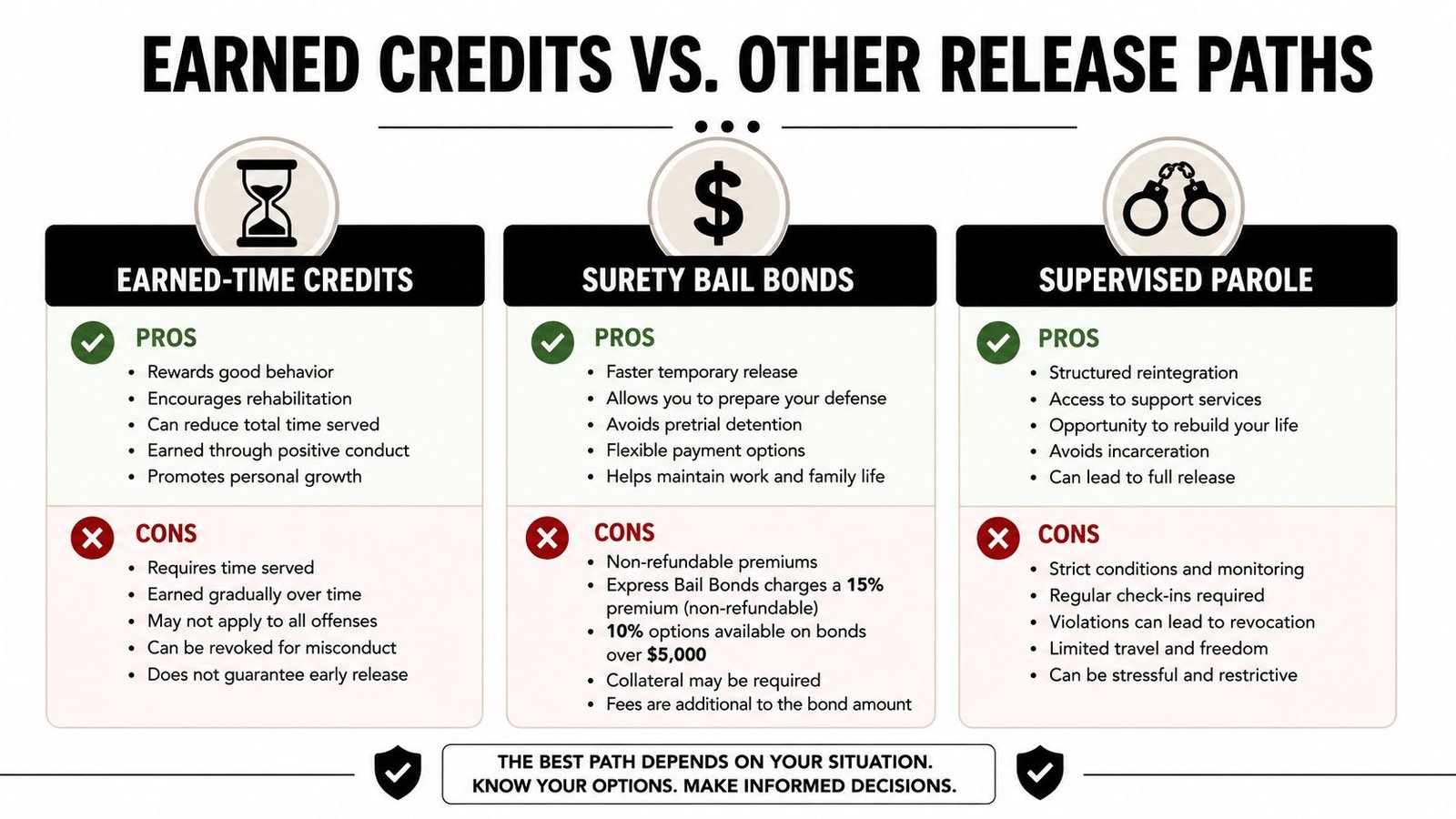
| Path | Strength | Trade-off |
|---|---|---|
| Earned-Time Credits | Rewards good behavior and program participation | Requires time served |
| Surety Bail Bonds | Faster temporary release | Premiums are non-refundable |
| Supervised Parole | Structured reintegration | Strict conditions and monitoring |
If language access slows the process, the delay can show up in bond paperwork, classification review, or a release hearing. Families can use the guide to legal language access in 2026 to check how interpreter access, translated notices, and plain-language forms affect release timing. That matters when a form is signed wrong, a notice is misunderstood, or a hearing instruction never reaches the person who needs it.
The right choice depends on where the person is in the system. A pretrial detainee may need a bond, while someone already serving a sentence usually needs to look at credits, parole, or another authorized release route. For families trying to post bond quickly, the purchase surety bond online guide can help explain how a bond request gets started and what information is usually gathered first. Medical or compassionate release is different again, because it turns on documented circumstances rather than ordinary conduct inside custody.

Next Steps and Expert Support
A family member can save time by asking the facility direct questions before anyone starts guessing. Find out whether the person is pretrial, sentenced, or under a hold. Then ask the classification officer, court clerk, or defense lawyer which credit system applies, which programs are approved, and whether any disciplinary record is already slowing release timing.
The paperwork matters just as much as the question. Intake forms, sentencing orders, jail time sheets, program completion records, and disciplinary notices can all affect the outcome. If a credit is missing, the file needs to show that the person earned it and that the facility did not apply it correctly.
If the situation is urgent and the person still qualifies for release on bond, surety bond help can sometimes move faster than waiting for a credit review. Express Bail Bonds offers statewide Colorado bail bond support, including local pages for Jefferson County Golden and Bail Bonds Centennial, and that can matter when the faster path is posting bond instead of waiting on sentence reduction. The internal guide on Lake County bail bonds shows how local posting rules can shape the release process just as much as the charge itself.

The fastest release option is the one that matches the custody status, not the one that sounds best on a phone call.
Federal cases can bring a different set of questions. First Step Act credits and recidivism findings still matter there, because early-release pathways can work alongside strong supervision when they are applied correctly. County jail cases are different, since some facilities offer a usable credit system and others do not.
If the person you care about is sitting in jail now, do not wait for the release date to sort itself out. Contact Express Bail Bonds for fast Colorado surety bond help, ask about the local process in Jefferson County or Centennial, and get the paperwork moving while you also check whether any good-behavior credits can shorten the case timeline.