
Your phone rings late. A son, partner, brother, or close friend says they've been arrested, and before you can even process that, someone mentions bond, first appearance, pretrial services, and a term that sounds technical and cold: pretrial risk assessment.
That's a hard moment. Most families aren't trying to learn criminal procedure. They're trying to figure out where their loved one is, whether they'll sleep in jail tonight, and what they're supposed to say or do next.
In Colorado, you may hear this term very early in the case. It can affect release, bond conditions, and how the judge sees risk before the case has even been decided. If that feels unfair, you're not wrong to ask questions. These tools are influential, but they aren't magic, and they aren't above challenge.
The Arrest and an Unfamiliar Term
A common scene looks like this. You get the call, then you start making your own list in your head. Which jail? When is court? Can they get out today? Should they talk to pretrial services? What papers should we gather?
Then a public defender, court clerk, or jail staff member mentions a pretrial risk assessment. For many families, that's the first time they've heard the phrase. It sounds like a psychological test or a secret scoring system. In reality, it's usually a structured tool the court uses to help decide whether someone should be released or kept in custody while the case is pending.
Why this term comes up so quickly
In many places, courts no longer rely only on a judge's first impression. They also use scoring tools that sort people into risk categories. That shift is widespread. Approximately 25% of people in the United States live in a jurisdiction that uses a pretrial risk assessment tool according to the Public Policy Institute of California's review of pretrial risk assessment use.
That matters because this score can shape what happens before trial, which is often the period when families feel the most pressure and the least control.
Practical rule: Treat the first hearing as important, even if it seems rushed. Early paperwork, accurate background information, and clear communication can affect how the court views release.
What families often get confused about
People often assume the score decides everything. It doesn't. The judge still makes the release decision. But the score can influence that decision, especially when the courtroom is moving fast and the judge has limited time.
Another point of confusion is timing. Families often want to organize documents and basic information quickly, and that instinct is smart. If you need a practical example of how legal matters often depend on having organized records ready, this article on streamlining legal client intake shows why clean, accessible documents help legal teams move faster.
If your family is still in the first hours after an arrest, it helps to read a straightforward guide on what to do when someone is arrested. Knowing the order of events can lower panic and help you focus on the next decision instead of all of them at once.
What Is a Pretrial Risk Assessment
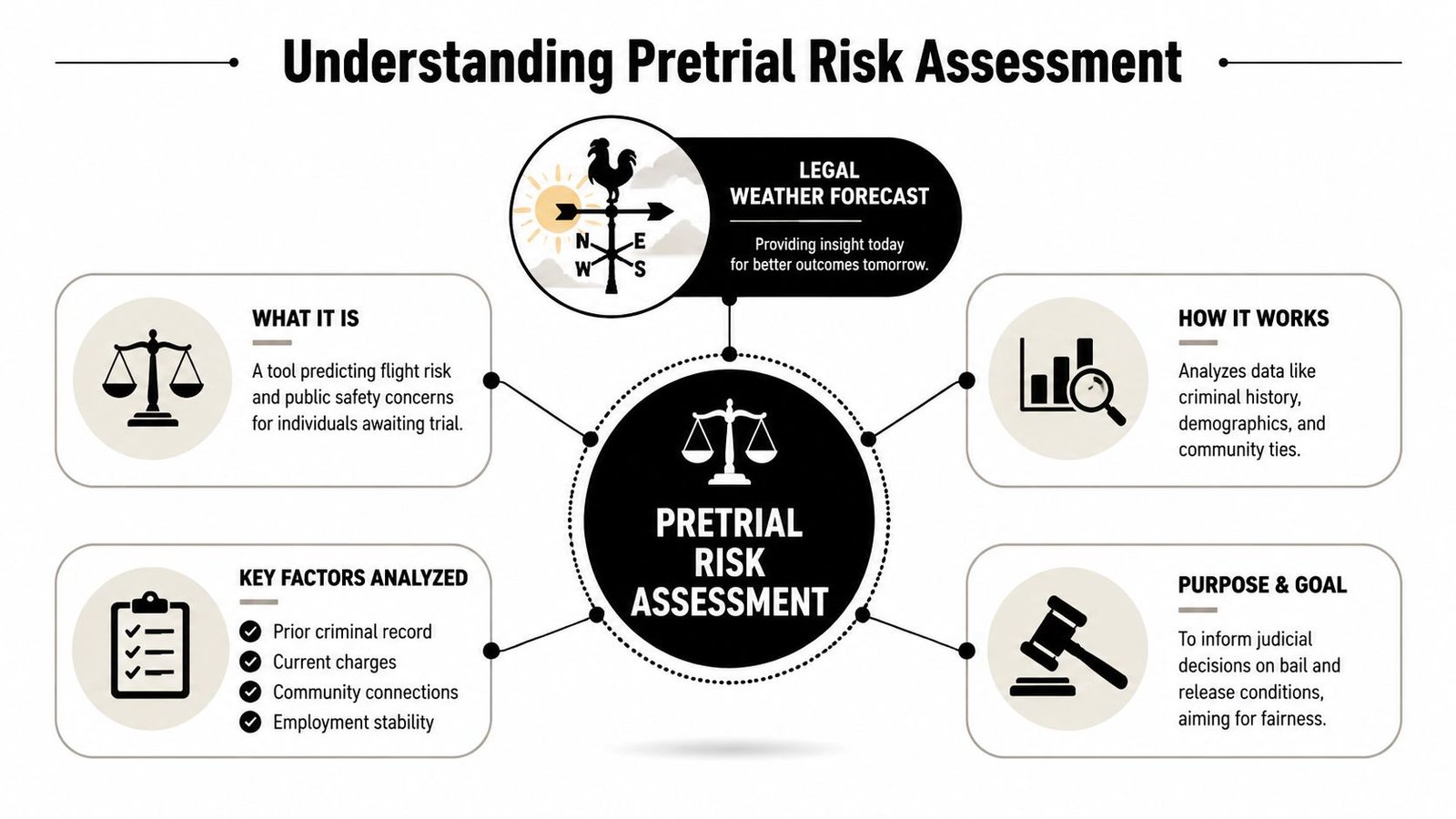
The simplest way to understand a pretrial risk assessment is this. It's like a credit score for the court system, but instead of estimating whether someone will pay a loan, it estimates whether someone will return to court and avoid a new arrest while the case is pending.
That comparison isn't perfect, but it helps. The court is using a scoring tool to sort people into levels of risk based on certain factors.
What the tool is trying to predict
A pretrial risk assessment is built around two core questions:
- Failure to Appear or FTA. Will the person come back to court when required?
- New Criminal Arrest or NCA. Will the person be arrested for a new offense before the case is resolved?
According to the Pretrial Justice Institute discussion of risk assessment instruments, pretrial risk assessment instruments are actuarial tools mathematically designed to estimate the likelihood of failure to appear for court and the probability of new criminal arrest before case disposition, using input factors weighted by their statistical correlation with those events.
Why courts use these tools
Courts use them because they want a structured way to guide release decisions. Instead of relying only on instinct, they use a formula that weighs selected facts, then produces a score or category such as low, medium, or high risk.
That sounds neutral. Sometimes it helps create consistency. But consistency and fairness aren't the same thing. A tool can be consistent and still be wrong, incomplete, or biased.
The score is a recommendation tool, not a verdict about character.
If you're trying to place this in the larger release process, this overview of what pretrial release means helps connect the score to the judge's options. The key point is that the court is making a temporary decision about liberty before guilt has been decided.
What the tool is not
It isn't a finding that the person is dangerous. It isn't proof that they'll miss court. And it isn't a final answer that can't be questioned.
That distinction matters because families often hear a score and think the system has already made up its mind. Usually, what the system has done is generate a recommendation. A recommendation can still be challenged with facts, context, and legal argument.
How Risk Scores Are Calculated and Used
When people hear “algorithm,” they often imagine something highly advanced and unknowable. In practice, many pretrial tools work more like a checklist mixed with a formula. The tool takes selected information, assigns weight to each factor, and turns that into a score or risk category.
Some sources describe these tools as mathematical recipes, which is a useful phrase. The recipe matters because two people can look similar in court but get different scores depending on what data the tool values most.
The kinds of information that go into the score
The common inputs usually include past court attendance, criminal history, age, and markers tied to stability, such as housing or work. Some tools also use other background factors depending on the jurisdiction.
Here's a simple way to think about the inputs:
| Risk Factor | Type | What It Helps Predict |
|---|---|---|
| Prior failure to appear | Criminal history | Whether the person may miss court |
| Prior convictions or arrests | Criminal history | Whether the person may face a new arrest |
| Age | Demographic indicator | Patterns tied to pretrial compliance |
| Residential stability | Socioeconomic marker | Whether the person has stable ties to the community |
| Employment status | Socioeconomic marker | Whether the person has routine and community connection |
| Current supervision status | Case status factor | Whether the court may view compliance risk as higher |
These categories reflect the kinds of predictors described in the earlier-cited research on RAIs. The basic idea is that the tool weighs these factors and assigns a score.
What happens after the score is produced
The result usually shows up as a number, a label, or both. Then pretrial services may make a recommendation to the judge about release, supervision, or detention.
The judge doesn't have to follow the tool. That point is essential. A judge can decide that the score fits the facts, or decide it doesn't. At a bail hearing, the court may consider the score alongside the charge, the prosecutor's position, the defense argument, and practical release conditions. This background on what happens at a bail hearing helps families see where the score fits into the broader decision.
For readers who want to compare civilian pretrial issues with another legal system, this guide for military pretrial questions is useful because it shows how different systems still wrestle with the same basic concerns. Risk, liberty, supervision, and return to court.
Why a score can feel more powerful than it legally is
In a busy courtroom, a number can carry weight because it looks objective. Judges, lawyers, and staff may all speak in shorthand. “Low risk.” “Higher score.” “Recommend supervised release.” That language can make the outcome sound scientific and fixed.
It isn't fixed. But if nobody pushes back, it can function that way.
That's why families should pay attention to what information was used, whether it was correct, and whether important stabilizing facts were left out.
Fairness and Legal Concerns in Colorado
A family sits through first advisement and hears a phrase like “higher risk” attached to someone they know as a parent, worker, or student. That moment can feel surreal. A score that sounds technical can start shaping how the court sees a real person.
Colorado courts, like courts elsewhere, may use risk tools because they appear more consistent than decisions based only on money bond. But consistency and fairness are not the same thing. If the underlying records reflect years of unequal police contact, charging decisions, or court access, the score can repeat those patterns in a new form.

Racial bias can enter through the data itself
This concern is not theoretical. In its analysis of pretrial risk assessments, the Leadership Conference Education Fund warns that these tools must be designed to reduce unwarranted racial disparities and often rely on criminal justice data shaped by systemic bias.
That matters in Colorado because a tool can look neutral on the surface while still weighing factors tied to unequal system contact. Prior arrests, missed court dates tied to unstable housing or transportation, and neighborhood-level policing patterns can all make a person appear riskier on paper than they are in daily life. A spreadsheet can preserve old unfairness just as easily as a file cabinet can.
A score may carry more authority than it deserves
Courtrooms move fast. Once a number appears in a report, people may start treating it like a medical test result instead of a prediction built from selected inputs and assumptions.
That can be dangerous for defendants of color in particular. If no one asks where the information came from, whether it is current, or whether the tool was tested for racial disparity in the local population, the score may become a shortcut for detention or tighter release conditions.
Some tools are fairly transparent. Others are hard to examine. When the defense cannot clearly see the factors, weighting, or cutoff points, it becomes harder to show why the score may be unreliable in a specific case.
A risk score should support judicial decision-making, not replace careful judgment about the actual person in front of the court.
If your loved one has appointed counsel, it helps to understand what a public defender does during a criminal case. One part of that job is challenging weak assumptions, bad records, and unfair reliance on a tool that may look more precise than it really is.
Labels about violence can be especially misleading
The word “violent” changes the temperature of a hearing immediately. Judges hear it. Prosecutors stress it. Families panic.
But a violence-related flag is still a prediction, not proof. Researchers and legal advocates have long warned that these labels can overstate what a tool can forecast, especially over a short pretrial period. In practical terms, a person may receive a troubling label based on statistical grouping rather than concrete facts showing an immediate threat in that individual case.
That does not mean safety concerns should be ignored. It means families and defense counsel should listen carefully to the language being used. Ask whether the court is relying on actual allegations and verified history, or on a broad label that may sound stronger than the underlying evidence.
How to Challenge or Mitigate a Risk Score
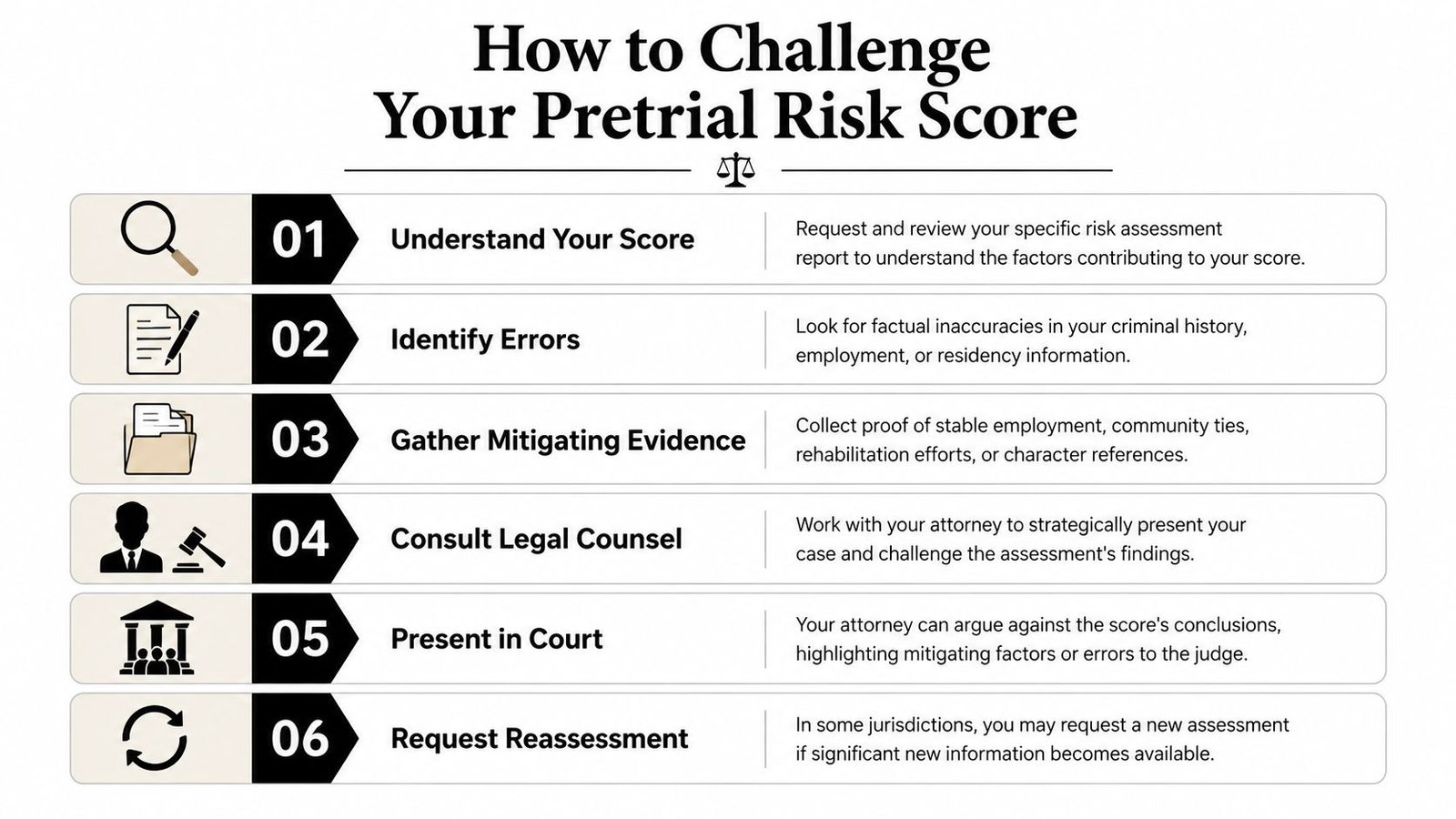
A pretrial risk score can feel like a wall. It isn't. It's more like a report card built from selected information, and report cards can contain mistakes, missing context, or unfair grading rules.
The first goal is accuracy. The second is context. The third is legal challenge where appropriate.
What families can do before and during the interview
Pretrial services interviews often happen quickly. The defendant may be tired, stressed, embarrassed, or confused. Families can help by gathering stable, verifiable information that supports release.
Useful items often include:
- Work proof. A recent pay stub, employer contact, or schedule can show structure and accountability.
- Housing information. A lease, family address, or written confirmation of a stable place to stay can matter.
- Community ties. Contact information for close family members, caregivers, or people willing to support compliance can help.
- Treatment or counseling records. If the person is already engaged in services, that may provide valuable context.
- Court-related logistics. Transportation plans, phone access, and a reliable mailing address can reduce concerns about missed appearances.
Bring facts, not speeches. Judges and pretrial staff respond better to verifiable details than emotional promises.
What an attorney may challenge
Some challenges are simple. The tool used the wrong criminal history, listed a missed court date that was resolved, or ignored a stable address. Those are factual errors, and they matter.
Other challenges are deeper. The defense may argue that the tool itself isn't properly calibrated for the defendant's profile, that the weight assigned to certain factors is unfair, or that the court is relying on a score without enough transparency.
According to the U.S. Courts explanation of the Federal Pretrial Risk Assessment, critical actionability for legal practitioners involves demanding full disclosure of the tool's design, weights, and thresholds to assess whether the risk score is biased or miscalibrated for the specific defendant profile.
A practical checklist
Ask for the report
The defense should know what the score says and what inputs produced it.Check every fact carefully
Wrong address, wrong supervision status, or wrong case history can change how the court sees the person.Give the lawyer documents, not just explanations
A judge can evaluate a letter, schedule, lease, or treatment confirmation more easily than a general claim that “he's doing better.”Show a release plan
Courts want to know where the person will live, how they'll get to court, and who will help keep them on track.Question the tool when necessary
If the score appears inflated or opaque, the defense can ask how it was built and whether it fits the local setting and this defendant.Request reassessment if new information exists
New verified facts may support a different recommendation.
For families facing this process in real time, the most important thing to remember is simple. A score can influence the court, but it doesn't replace advocacy.
Where a Bail Bond Agent Fits Into the Process
A family can do everything right at the hearing, present good information, raise concerns about the risk score, and still hear the judge set a surety bond. That moment catches people off guard. They were preparing for an argument about release, and now they also have to solve a payment and paperwork problem before their loved one can leave custody.
That happens because pretrial risk assessment and money bail often operate side by side. The score may shape how the court views the person. The bond amount still controls what has to happen for release if the judge orders a surety bond.
Why families still call a bond agent
In plain terms, the risk score is one part of the judge's decision. It is not the whole machine. A score can influence whether the court sees someone as lower or higher risk, but it does not guarantee release on recognizance or low-cost conditions.
That matters in Colorado, especially when families are already worried that a score may reflect biased data or missing context. Even if the defense is challenging the score, the family may need a practical release option the same day.
What a bail bond agent actually does
A bail bond agent helps satisfy the surety bond set by the court. The agent does not recalculate the pretrial score, argue constitutional issues, or reverse the judge's ruling. The role is narrower and more practical. Get the bond posted, explain the paperwork, and help the family understand what must happen next for release to go through.
If you want a plain-language explanation of that role, this guide on what a bail bond agent does is a useful starting point.
Local knowledge matters too. Release is not like flipping a switch. It works more like moving through a series of checkpoints, and the timing can change by county, jail staffing, and court schedule. If the case is in Golden or nearby, local information about Jefferson County bail bonds can help you understand the process. If the case is farther south in the metro area, this page on Centennial bail bonds gives location-specific guidance families often need during a fast-moving release process.
The practical takeaway
Families should prepare for two tracks at once. One track is legal advocacy around the score, especially if bias, bad data, or missing facts may have pushed the court toward stricter conditions. The other is the release process itself if the judge sets surety.
A bail bond agent fits into that second track. The agent helps carry out the court's release condition so the person can get out while the case continues.
Navigating the Pretrial Process with Confidence
The hardest part of the pretrial process is how fast it moves while you're still trying to understand the language. A loved one is arrested. The court uses a pretrial risk assessment. People talk in shorthand. Release, detention, FTA, NCA, surety, supervision. It can all feel designed to leave families behind.
It doesn't have to.
A pretrial risk assessment is powerful, but it's still a tool made by people, fed by data, and used inside a system that can make mistakes. In Colorado, that means two things are true at the same time. The score can influence release in a serious way, and the score can still be questioned.
What helps most is getting grounded in the basics. Know what the score is trying to predict. Ask what facts went into it. Watch for missing context, especially around housing, work, family support, and treatment. If the score seems inflated or unfair, make sure the defense has what it needs to challenge it.
And if the judge sets a surety bond, move quickly and carefully. Delay can mean more time in custody, more stress on the family, and more disruption to work, childcare, and treatment.
When you understand the system, even a little, the process becomes less mysterious. That doesn't make it easy. But it does make it navigable.
If you need fast, clear help after an arrest in Colorado, Express Bail Bonds can walk you through the surety bond process, explain what to expect next, and help your family act quickly with experienced statewide support.