
The call usually comes at the worst time. A spouse, parent, sibling, or friend says they've been arrested, they're scared, and someone at the jail mentioned bail conditions. Most families immediately focus on one question: how much will it take to get them out?
That matters, but it's only part of the picture. The condition of bail is the rulebook your loved one must follow after release. If they don't follow it, they can lose their release, face another arrest, and create a financial mess for anyone who signed for the bond. Families who understand the rules early usually make better decisions, avoid preventable violations, and give the defense lawyer a better chance to protect the case.
Your First Steps After an Arrest in Colorado
The first few hours after an arrest feel chaotic because everything comes at you at once. Booking. Charges. A court date. Bail. Conditions. Different people use different terms, and families often assume “bail conditions” just means the money. It doesn't.
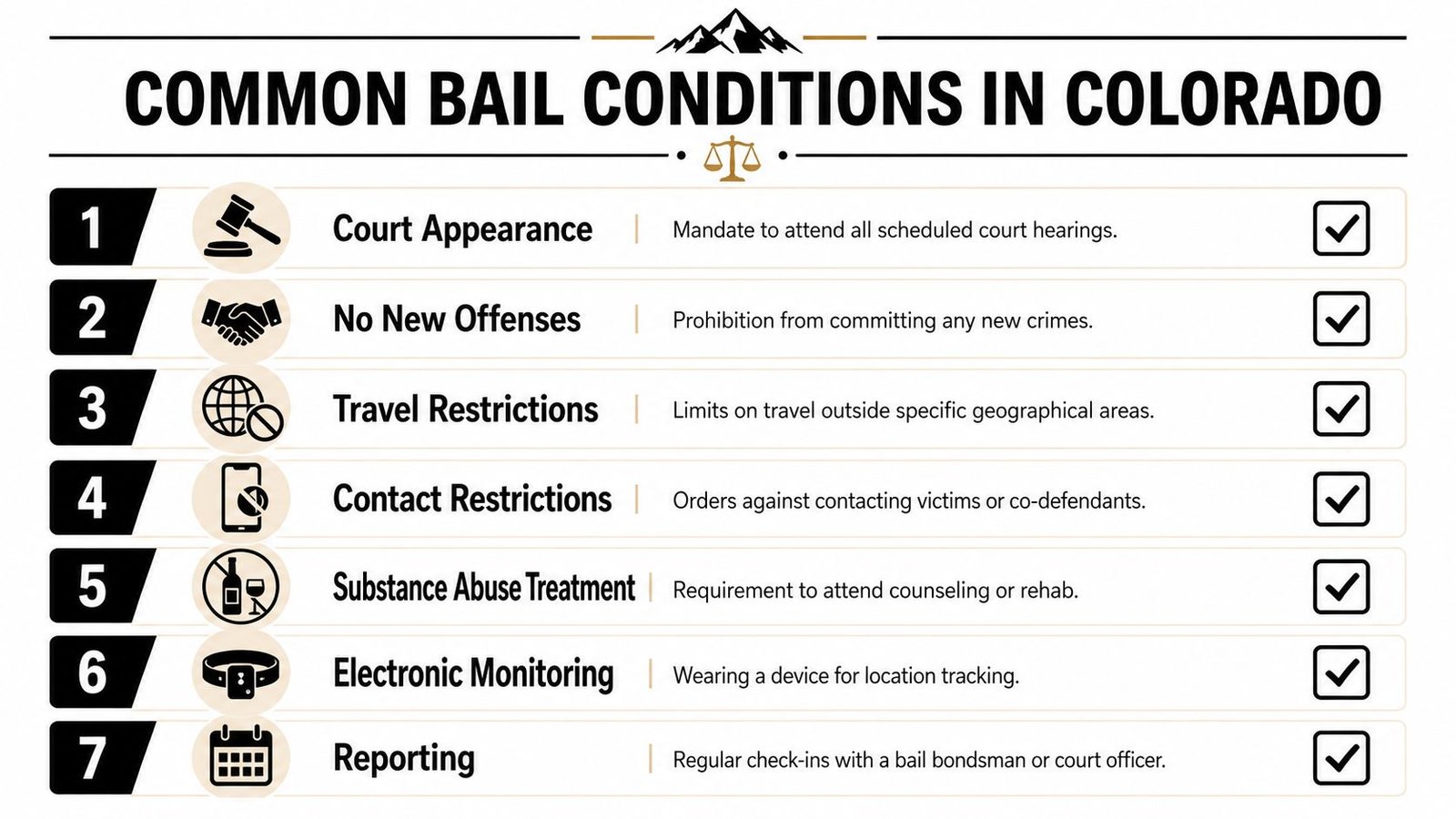
A condition of bail means the rules attached to release while the criminal case is still pending. The court may require the person to appear at every hearing, avoid contact with a certain person, stay in Colorado, test for drugs or alcohol, follow a curfew, or check in with supervision. Money may be part of release, but conditions are the part that controls day-to-day life.

What to do first
Start with the basics. You need accurate information before you make promises, transfer money, or tell the defendant what to expect.
- Confirm where they are. Jails, city facilities, and county detention centers don't all process people the same way.
- Find out the next court event. In some cases, conditions are set quickly. In others, they're reviewed at a hearing.
- Ask for the exact release terms. “Bond is set” is not enough. You need the amount and the conditions.
- Write everything down. Names, dates, case number, court location, and every rule the court mentions.
If you're still trying to get oriented, this guide on what to do when arrested in Colorado is a practical place to start.
Why this matters right away
Families often make two mistakes. First, they focus only on paying for release. Second, they assume common sense will be enough once the person gets out. That's where trouble starts.
Practical rule: Treat every release condition like a direct court order, because that's exactly what it is.
If a judge says no contact, that usually means no texting, no calling, no social media messages, and no passing messages through relatives. If the judge says appear in court, being late can become its own problem. The safest move is to get the exact terms in writing and follow them precisely until the court changes them.
What Are Bail Conditions The Core Concept
Think of bail conditions as a rulebook for temporary freedom. The court is allowing someone to stay out of custody before trial, but only under rules the court believes will manage risk. Those rules aren't supposed to be random. They're supposed to serve a purpose.
In plain English, courts usually impose conditions for two reasons:
- To make sure the defendant comes back to court
- To protect the public, alleged victims, witnesses, or the case itself
That's why some conditions are simple and universal, like showing up to every hearing. Others are highly specific, like no contact with a named person, surrendering a passport, or wearing a monitoring device.
The two goals behind the rules
A court doesn't need to like the defendant to release them. It needs to believe release can work. If the judge worries about missed hearings, the court may use reporting rules, travel limits, or reminders tied to supervision. If the judge worries about safety, the court may use no-contact orders, treatment requirements, or location restrictions.
That basic logic shows up across legal systems. In Canada, the Supreme Court held in R. v. Antic that bail conditions should be adapted to specific risks rather than imposed as a one-size-fits-all package. That's a useful way for families to think about it too. A condition should connect to a risk the court is trying to control.
For a broader look at release before trial, this explanation of how pretrial release works helps put bail conditions in context.
Why money became such a big part of the system
Over time, American courts relied more heavily on financial conditions. From 1990 to 2009, the share of felony pretrial releases in the United States that required financial conditions increased from 37% to 72%, according to The Hamilton Project's analysis of bail and pretrial detention. That shift matters because many families still think bail is mainly about writing a check.
It isn't. Money can open the jail door, but the condition of bail determines whether the person stays out.
| What the court wants | Common condition used |
|---|---|
| Court appearance | Mandatory appearances, reporting, travel limits |
| Community protection | No-contact orders, curfew, monitoring, treatment |
| Stability during the case | Employment reporting, address updates, supervision |
Temporary release is still court control. The location changes. The obligation doesn't.
Common Types of Bail Conditions in Colorado
Colorado courts use a mix of standard and case-specific conditions. Some apply in almost every case. Others depend on the charge, the allegations, and the person's history. The important point is this: the judge should be able to explain why a condition fits the risk.
The same individualized approach appears in the Canadian Supreme Court's reasoning in R. v. Antic, which held that conditions should address specific risks like flight or re-offense, not just repeat a standard checklist. A curfew, for example, should be tied to a real concern in that defendant's case.
Conditions families see most often
Court appearance requirements
This is the foundation. The defendant must appear at every hearing, even if they think the lawyer can handle it or the hearing seems minor. A missed court date can trigger a warrant and put the bond at risk.
No new offenses
This sounds obvious, but it's broader than people think. If a person picks up a new case while on release, the court may treat that as proof the original conditions weren't enough.
Travel restrictions
Some orders limit travel to Colorado or to a specific county unless the court gives permission. If work requires travel, don't guess. Review the written order first. This article on leaving the state while on bail is useful when that issue comes up.
Conditions tied to the allegations
Some rules are closely connected to the alleged conduct.
- No-contact orders often appear in domestic violence, harassment, assault, or witness-related cases.
- Substance conditions may include testing, treatment, or orders not to drink alcohol or use controlled substances.
- Firearm restrictions can appear where safety is a central concern.
A no-contact order is one of the most disruptive conditions because it can affect housing, parenting, shared finances, and work. The dangerous mistake is assuming contact is allowed if the other person reaches out first. The court's order still controls.
Conditions that increase supervision
When a judge wants added structure without full detention, the court may use more active oversight.
| Condition | What it usually means in real life |
|---|---|
| Electronic monitoring | The defendant's location is tracked or restricted |
| Curfew or house arrest | The person must stay home during set hours |
| Reporting requirements | Regular check-ins with pretrial services or a bondsman |
| Address and job updates | The court expects current contact information at all times |
A condition that seems minor in court can become the hardest part of daily life after release. Transportation, work schedules, childcare, and phone access all matter.
Families should read every line of the release order and ask practical questions immediately. How will they get to testing? What happens if work shifts change? Who keeps the calendar? Those details are where compliance succeeds or fails.
How Colorado Courts Impose Bail Conditions
A judge in Colorado doesn't pull conditions out of thin air. The court looks at the charge, the alleged facts, prior record, past failures to appear, ties to the community, and whether there's a reason to worry about safety or witness contact. In theory, that leads to an individualized decision. In practice, the outcome can still lean heavily on money.
That's the part families often don't see coming. Courts may talk about the “least restrictive” approach, but that phrase can lose its meaning if the court sets a financial condition the family can't meet.
The least restrictive problem
Colorado has wrestled with a gap between legal language and real-world results. A 2023 Prison Policy Initiative study found that 50% of detained defendants in Colorado were held solely because they could not pay bail, even in cases where non-monetary conditions could have worked. That finding is the clearest example of how a court can call an order “least restrictive” while still keeping a low-income person in jail.
A high cash amount may look simpler than an individualized release plan. For the family, it feels like detention by another name.
If you want to understand what the court is weighing at that stage, this overview of what happens at a bail hearing can help.
What judges should be doing
A good bail decision matches the condition to the actual concern. If the court worries about travel, it can limit travel. If the court worries about contact with a witness, it can issue a no-contact order. If the court worries about substance use, it can require testing or treatment. Those are direct responses to specific risks.
A weak bail decision uses money as the shortcut answer to every problem.
That's one reason record screening and background information matter so much in pretrial decisions. Families trying to understand how criminal record visibility affects employment and review processes may also find VolunteerBadge's screening compliance guide on public criminal records useful, especially when a pending case starts affecting work or housing questions.
What helps at this stage
The court responds better to concrete information than to panic. Verified housing, stable employment, family support, treatment options, and a workable supervision plan all matter because they give the judge something specific to rely on.
- A real address helps because it shows the court where the defendant will live.
- Work history matters because regular employment can support a structured release plan.
- A narrow request works better than a vague one. Asking for a travel exception for one job trip is more persuasive than asking for “flexibility.”
The strongest approach is practical. Show the court how release will work, not just why detention feels unfair.
What Happens If You Violate a Bail Condition
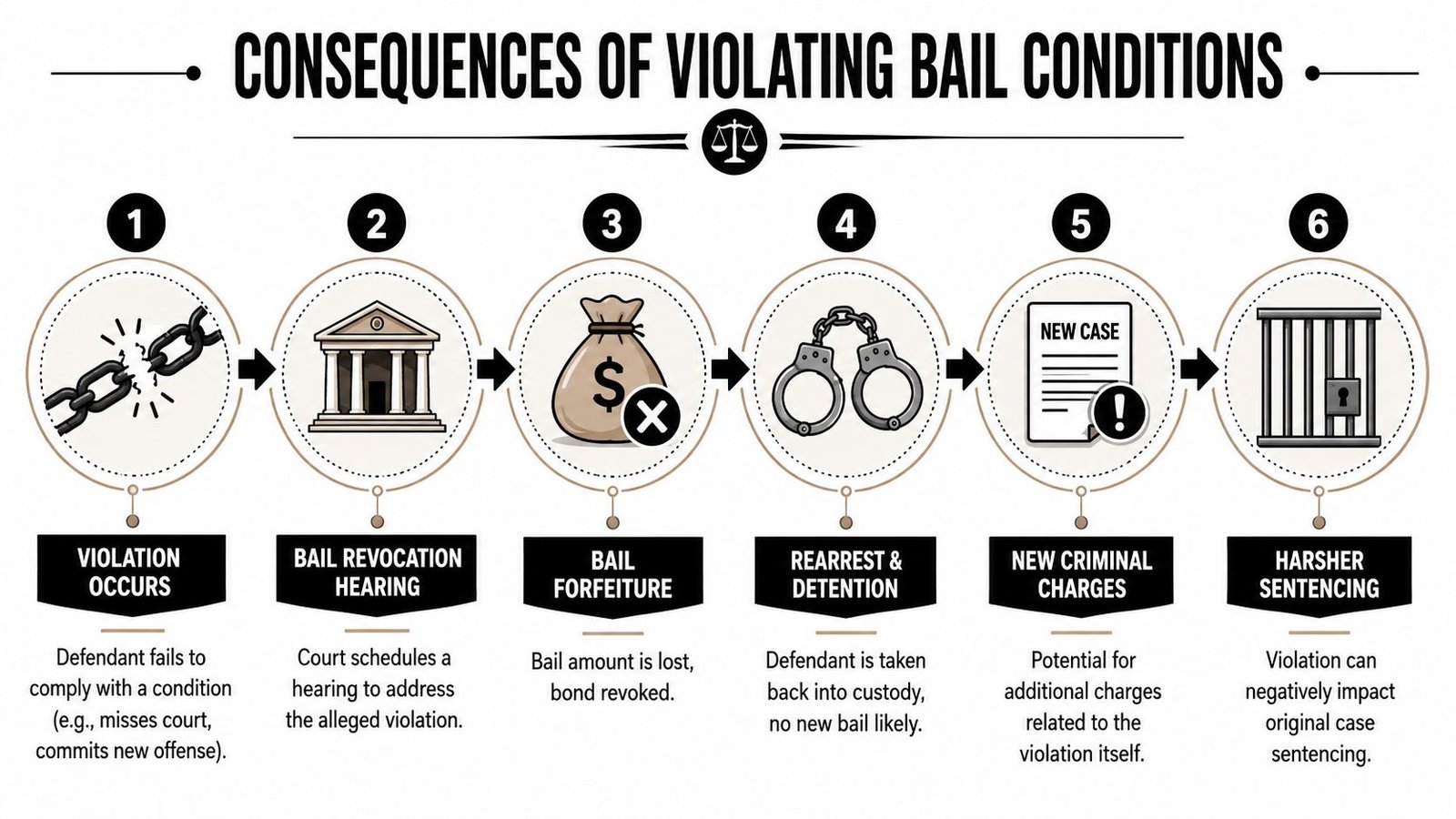
Families need to be brutally clear-eyed. A bail condition is not a suggestion, and a violation doesn't usually get fixed with an apology. If the defendant breaks the rules, the court can revoke release, issue a warrant, and put them back in custody.
For some violations, the damage starts before the person is rearrested. The judge may decide the original conditions failed. That can mean stricter terms later, or no realistic second chance at release.
The legal fallout
The chain reaction usually looks like this:
- A violation is reported. That might be a missed court date, prohibited contact, a failed test, or a new arrest.
- The court responds. The judge may schedule a hearing or issue a warrant.
- Release is at risk immediately. The person may be taken back into custody while the court sorts out what happened.
- The case gets harder. Judges rarely view violations as harmless misunderstandings.
This short video gives a quick visual overview of how these consequences can unfold:
The financial risk to the cosigner
The cosigner, also called the indemnitor, has real exposure here. When a defendant fails to appear in court, the bail bond agency becomes liable for the full bail amount. That can trigger forfeiture of collateral, and the cosigner's liability extends to 100% of the bond, not just the premium.
That's the part many families underestimate. They think the risk ended when they paid the premium. It didn't.
If you need a plain-English comparison, this guide to immigration bond compliance is helpful because it shows the same core principle in another bond setting. Once a release order is tied to conditions, violating them can put both liberty and money in jeopardy.
You should also understand how bond forfeiture works in Colorado before anyone agrees to sign.
If you sign for someone's bond, you're not just helping them get out. You're taking responsibility for what happens if they don't follow the court's rules.
What does not work after a violation
Families often try the wrong fixes.
- Calling the protected person doesn't undo a no-contact violation.
- Explaining that it was an accident doesn't erase a missed court date.
- Waiting to see what happens usually makes the problem worse.
The right move is fast communication with the defense lawyer and anyone involved in the bond. Delay turns manageable problems into expensive ones.
A Practical Guide to Managing Your Bail Conditions
It is 9:30 at night, your son is finally home, and everyone in the house thinks the hard part is over. Then the true risk starts. People get arrested again on bond every week for preventable mistakes, not new crimes. They answer a text they should ignore, miss a check-in because nobody wrote it down, or assume work travel is fine because it sounds reasonable.
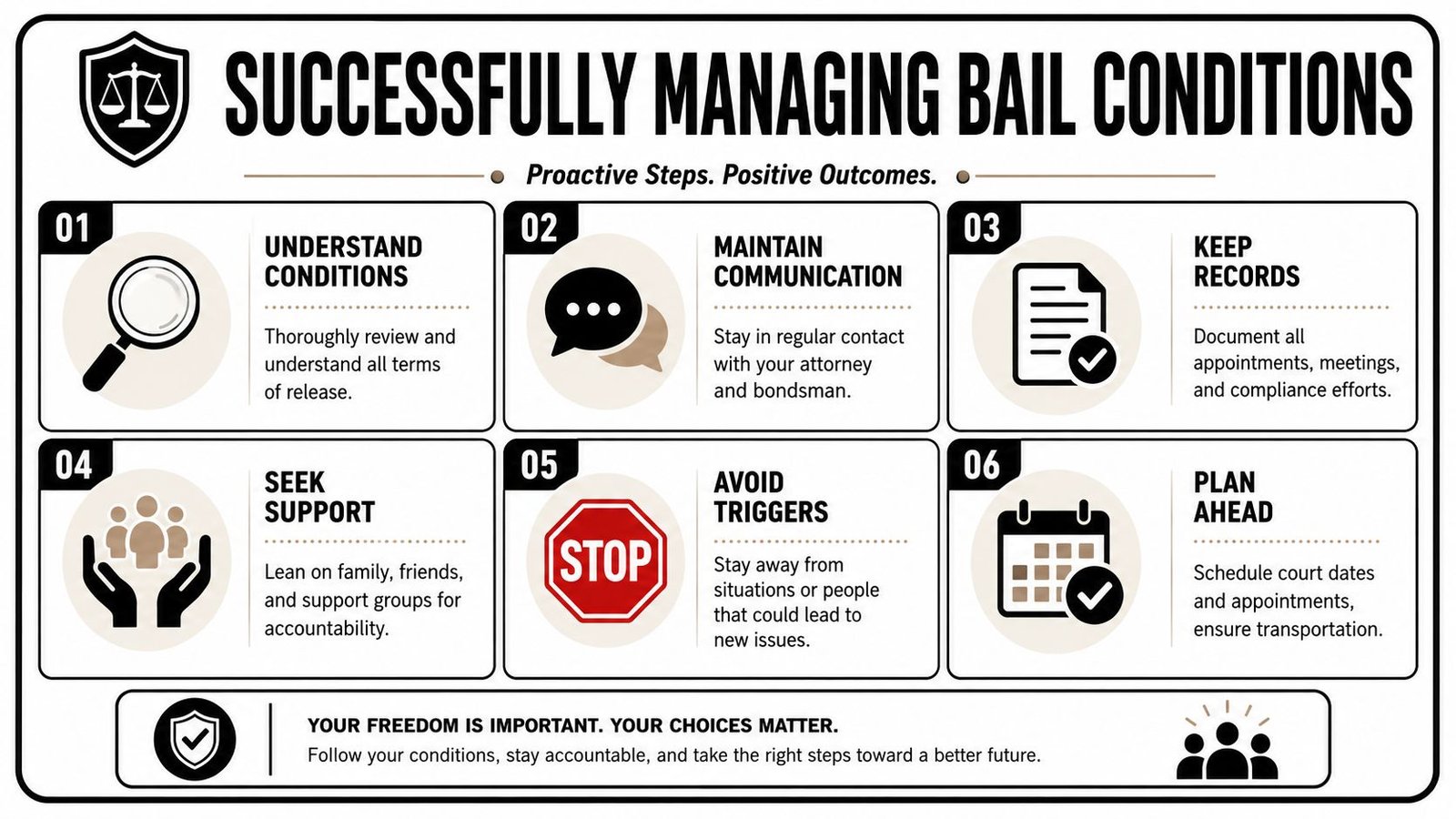
Release works best when the family treats the court order like a set of operating instructions. Read it. Write it out in plain English. Give one person the job of keeping the calendar straight. I tell families this all the time because confusion is expensive, and in custody cases or no-contact cases it can get serious fast.
Build a routine that works in real life
Start with the paperwork from the court, not memory and not somebody's version of what they think the judge said.
- Write out every condition separately. Include court dates, reporting rules, testing, curfew, travel limits, firearm restrictions, and every person covered by a no-contact order.
- Put deadlines in two calendars. The defendant should have them. One reliable family member should have them too.
- Keep one proof folder. Save receipts, screenshots, treatment records, testing confirmations, and any written instruction from the lawyer or pretrial services.
- Arrange transportation early. Court does not care that a ride fell through at the last minute.
- Post the risky conditions where they can be seen. No-contact, curfew, and travel limits cause a lot of trouble because people treat them casually.
One good habit prevents a lot of damage. Before bed each night, check tomorrow's schedule against the release order.
Treat gray areas like problems that need approval
Bail conditions often collide with normal life. A parent needs to attend a child exchange. A boss asks for an overnight trip. A testing window overlaps with a work shift. Those are common problems, but they are still problems until the court changes the order.
Acting first and asking later is how people violate bond.
The safer move is to pause, gather the details, and get the lawyer involved. Judges usually respond better to a narrow request with dates, times, addresses, and a clear reason than a vague statement that the condition is hard to follow. That is one of the practical trade-offs families need to understand. “Least restrictive” language sounds protective, but in actual courtrooms it can still come with cash bail plus a long list of rules. The answer is not guessing. The answer is a documented plan that shows the defendant can follow the conditions in the actual world.
A good bail agent helps here too. At Express Bail Bonds, we spend a lot of time reminding families what the bond payment solved and what it did not. The bond gets release started. Daily compliance keeps that release in place.
Keep the signer involved
The signer should not disappear after pickup. That person needs a copy of the conditions, the court calendar, and the name of the defense lawyer. If the defendant starts missing appointments, talking about leaving town, or minimizing a no-contact order, the family needs to address it immediately.
Silence is costly.
I have seen families avoid hard conversations because they do not want to create tension at home. Then a small issue turns into a warrant, a revocation hearing, or a bond problem that could have been avoided with one phone call and some honest pressure early.
Use a simple division of responsibility
| Task | Who should handle it |
|---|---|
| Court calendar | Defendant and one backup family member |
| Written condition list | Defendant, lawyer, and signer |
| Transportation plan | Family or trusted friend |
| Modification requests | Defense attorney |
| Proof of compliance folder | Defendant and household organizer |
Families who manage bond well do not wing it. They set up a routine, document everything, and ask for clarification before a mistake turns into a violation.
Frequently Asked Questions About Bail Conditions
A family gets someone out on bond Friday night, then the critical questions start. Can he answer her text? Can she leave the state for work on Monday? Can the judge loosen a condition later? These are the questions that decide whether release holds or falls apart.
Can the defendant talk to the alleged victim if that person starts the conversation
Usually no.
If the court entered a no-contact order, that order controls until the judge changes it. It does not matter who started the call or text. It does not matter if the other person says contact is fine. I tell families to treat this as a hard stop and save the messages for the lawyer instead of replying.
One bad response can create a new problem fast.
What if work requires travel outside Colorado
Get permission before the trip. Do not assume work travel is automatically allowed because the job depends on it.
Some release orders limit travel. Others require advance approval for any out-of-state trip. A defense lawyer can ask the court for a modification, and judges respond better to a specific work plan with dates, destination, and return time than to a last-minute request after tickets are already booked.
Can a bail condition be changed after release
Yes, but the court has to approve it.
The strongest requests are narrow and practical. A judge is more likely to approve a change to travel, reporting, or scheduling when the defendant has been following the current order and can show a real reason for the adjustment. In practice, that is where families and a bail bondsman can help. Good records, good communication, and early action give the lawyer something useful to take into court.
Is paying for the bond enough to keep someone out
No. Paying for the bond gets the door open. Following the bail conditions keeps it open.
This is one of the biggest misunderstandings I see. Courts often talk about the least restrictive conditions needed to get someone back to court and protect the community, but families then get handed cash bail plus a stack of rules to manage. That is the system you have to handle in real life. A good agent helps you deal with that reality by making sure the family knows what the court ordered, what the bond covers, and where a simple mistake can turn into a violation.
If your family needs fast, professional help with a Colorado surety bond, contact Express Bail Bonds. They serve detention facilities statewide and offer electronic processing to help families act quickly when time matters.