
A murder arrest usually enters a family's life the same way a fire alarm does. Fast, loud, and all at once. Someone calls from a jail phone. Another relative texts half the story. You start searching one question because it feels like the only thing you can control: how much is bail for murder?
The hard truth is that this question often has no simple price tag. In Colorado, the answer depends on the charge, the court, the facts alleged by law enforcement, the defendant's history, and one threshold issue that matters more than any number. Will the court allow release at all?
That's the part families often don't hear in those first frantic hours. They hear “bond hearing,” “first appearance,” “hold,” or “no bond,” and it all blurs together. But there is a process. If you understand what the court is looking at and what practical steps matter early, you can make better decisions for your loved one and avoid wasting time, money, and emotional energy.
The Phone Call No One Wants to Receive
It's late. Your phone rings from an unfamiliar number. On the other end is a voice you know, but it doesn't sound like the person you know. They say they've been arrested. Then they say the charge. Murder.
At that moment, most families don't think like lawyers. They think like people in crisis. Is my son safe? Is my wife still in county jail? Can I get there tonight? What happens in the morning? Then the question lands: how much is bail for murder?

The problem is that families usually ask for a number before they know which legal door they're standing in. A murder case isn't handled like a routine bond where someone looks up a schedule, pays a fee, and heads home. Homicide allegations trigger closer review, more argument from the prosecutor, and more caution from the judge.
What families usually need first
In the first few hours, the most useful information is basic:
- The exact booking name used by the jail
- The county and facility where the person is being held
- The formal charge listed at booking, if available
- The date and time of the first court appearance
- Whether the jail is showing a hold or no-bond status
That short list matters more than rumors from social media, scanner chatter, or what a friend says “usually happens.”
When families slow down long enough to gather accurate booking information, the next step gets much clearer.
What helps and what wastes time
Calling multiple people for guesses usually doesn't help. Calling the jail for custody status, confirming the court location, and contacting defense counsel does.
If you're in Colorado, keep your focus local. Bail law is highly jurisdiction-specific. Generic advice from another state can send you in the wrong direction, especially in a homicide case where procedure matters as much as dollars. The right goal isn't finding a random online estimate. It's finding out whether release is legally possible, when the hearing is set, and what the court will need to hear.
The Reality of No-Bail Holds for Homicide Charges
The biggest mistake people make is assuming every charge comes with a bond amount. In murder cases, that often isn't true.
Many jurisdictions use no-bail or deny-release rules for the most serious homicide charges. One clear example appears in Marin County's felony bail schedule, which lists “All Other Murders” as “NO BAIL.” The same verified context shows why a generic national answer fails. Pike County, Pennsylvania sets murder or attempted murder at $1,000,000, while some California examples place murder bail near $2,000,000. The range is wide because the actual answer depends on where the case is filed and how the charge is framed.
Why the first question is not always price
In Colorado practice, families need to understand that a murder filing can start from a position of detention, not release. The court may treat the allegation as too severe for immediate bond, especially when the prosecution argues the defendant presents a flight risk or a public-safety risk.
That means the practical question becomes:
- Is the defendant being held without bond right now?
- Is there a hearing scheduled on release?
- Is the charge one of the versions that can trigger a detention fight from the outset?
If you don't know that answer yet, a price quote is premature.
Why charge language matters
Not every death investigation leads to the same legal category. Families often hear “homicide” and assume it automatically means murder, but homicide is a broader word. Some deaths are criminal. Some are not. If you need a plain-language explanation of those distinctions, Texas law on non-criminal homicide gives a useful overview of how the term can include situations that are not treated as murder.
That doesn't decide a Colorado bond issue, but it can help families understand why the exact filed offense matters so much.
Practical rule: Before you ask what bond costs, ask whether the jail record shows a bond at all.
If the jail status is confusing, a plain-language guide to what no bail means can help you sort out the difference between a temporary hold, a judicial no-bond status, and a case where release may still be argued later.
The Factors a Colorado Judge Will Consider
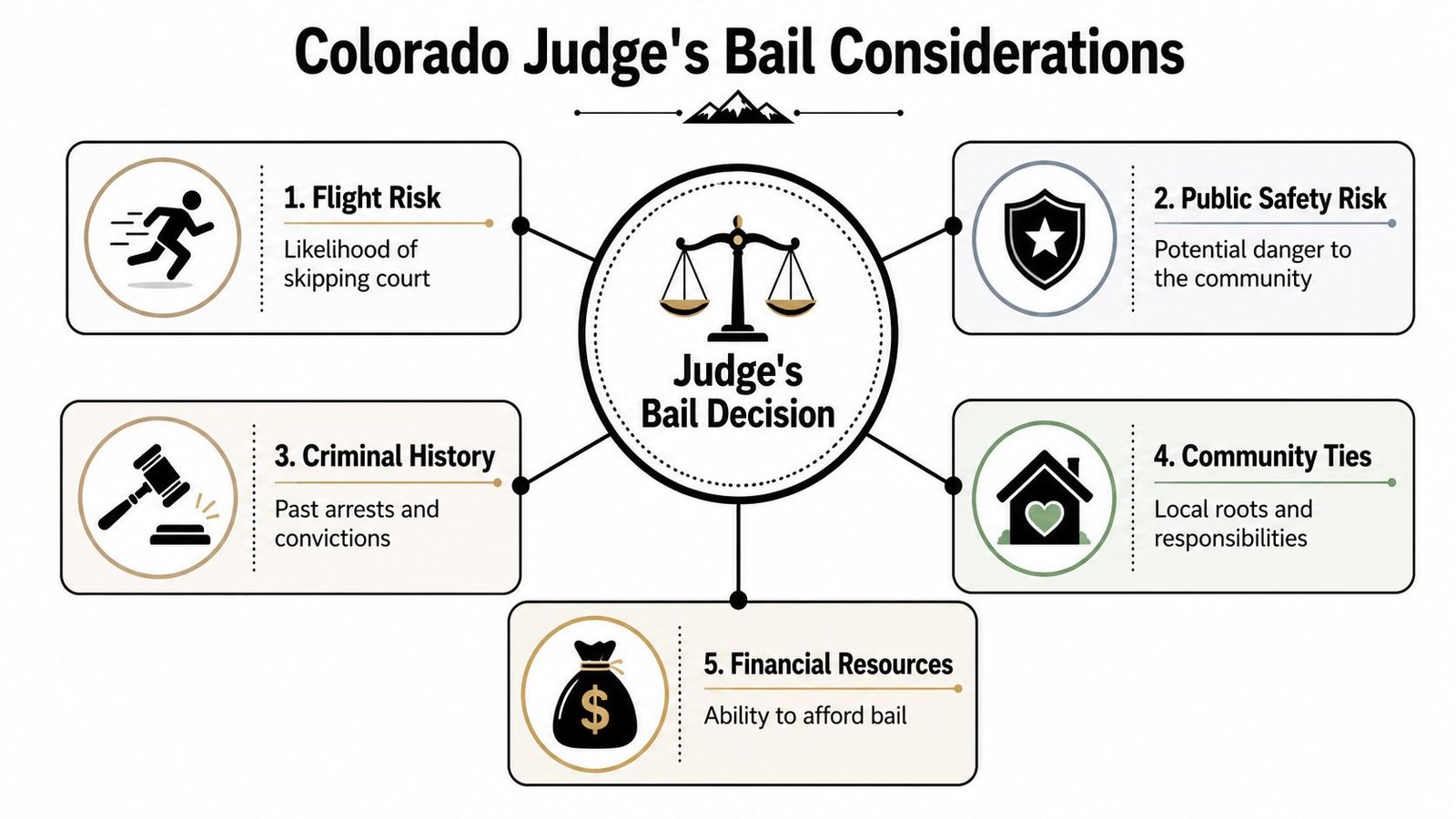
When a Colorado court does consider bond in a murder-related case, the amount is not pulled out of thin air. Judges look at a cluster of facts that all point to one core issue. Can this person be released while the case proceeds, and if so, under what conditions?
Severity and public safety
A murder allegation sits at the top end of how courts evaluate seriousness. That affects bond in two ways. First, the charge itself tells the judge the stakes are extreme. Second, the prosecutor will often argue that the facts suggest a heightened danger if the defendant is released.
The court will be looking closely at the probable-cause narrative, any alleged use of a weapon, statements made after the event, and whether the facts suggest planning, retaliation, or impulsive violence.
Flight risk and ties to the community
Judges also ask whether the person is likely to return to court. Families sometimes think this is only about money. It isn't. Stable local ties can matter a lot.
Relevant facts often include:
- Long-term residence in Colorado
- Close family in the area
- Employment history
- Caretaking responsibilities
- Prior attendance or non-attendance in court
A person with deep local roots may be argued as less likely to flee than someone with limited ties, unstable housing, or a record of skipping court.
Criminal history and conduct in the case
Prior convictions, open cases, probation status, and past failures to appear all matter. So does conduct after the alleged offense. If law enforcement claims the defendant tried to leave, hide evidence, contact witnesses, or avoid arrest, the prosecution will use that to argue for detention or a very high bond.
Sometimes the strongest early work in a bond hearing isn't emotional. It's organized. Lawyers and families who bring records, verifiable timelines, and clean documentation usually help the court more than people who come in angry and unprepared. In cases involving digital evidence or recordings, a careful chain of custody is essential for authentic evidence documentation, especially when the defense may later challenge how material was collected and preserved.
A judge wants specifics. “He'd never run” carries less weight than documented work history, family support, and a clear residence plan.
Financial resources and realistic bond conditions
The court may also look at the defendant's ability to post bond, though in a murder case that factor won't outweigh safety and flight concerns. Judges can structure release conditions around supervision, restrictions on travel, contact limits, and check-ins when bond is allowed.
If your family is preparing for court, it helps to understand what happens at a bail hearing so you know when arguments are made, who speaks, and what information the judge is likely to weigh.
Understanding Bail Schedules and High-Dollar Bonds
Inquiries about bail for murder often seek a specific figure for planning purposes. The problem is that murder bond amounts are often set at the highest end of any local schedule, and they can change sharply from one county to another.
What a bail schedule does
A bail schedule is a court or county reference point that lists standard starting amounts for certain charges. It is not always the final word. In serious violent cases, it often functions more like a baseline the judge can modify, reject, or replace after hearing argument.
Verified examples show how large the spread can be. In California, one source notes the Uniform Bail Schedule lists $750,000 for murder, while Marin County lists $1,000,000 for murder-related charges and no bail for murder with special circumstances in the verified data summarized at Wikipedia's overview of murder in California law. That tells you something important. Even within one state, there may not be a single “standard” murder bail amount.
Why murder bail is so much higher
Murder is commonly treated far more severely than other felony offenses on bail schedules. One verified California example lists murder at $2,000,000, compared with $100,000 for voluntary manslaughter and $25,000 for involuntary manslaughter, meaning the murder figure is 20× higher than voluntary manslaughter and 80× higher than involuntary manslaughter according to this murder bail schedule example.
That comparison helps families understand why sticker shock is so common in homicide cases. The system is built to treat murder as one of the most serious accusations a person can face.
What this means in practice in Colorado
Colorado counties may use schedules, standing bond practices, and judge-specific decisions as starting points, but a homicide case is rarely routine. The number, if there is one, tends to reflect the gravity of the allegation, local practice, and any facts that increase concern.
A simple comparison helps:
| Charge context | What families often see |
|---|---|
| Routine lower-level case | A preset amount may be available quickly |
| Serious violent felony | Judge review becomes more important |
| Murder allegation | Bond may be very high, heavily conditioned, or denied |
If you're trying to understand the terminology, a short guide to what a cash bond means can help separate cash-only requirements from surety bond situations, which is a critical distinction before anyone starts moving money.
How a Bail Bond Makes Release Possible
Once a judge sets a high bond, the next shock is usually financial. Families hear a six-figure or seven-figure number and assume release is impossible. In many cases, the full amount is not what gets paid out of pocket.
The difference between bail and bond
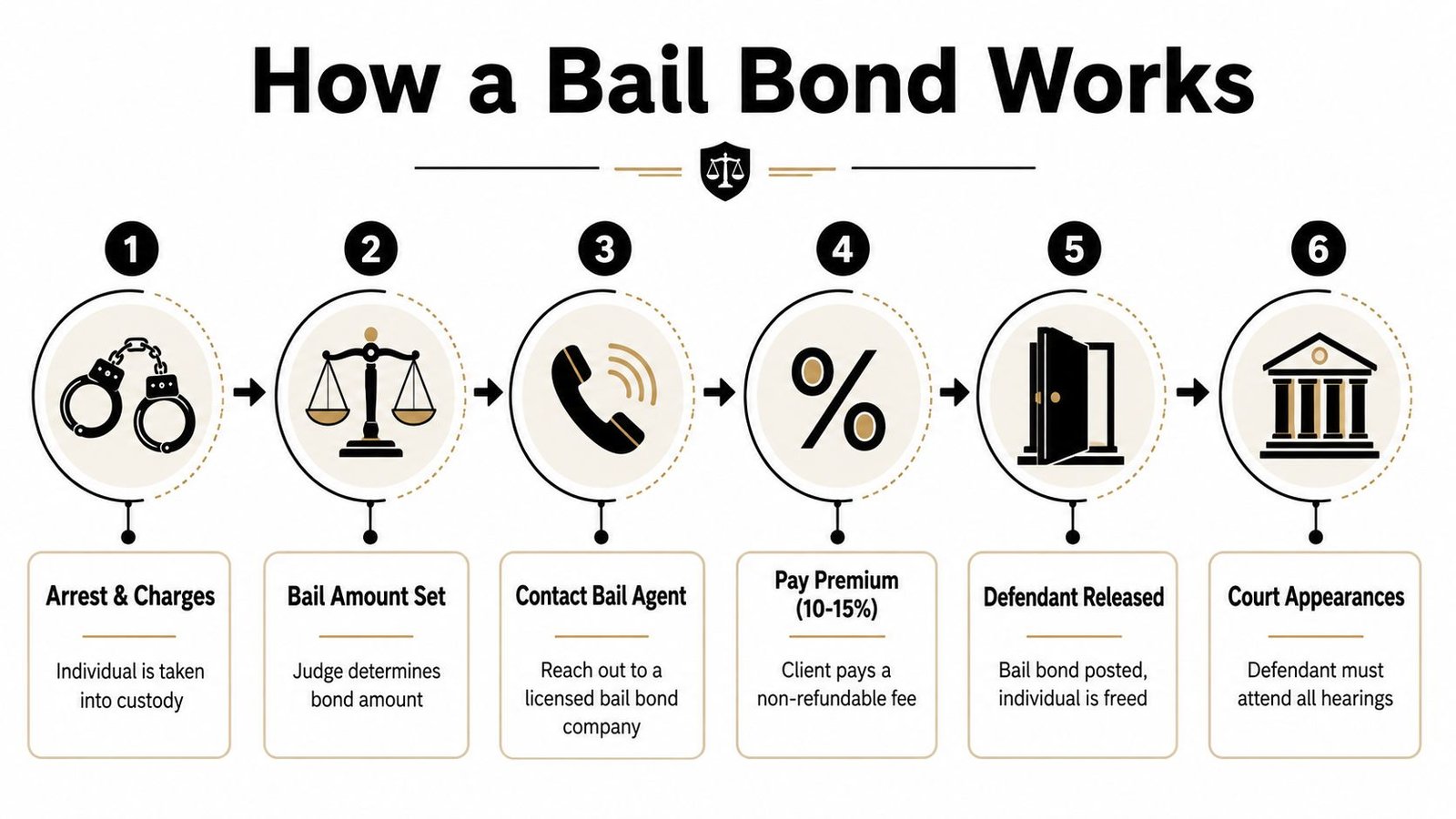
Bail is the amount the court sets. A surety bond is the mechanism a licensed bail bond company uses to guarantee that amount to the court.
At the national level, verified data states that a surety bond is commonly priced at about 10% of the total bail amount, and a deposit bond also typically uses 10% of the full amount posted directly with the court, as summarized in Wikipedia's entry on bail in the United States. That matters because a $500,000 bail implies about $50,000 in premium, and a $2,000,000 bail implies about $200,000 in premium, before collateral or co-signer requirements.
How that plays out for families
A surety bond makes release possible by bridging the gap between the court's bond amount and what the family can realistically produce. Instead of delivering the full bail to the jail or court, the family works with a bail bond company, pays the required premium, signs the paperwork, and may provide a qualified co-signer or collateral depending on the size and risk of the bond.
The process usually looks like this:
- Bond gets set by the court. The defendant remains in custody until the bond is posted or the court changes the release decision.
- The family contacts a licensed bond agent. The agent confirms the jail, the charge, and the bond type.
- The co-signer is evaluated. The company will look at identification, stability, and ability to stand behind the bond obligations.
- Paperwork is completed. Many companies can handle this remotely, which matters when family members live outside the county or outside Colorado.
- The bond is posted. The jail processes release according to its own timetable.
- Court compliance becomes the priority. Missing court can trigger serious consequences for both the defendant and the co-signer.
The fastest release usually comes from complete, accurate paperwork. Delays often come from missing identification, confusion about the charge, or a co-signer who can't verify basic information.
If you're sorting out terminology, what a surety bail bond is gives a straightforward explanation of how the guarantee works and why families don't typically bring the full court-set amount in cash.
Your First Steps After a Loved One's Arrest
A murder arrest creates emotional chaos. The best response is a short action plan. Not twenty tasks. Just the next right ones.
Step one, confirm the facts
Start with the jail, not with rumor. Confirm the person's legal name, booking location, and custody status. Ask whether a bond has been set, whether there is a no-bond hold, and when the first court appearance is scheduled.
If the arrest happened in a Colorado county you don't know well, don't guess which court will handle it. Get the exact facility and the exact case information first.
Step two, organize a release file
Create one document or note on your phone and keep everything there. Include:
- Booking details
- Case number if available
- Court date and courtroom
- Attorney contact information
- Medication or urgent medical concerns
- Names of close family members involved in decisions
This sounds simple, but it prevents a lot of crossed wires. Families often lose precious time because four relatives are calling four different places and no one is keeping one clean record.
Step three, contact the right local help
Bond practice is local. A family dealing with a Jefferson County case needs a different practical roadmap than someone dealing with a Centennial-area jail or court process. If you're trying to orient yourself geographically, these local pages can help you identify the right area resources for Jefferson County and Golden and for Centennial bail bond support.
You should also understand the basics of what to do when someone is arrested so you can separate urgent steps from things that can wait until the next day.
Step four, get defense counsel involved early
In a murder case, bond strategy and defense strategy start interacting almost immediately. The lawyer needs to know what the jail is showing, whether a bond hearing is set, and what information the family can provide about residence, work history, treatment history, military service, or caretaking obligations.
A calm, documented family presentation usually helps more than emotional pleas.
Bring facts the court can verify. Address where the defendant would live, who would supervise, and how the person would get to court.
Take Control with an Experienced Colorado Bail Partner
The worst part of a homicide arrest is the sense that everything is happening behind a wall. You're waiting for the jail to answer. Waiting for the court date. Waiting for the lawyer to call back. Waiting to learn whether bond is even possible.

What helps is working with someone who understands Colorado detention facilities, Colorado bond practice, and the difference between a routine bond and a high-stakes violent case. In murder cases, speed matters, but clarity matters just as much. Families need straight answers about bond type, co-signer requirements, electronic paperwork, and what can happen next.
The right bail partner won't make reckless promises. They'll tell you when release may not be available yet. They'll explain the bond process in plain English if it is. They'll move quickly when the court allows a surety bond and the paperwork is ready.
For a closer look at how the process works in real life, this short video is a useful starting point.
Colorado families also need practical advantages. Remote applications help when relatives live out of town. Electronic signatures help when time is tight. Statewide jail familiarity helps when the arrest happened hours away from where the family lives.
If you need immediate help, a licensed Colorado agency with statewide experience and remote processing can shorten the time between confusion and action.
If your family is facing a serious arrest and needs clear guidance right now, contact Express Bail Bonds. They serve detention facilities across Colorado, handle electronic paperwork for faster processing, and can walk you through bond status, co-signer requirements, and next steps any time of day.