
Bail jumping is usually a separate criminal offense, not just a simple failure to appear, and prosecutors typically have to prove the person knowingly failed to appear without lawful excuse after release on bail or recognizance. In places where courts treat it aggressively, the exposure can be serious. Wisconsin opened 7,034 felony bail-jumping cases in one recent year, and that same reporting notes some violations can be punished by up to six years in prison.
If you're reading this because a loved one missed court, signed bond paperwork and then broke a condition, or stopped answering the phone after release, you're probably trying to figure out one thing first. Is this a paperwork problem, or is it a new criminal problem?
Most families hope it's just a scheduling mistake that can be fixed with one phone call. Sometimes fast action does help. But when a person has been released and then doesn't show up as required, or violates a bond condition, the court may treat that conduct as bail jumping. That changes the stakes for the defendant, the family, and the person who cosigned the bond.
In Colorado, the smartest move is to respond early, stay organized, and treat the situation like a legal emergency without panicking. Calm, quick action usually works better than hiding, waiting, or assuming the court will sort it out on its own.
When a Court Date Is Missed What Happens Next
The call usually comes late. A sister says her brother thought court was next week. A spouse says the reminder never came through. A parent says nobody understood that the appearance was mandatory. By the time the family starts comparing text messages and paperwork, the hearing is over and the judge has already noticed the empty chair.
That moment matters because a missed court date after release isn't just a bad look. It can trigger a chain of consequences that may include a warrant, trouble with the bond, and a separate charge tied to the defendant's release status.
Why families get caught off guard
The phrase "missed court" often evokes thoughts of a clerical error or an ordinary delay. Courts often see it differently. If the person was released on bail or recognizance, the system may treat the absence as a breach of a legal obligation, not just a scheduling problem.
Practical rule: The first hours after a missed appearance are for action, not explanation. Verify the date, confirm what order was entered, and start communicating with counsel and the bond company.
Colorado families also run into a second problem. They assume the issue only affects the defendant. It doesn't. A cosigner may be pulled into the financial fallout if the bond is forfeited or if the defendant disappears after release.
What to do before anyone starts guessing
Start with facts. Pull the bond paperwork, the next court notice, the defendant's release conditions, and any texts or emails about the date. Then check the court status and review a practical breakdown of what happens if you miss court.
Use this short checklist right away:
- Confirm the hearing type: Was it arraignment, advisement, pretrial, or another required appearance?
- Check bond conditions: Missing court may not be the only issue if other release terms were also broken.
- Preserve proof: If there was a medical event, custody issue, transportation breakdown, or notice problem, keep documents now.
- Stop casual communication: Don't let family members call around making conflicting statements.
A family that moves quickly can sometimes help reduce the damage. A family that waits usually gives the court, the prosecutor, and the bond company less room to work with.
Bail Jumping and Failure to Appear Explained
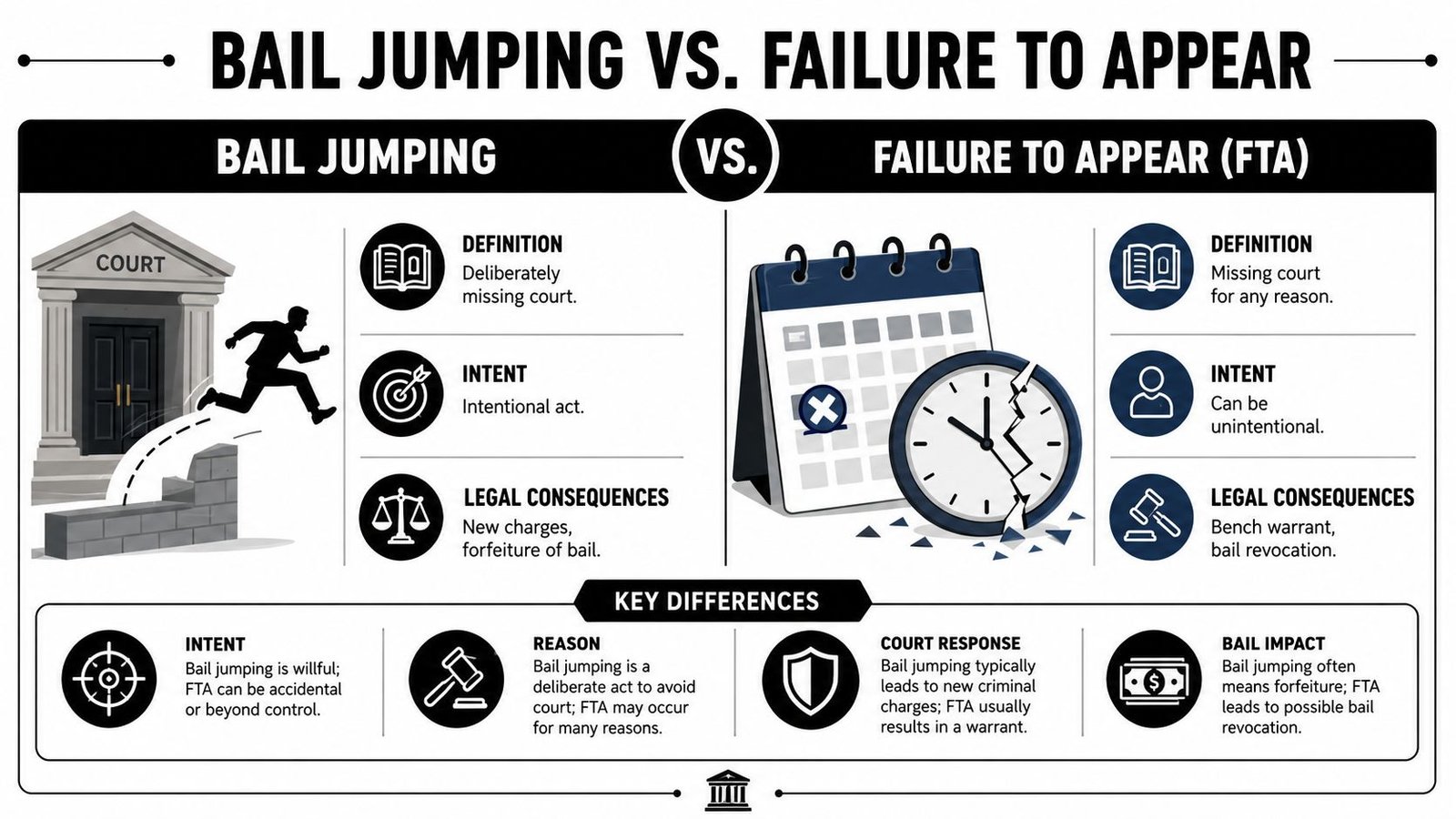
People often use these terms as if they mean the same thing. They don't. The difference matters because each one can lead to a different legal response.
Bail jumping is commonly treated as a separate offense from the original case. One legal explanation notes that prosecutors usually must prove the defendant was charged, released on bail or recognizance, had a known obligation to appear, and knowingly failed to appear without lawful excuse, which makes notice and intent central to the case rather than mere absence alone, as explained in this discussion of the elements prosecutors often must prove in bail jumping cases.
The simplest way to think about it
A failure to appear is the event. The person didn't show up.
A bail jumping charge is the legal accusation that the missed appearance, or in some places a release violation, crossed the line into a new crime.
A bond violation is broader. It can include breaking conditions of release even when no court date was missed.
That means one bad decision can create multiple problems at once.
| Term | What it usually means | Common result |
|---|---|---|
| Failure to appear | The person did not come to court as ordered | Bench warrant or court sanction |
| Bail jumping | A separate criminal allegation tied to release and nonappearance | New criminal exposure |
| Bond violation | A release condition was broken | Revocation, arrest, or stricter conditions |
Bail jumping isn't always about an empty courtroom
Families can be blindsided by this. Some people think bail jumping only happens when someone misses a hearing date. That's too narrow.
A useful legal overview explains that the law may also treat violating bond conditions as jumping bail or a bond violation, and some states even allow the problem to arise before a defendant fully leaves custody after signing bond paperwork. You can read that nuance in Cornell's explanation of how jump bail can include condition violations, not just a missed hearing.
Missing court is the most familiar version of bail jumping. It isn't the only version families need to worry about.
If you're trying to sort out whether the court is dealing with a missed hearing, a warrant, or a separate nonappearance offense, this guide on what is failure to appear helps clarify the distinction.
The Legal Definition of Bail Jumping in Colorado
Colorado readers usually want the local answer, not the generic one. That's the right instinct. Bail jumping rules are not uniform from state to state, and local details shape the actual risk.
In practical terms, Colorado treats bail jumping as conduct tied to release and a knowing failure to meet a required appearance or release obligation. The key fight in many cases is not whether the defendant was absent. It's whether the state can show the defendant had notice and knowingly failed to comply.
What prosecutors usually focus on
When a bail jumping case develops, the legal battle often centers on a few basic questions:
- Was there an underlying criminal case? The release has to connect to an actual pending matter.
- Was the person lawfully released? The court or bond process must have placed the person under specific obligations.
- Did the person know what was required? Notice matters. A date buried in confusion may be argued differently than a date clearly acknowledged.
- Was the nonappearance or violation knowing? That mental state is often where defense lawyers do their best work.
A family should understand what that means in plain English. If the defendant did not know about the date, was in the hospital, was in custody elsewhere, or has proof the notice process broke down, those facts may matter. If the person chose not to go, the room for defense usually narrows.
Why Colorado families shouldn't assume all states work the same way
A lot of internet content makes bail jumping sound automatic. It isn't. State law changes the standard, the defenses, and the penalties.
New York offers a useful comparison because it treats bail jumping as a tiered offense. One summary states that third-degree bail jumping can reach up to one year in jail, while first-degree bail jumping can carry over two to seven years in prison, and it also notes that Colorado classifies bail jumping by the seriousness of the original matter as well. That overview is in this explanation of how New York tiers bail jumping penalties and how Colorado also distinguishes misdemeanor and felony exposure.
That doesn't tell you the exact outcome in a Colorado case. It does show the core pattern. Courts often tie the later bail-jumping risk to the seriousness of the original charge.
What works: Reading the exact release paperwork, court notices, and local case entries.
What doesn't: Relying on a general online definition from another state and assuming it applies in Jefferson, Arapahoe, Denver, or anywhere else in Colorado.
The issue isn't always limited to the court date
Colorado families also need to think beyond the hearing itself. Release conditions can matter just as much as the appearance date. If the defendant had restrictions about contact, travel, substances, or reporting, those details may shape what happens next even before the missed appearance gets sorted out.
That is why the safest approach is to treat every signed release condition as active and enforceable from the moment of release.
What Happens After Jumping Bail
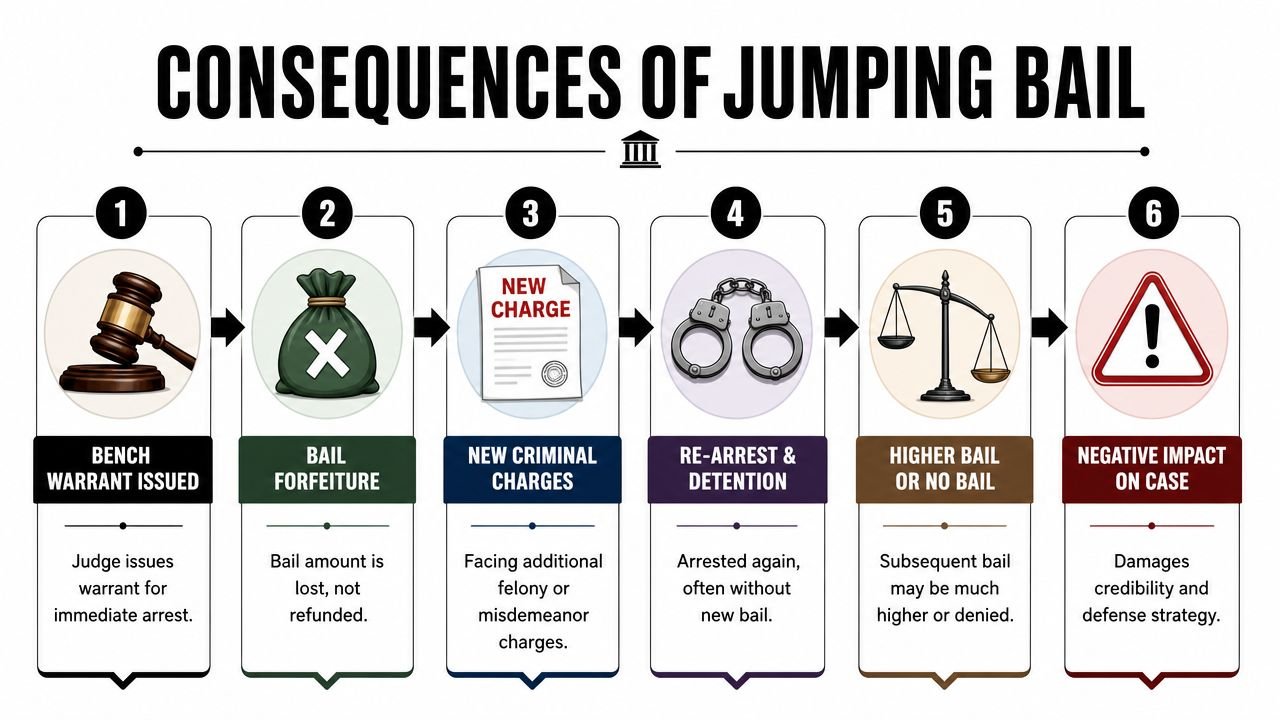
Once bail jumping is in play, the trouble usually unfolds in a sequence. The court addresses the missed appearance. The bond becomes vulnerable. Then the original case gets harder to manage because the defendant now looks less reliable in the eyes of the judge.
Start with the immediate fallout.
First the court acts
A judge may issue a bench warrant when the defendant doesn't appear. That means law enforcement can arrest the person and bring them back before the court. In practice, this changes the entire tone of the case.
The next hearing is no longer just about the original charge. It may also involve why the defendant didn't comply, whether release should be revoked, and whether future bond should be raised or denied.
Then the money is at risk
For families and cosigners, this is often the most painful part. The bond can be forfeited, which means the financial promise behind the defendant's release is now exposed. If you want a fuller explanation of that process, review what bail forfeiture means.
A major public example of how financially serious bail remains comes from New York City. After reforms took effect on January 1, 2020, cases with bail set fell from 24,657 in 2019 to 14,545 in 2021, but the total amount of bail posted in 2021 still reached $268 million. In that same period, the average cash bail at arraignment rose to $38,866, compared with $19,162 in 2019, according to the New York City Comptroller's report on bail trends since 2019. Even where bail was used less often, the financial pressure around appearance obligations stayed substantial.
That matters in Colorado because the basic risk is similar. When a person misses court, the legal problem doesn't stay personal. It can spread directly to the people who backed the bond.
A short explainer can help with the sequence before you watch the video below.
Then the criminal exposure grows
The third layer is the added charge itself. In some jurisdictions, that new offense can be charged as a misdemeanor or a felony depending on the original case. That means a person who was already defending one case may suddenly be defending two.
The practical damage goes beyond paperwork:
- Credibility suffers: Judges and prosecutors may view the defendant as less trustworthy.
- Release gets harder: Future bail may become stricter.
- Defense strategy tightens: Lawyers now have to address both the original case and the missed appearance problem.
- Cosigner stress rises fast: Financial exposure and communication pressure usually increase at the same time.
What works here is speed. What fails is silence. Once a warrant, forfeiture risk, and new charge start moving together, each day of delay usually makes resolution harder.
Potential Defenses and How to Mitigate Damages
A bail jumping accusation is serious, but it isn't the same thing as a conviction. The law usually leaves room to challenge whether the defendant had notice, whether the conduct was knowing, and whether there was a lawful excuse.
The hard truth is that some explanations help, and some don't.
Defenses that may matter
If the missed appearance happened because of a medical emergency, lack of actual notice, or another documented circumstance outside the defendant's control, that may give a lawyer something concrete to work with. Documents matter here. Hospital records, jail records from another jurisdiction, message logs, and court notices all carry more weight than verbal stories passed through family members.
By contrast, "I forgot," "I was scared," or "I thought my lawyer would handle it" usually don't land well. Courts expect adults on release to know their dates and follow their conditions.
Hard truth: Good faith is easier to argue when the defendant acts quickly, gathers records, and addresses the issue before an arrest happens.
Mitigation is often more important than argument
Even when a perfect legal defense doesn't exist, smart mitigation can still help. That means reducing the damage instead of making it worse.
State law varies a lot on nonappearance issues. Some states require willful or knowing nonappearance, some allow a grace period to surrender, and penalties can range from misdemeanor to felony. That variation is exactly why local knowledge matters, as discussed in Nolo's overview of how state-by-state differences change bail jumping risks and defenses.
A practical response usually looks like this:
- Call the defense lawyer first: The lawyer needs the exact date missed, the case number, and any proof of excuse.
- Contact the bond company promptly: Early notice is usually better than forcing the company to discover the missed appearance on its own.
- Collect real documents: Screenshots, discharge papers, GPS records, jail logs, and transportation records can all matter depending on the facts.
- Discuss surrender strategy: In some cases, voluntary surrender is far better than waiting to be picked up unexpectedly.
What doesn't help
Families often hurt the case by improvising.
Don't post emotional explanations on social media. Don't coach the defendant to disappear for "just a few days." Don't call the court and guess at facts you can't prove. And don't assume that if the original charge seems minor, the nonappearance issue will also be minor.
Courts tend to respond better to responsibility than avoidance. If there's a path to limit the fallout, it usually starts with early, organized communication.
Next Steps for Defendants Cosigners and Families
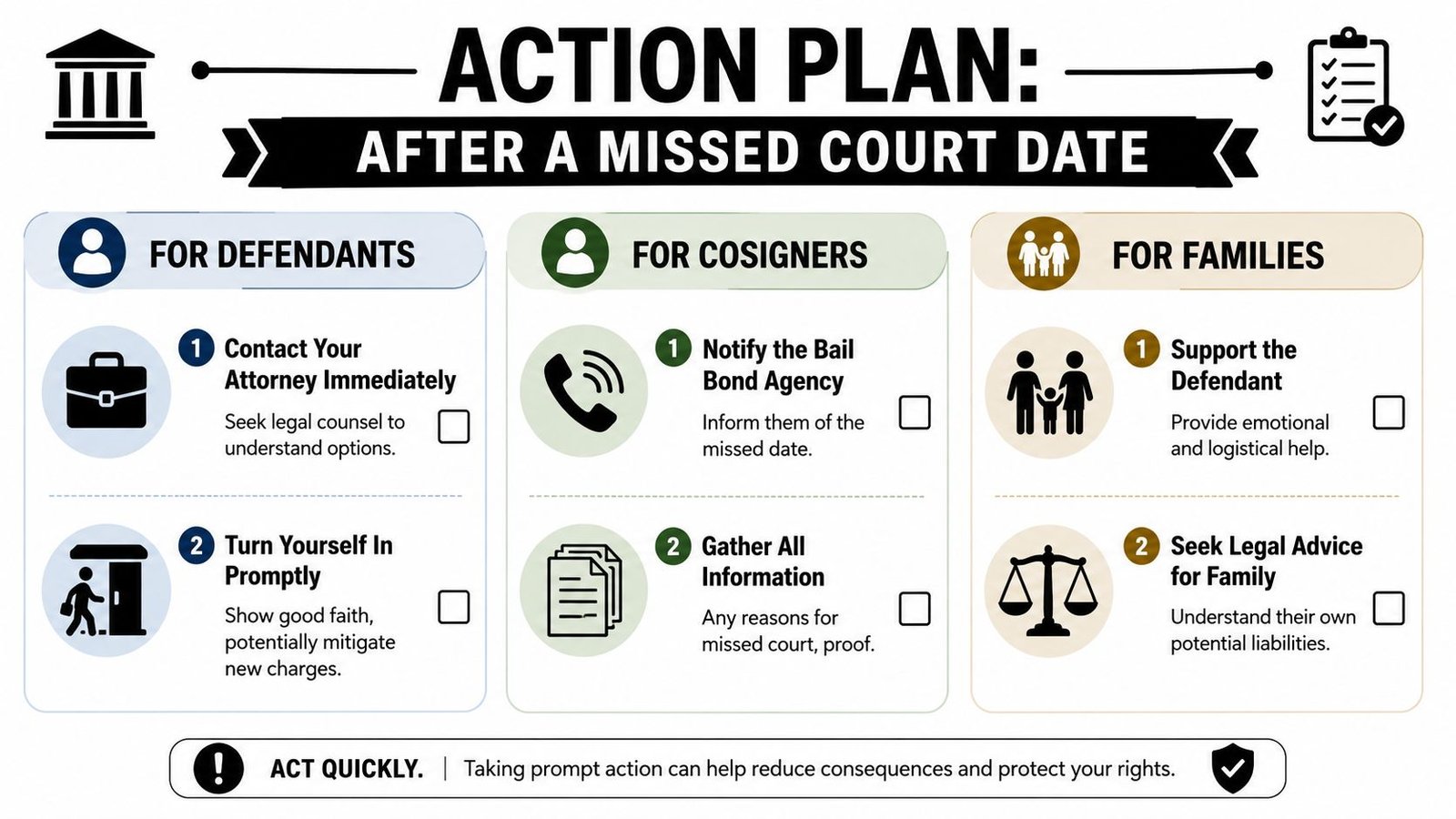
When a court date is missed, everyone in the circle has a job. Problems get bigger when the defendant, the cosigner, and the family each make separate decisions without sharing information.
For the defendant
The first goal is to stop the situation from drifting. Hiding usually leads to arrest at the worst possible time, and it tends to damage any later argument that the missed appearance was accidental.
Use this order of operations:
- Call your lawyer now. Don't wait until you have a perfect explanation.
- Review the release paperwork. Check every condition, not just the hearing date.
- Get ready to act. Your lawyer may advise a surrender plan, immediate appearance, or another response based on the warrant status.
- Stay reachable. If your phone is off and your location is unknown, everyone trying to help you is working blind.
If the case is in the west metro area, local case-specific support often starts with knowing the jail, court, and bond process in that county. Families dealing with that area can review the local bail bond page for Jefferson County and Golden, Colorado.
For the cosigner
Cosigners often think their role ended when release happened. It didn't. A cosigner is part of the bond equation until the case is resolved or the bond is properly discharged.
A few moves matter more than others:
- Notify the bond agency quickly: Silence increases distrust and reduces options.
- Gather your file: Keep the bond contract, indemnity paperwork, payment records, and release details in one place.
- Understand your exposure: If you're new to this role, read about the responsibilities of a bail bond cosigner.
- Push for facts, not promises: "He said he'll go next time" isn't a plan.
A cosigner helps most by being organized and honest. The worst move is covering for the defendant while the bond remains active.
For the family
Families often become the logistics team. They find paperwork, track down the defendant, arrange transport, and help collect documents that support a legitimate excuse.
That support matters most when it stays focused.
| Family task | Why it helps |
|---|---|
| Collect documents | Lawyers and bond agents need proof, not secondhand summaries |
| Coordinate one point of contact | Conflicting stories create more problems |
| Help with transportation and scheduling | Practical barriers still need solving |
| Keep communication calm | Panic leads to bad decisions |
If the defendant is in the south metro area, local resources can also make the process easier to handle. Families near Arapahoe County often look first at Centennial bail bond support because local detention and court logistics can shape what happens next.
What all three groups should avoid
The biggest mistakes repeat themselves:
- Don't disappear
- Don't guess about warrant status
- Don't assume a missed date will fix itself
- Don't let five relatives call five different offices
- Don't destroy messages, paperwork, or location records
The better approach is simple. One defendant. One lawyer. One bond contact. One shared set of facts.
How a Bail Bonds Agency Can Help
When bail jumping becomes part of the problem, people usually need more than a definition. They need coordination. A good bail bonds agency helps families understand the bond status, the surrender process, and the financial stakes without adding confusion.
That doesn't mean a bondsman replaces a lawyer. The lawyer handles legal advice and defense strategy. The bond agency handles the bond side of the crisis, including what the release conditions require, what the cosigner may be facing, and what practical steps can reduce further damage.

Where an experienced agent adds value
An experienced agent can often help with the parts families struggle to manage on their own:
- Explaining the bond terms clearly
- Telling the cosigner what financial issues may be developing
- Helping coordinate the practical side of surrender or rebooking
- Keeping communication direct instead of emotional
If you want the role broken down in plain language, review what a bail bond agent does.
The real advantage is damage control
Families under stress often waste time trying to decode legal language, detention procedures, and bond paperwork all at once. A seasoned agency helps narrow the problem. What is the bond status? Who needs to call whom? What documents matter? What deadline matters first?
That kind of guidance doesn't erase a missed court date. It does make the next move clearer, and clear next moves are what keep a bad situation from getting worse.
If you're dealing with a missed court date, a bond violation, or questions about what bail jumping means in Colorado, contact Express Bail Bonds. Their licensed team has served Colorado since 1988, works statewide, and can help defendants, cosigners, and families understand the bond process quickly and calmly.